
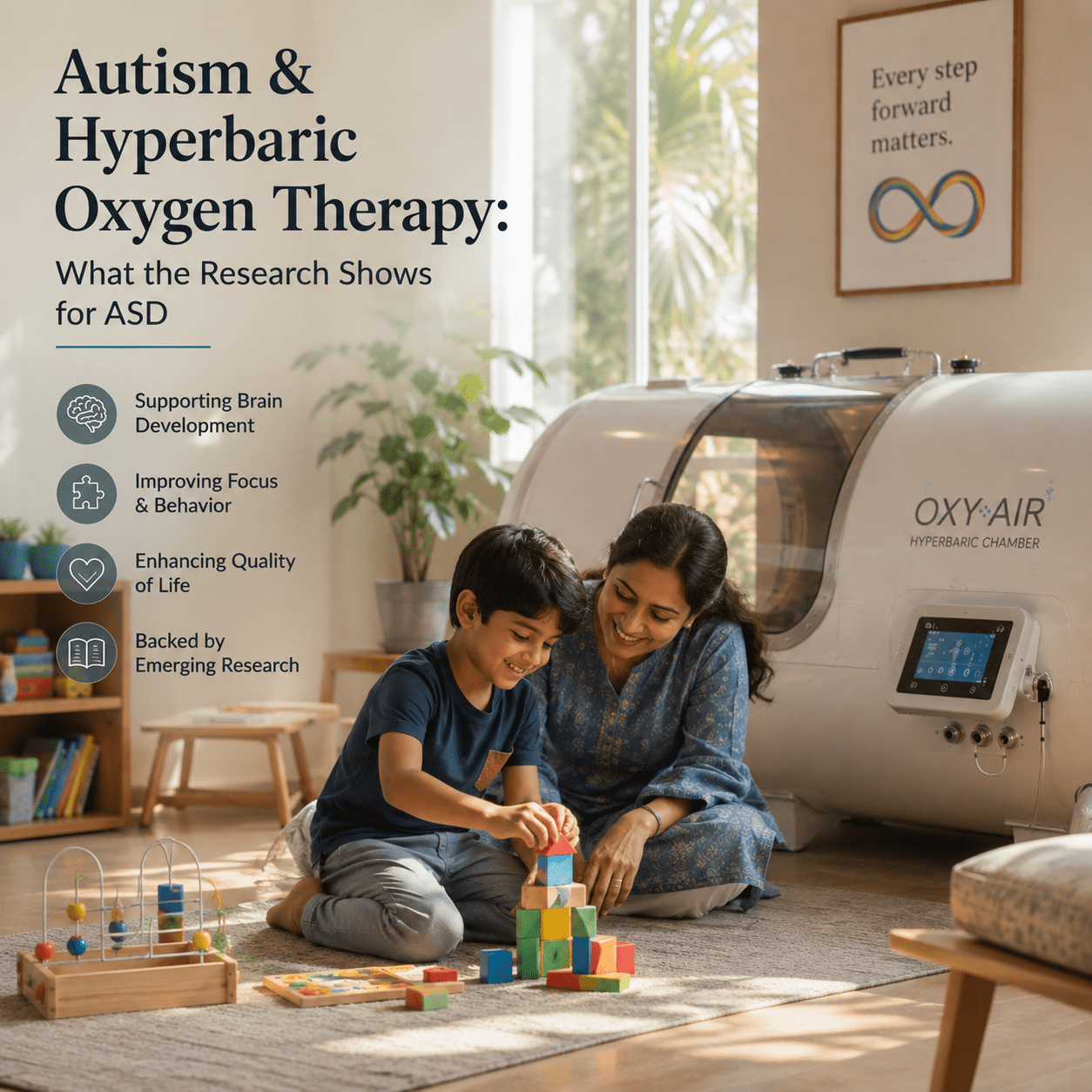
Autism and Hyperbaric Oxygen Therapy: What the Research Shows for ASD
Considering hyperbaric oxygen therapy for autism? Below is what the research does and doesn’t show, framed honestly for parents — and how to discuss it with our clinical team alongside your child’s specialist.
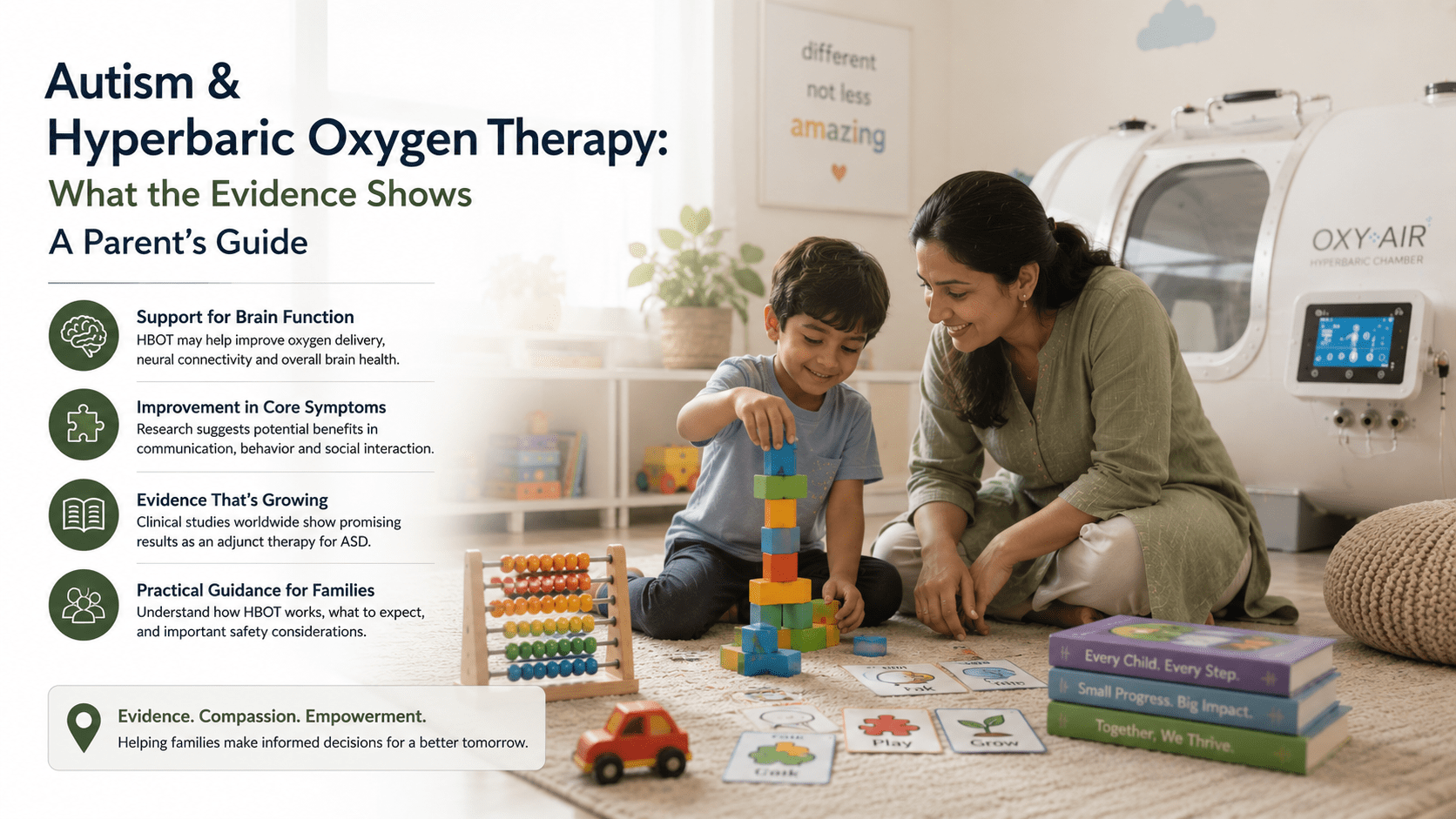 autism and hyperbaric oxygen therapy evidence India parent guide ASD research Caption: Autism and hyperbaric oxygen therapy — what peer-reviewed research shows for ASD and what parents in India need to know before starting.
| Also read: Our practical guide to HBOT for autism — benefits, effectiveness and what parents need to know — a companion resource covering the practical side of autism HBOT. |
|---|
You have probably already read everything. You have already asked every question. You are not looking for false hope — you are looking for an honest answer about whether autism and hyperbaric oxygen therapy is a road worth taking for your child.
This article gives you the research — including both what has been found and where the evidence is genuinely uncertain.
| Important: HBOT is not an approved treatment for autism spectrum disorder. Evidence is investigational. Any decision about adjunctive therapy should be made with your child’s developmental paediatrician or neurologist. |
|---|
Why Researchers Are Looking at HBOT for Autism
ASD is not one thing. But several biological findings appear consistently across autistic individuals — and they are relevant to what HBOT does:
- Oxidative stress — Elevated markers of oxidative stress are one of the most consistently replicated biological findings in autism research. HBOT stimulates antioxidant enzyme production and reduces oxidative damage in neural tissue (Rossignol & Frye, Front Physiol, 2014).
- Mitochondrial dysfunction — A significant subset of children with ASD show impaired mitochondrial energy production in neural cells. HBOT has demonstrated the ability to improve mitochondrial function in stressed tissue by increasing available oxygen.
- Neuroinflammation — Post-mortem and imaging studies have found evidence of neuroinflammation in autism. HBOT has demonstrated anti-inflammatory effects in neural tissue across multiple conditions.
- Cerebral hypoperfusion — SPECT and fMRI studies have identified reduced blood flow in specific brain regions in autistic children. HBOT directly targets hypoperfused tissue. Rossignol & Rossignol (Med Hypotheses, 2006) proposed this as the primary mechanism for HBOT’s potential in autism.
For how HBOT addresses brain perfusion and neuroplasticity more broadly, see our article on how HBOT supports neuroplasticity.
What the Research Shows — Study by Study
The Rossignol 2009 RCT — the landmark trial
The most cited autism HBOT study is a multicentre, randomised, double-blind, controlled trial by Rossignol DA et al published in BMC Pediatrics (2009). 62 children with ASD were randomised to receive either 40 sessions of HBOT at 1.3 ATA and 24% oxygen, or sham sessions.
Results: the HBOT group showed significantly greater improvements in overall functioning, receptive language, social interaction, eye contact, and sensory and cognitive awareness compared to the sham group. Irritability, hyperactivity, and speech were also improved.
Rossignol DA, Rossignol LW, Smith S, et al. Hyperbaric treatment for children with autism: a multicentre, randomised, double-blind, controlled trial. BMC Pediatr. 2009;9:21.
Rossignol 2012 — evidence review
Rossignol DA, Bradstreet JJ, Van Dyke K, et al (Med Gas Res, 2012) reviewed the published literature on HBOT in ASD and found that across multiple studies, HBOT showed improvements in language, social awareness, cognition, and adaptive behaviour — though effect sizes varied.
Rossignol DA, Bradstreet JJ, Van Dyke K, et al. Hyperbaric oxygen in autism spectrum disorders. Med Gas Res. 2012;2(1):16.
The Cochrane Review 2016 — the honest counterbalance
Xiong T, Chen H, Luo R, et al (Cochrane Database Syst Rev, 2016) is the most rigorous systematic review of HBOT for ASD. The review concluded that current evidence is insufficient to support the use of HBOT for ASD — largely because the existing trials are small, heterogeneous in protocol, and do not meet the high evidence bar required by Cochrane criteria.
Xiong T, Chen H, Luo R, et al. Hyperbaric oxygen therapy for people with autism spectrum disorder (ASD). Cochrane Database Syst Rev. 2016;10:CD010922.
This is the honest tension in the autism HBOT literature: positive results from individual trials, but insufficient evidence to meet systematic review standards. Families deserve to know both sides of this.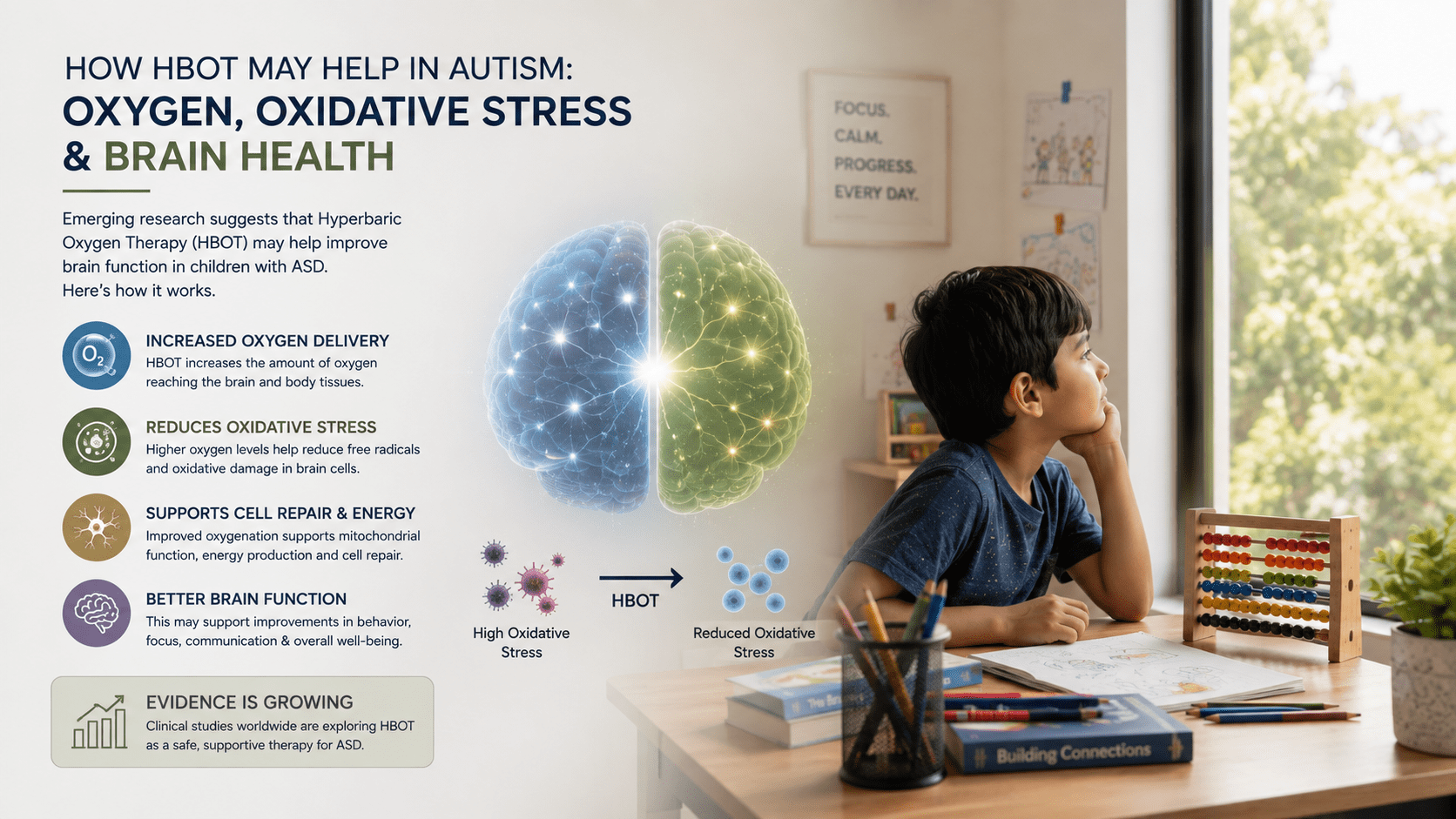 autism hbot oxidative stress mitochondrial dysfunction brain oxygen ASD mechanism Caption: How HBOT targets oxidative stress and mitochondrial dysfunction — two consistently identified biological findings in autism spectrum disorder.
What This Means in Plain Language for Parents
The research is real — but it is not conclusive. Here is an honest summary:
| What the research suggests | What it does not yet prove |
|---|---|
| HBOT at 1.3 ATA produced measurable ASD symptom improvements in a controlled trial (Rossignol 2009) | That HBOT is an effective treatment for ASD — Cochrane criteria are not yet met |
| Biological mechanisms in autism (oxidative stress, neuroinflammation) are plausibly targeted by HBOT | That targeting these mechanisms produces consistent clinical outcomes across all autistic children |
| Improvements in language, social interaction, and cognition have been observed | That these improvements are permanent or apply to all children on the spectrum |
| HBOT is generally safe at 1.3 ATA in controlled settings for children | Long-term safety data in paediatric ASD populations is limited |
What to Ask Before Starting HBOT for an Autistic Child
- Consult your developmental paediatrician — HBOT should complement your child’s existing ABA, speech, or occupational therapy — not replace it. Discuss with the specialist managing your child’s care.
- Ask about the chamber — Any clinic claiming to treat ASD with HBOT must use a PVHO-certified hard chamber — a pressure vessel for human occupancy meeting ASME PVHO standards. Soft portable chambers at 1.3 ATA were used in the Rossignol 2009 trial, but clinical safety and quality assurance require a certified setup.
- Document a baseline first — Before any sessions begin, document your child’s communication, social, sensory, and behavioural function using standardised scales (CARS, ABC, ATEC). Without a baseline, any change cannot be meaningfully evaluated.
- Set a clear review point — Agree on an assessment point after 20–40 sessions. If no meaningful change is observed, the protocol should be reviewed.
- Understand the financial picture — 40 sessions at a certified clinic in India costs ₹1.4–₹3.2 lakh depending on the city. See our guide to HBOT session costs in India for current pricing.
For safety considerations for children specifically, read our article on is HBOT safe for children and our full overview of HBOT side effects — what to know before treatment. For PVHO certification and what it means, see PVHO chamber safety standards in India.
Frequently Asked Questions
Does hyperbaric oxygen therapy help autism?
A randomised controlled trial (Rossignol 2009) showed significant improvements in ASD symptoms including language, social interaction, and cognition after 40 HBOT sessions. However, a Cochrane systematic review (Xiong 2016) concluded the evidence is not yet sufficient to recommend HBOT as a standard ASD treatment. It remains investigational.
What improvements have parents reported with HBOT for autism?
In published trials and case series, parents and clinicians have reported improvements in eye contact, receptive language, social interaction, sensory processing, sleep, and overall responsiveness. Effect sizes and consistency vary between individuals.
Is HBOT safe for autistic children?
HBOT at 1.3–2.0 ATA at certified clinics is generally safe for children. The Rossignol 2009 trial reported no serious adverse events. Common minor effects include ear discomfort from pressurisation — this is managed by teaching children to equalise ear pressure before starting. Children with active ear infections should not undergo HBOT.
How many sessions does an autistic child need?
The most cited research protocol used 40 sessions at 1.3 ATA over 8 weeks (Rossignol 2009). Some clinics use 2.0 ATA for 60 sessions. A review at session 20 is standard practice to assess whether meaningful progress is occurring.
Where can I access HBOT for an autistic child in India?
Certified HBOT centres treating paediatric cases are available across Delhi NCR, Noida, Bangalore, Mumbai, and Chennai. Use our guide to find a certified HBOT clinic near you and also read our earlier guide to HBOT for autism and what parents need to know for a full practical overview.
HBOT is an adjunctive option and should support, never replace, your child’s prescribed care. Learn more on our hyperbaric oxygen therapy guide and related neurological evidence for stroke and traumatic brain injury. To find a certified centre, see HBOT near me.
Speak to our clinical team — we’ll give you an honest, evidence-based view and coordinate with your specialist.
📞 Call +91 98219 94283💬 WhatsAppBook free consultation →

Subscribe
38 Comments
Comments are closed.
[…] Read the full evidence: autism and hyperbaric oxygen therapy — the evidence. […]
[…] any decision should be made with your child’s specialist. Read the balanced evidence in our HBOT for autism research review and the source […]
[…] any decision should be made with your child’s specialist. Read the balanced evidence in our HBOT for autism research review and the source […]
[…] any decision should be made with your child’s specialist. Read the balanced evidence in our HBOT for autism research review and the source […]
[…] any decision should be made with your child’s specialist. Read the balanced evidence in our HBOT for autism research review and the source […]
[…] any decision should be made with your child’s specialist. Read the balanced evidence in our HBOT for autism research review and the source […]
[…] any decision should be made with your child’s specialist. Read the balanced evidence in our HBOT for autism research review and the source […]
[…] any decision should be made with your child’s specialist. Read the balanced evidence in our HBOT for autism research review and the source […]
[…] any decision should be made with your child’s specialist. Read the balanced evidence in our HBOT for autism research review and the source […]
[…] any decision should be made with your child’s specialist. Read the balanced evidence in our HBOT for autism research review and the source […]
[…] any decision should be made with your child’s specialist. Read the balanced evidence in our HBOT for autism research review and the source […]
[…] any decision should be made with your child’s specialist. Read the balanced evidence in our HBOT for autism research review and the source […]
[…] any decision should be made with your child’s specialist. Read the balanced evidence in our HBOT for autism research review and the source […]
[…] any decision should be made with your child’s specialist. Read the balanced evidence in our HBOT for autism research review and the source […]
[…] any decision should be made with your child’s specialist. Read the balanced evidence in our HBOT for autism research review and the source […]
[…] any decision should be made with your child’s specialist. Read the balanced evidence in our HBOT for autism research review and the source […]
[…] any decision should be made with your child’s specialist. Read the balanced evidence in our HBOT for autism research review and the source […]
[…] any decision should be made with your child’s specialist. Read the balanced evidence in our HBOT for autism research review and the source […]
[…] any decision should be made with your child’s specialist. Read the balanced evidence in our HBOT for autism research review and the source […]
[…] any decision should be made with your child’s specialist. Read the balanced evidence in our HBOT for autism research review and the source […]
[…] any decision should be made with your child’s specialist. Read the balanced evidence in our HBOT for autism research review and the source […]
[…] any decision should be made with your child’s specialist. Read the balanced evidence in our HBOT for autism research review and the source […]
[…] any decision should be made with your child’s specialist. Read the balanced evidence in our HBOT for autism research review and the source […]
[…] any decision should be made with your child’s specialist. Read the balanced evidence in our HBOT for autism research review and the source […]
[…] any decision should be made with your child’s specialist. Read the balanced evidence in our HBOT for autism research review and the source […]
[…] any decision should be made with your child’s specialist. Read the balanced evidence in our HBOT for autism research review and the source […]
[…] any decision should be made with your child’s specialist. Read the balanced evidence in our HBOT for autism research review and the source […]
[…] any decision should be made with your child’s specialist. Read the balanced evidence in our HBOT for autism research review and the source […]
[…] any decision should be made with your child’s specialist. Read the balanced evidence in our HBOT for autism research review and the source […]
[…] any decision should be made with your child’s specialist. Read the balanced evidence in our HBOT for autism research review and the source […]
[…] any decision should be made with your child’s specialist. Read the balanced evidence in our HBOT for autism research review and the source […]
[…] any decision should be made with your child’s specialist. Read the balanced evidence in our HBOT for autism research review and the source […]
[…] any decision should be made with your child’s specialist. Read the balanced evidence in our HBOT for autism research review and the source […]
[…] any decision should be made with your child’s specialist. Read the balanced evidence in our HBOT for autism research review and the source […]
[…] any decision should be made with your child’s specialist. Read the balanced evidence in our HBOT for autism research review and the source […]
[…] any decision should be made with your child’s specialist. Read the balanced evidence in our HBOT for autism research review and the source […]
[…] any decision should be made with your child’s specialist. Read the balanced evidence in our HBOT for autism research review and the source […]
[…] any decision should be made with your child’s specialist. Read the balanced evidence in our HBOT for autism research review and the source […]