
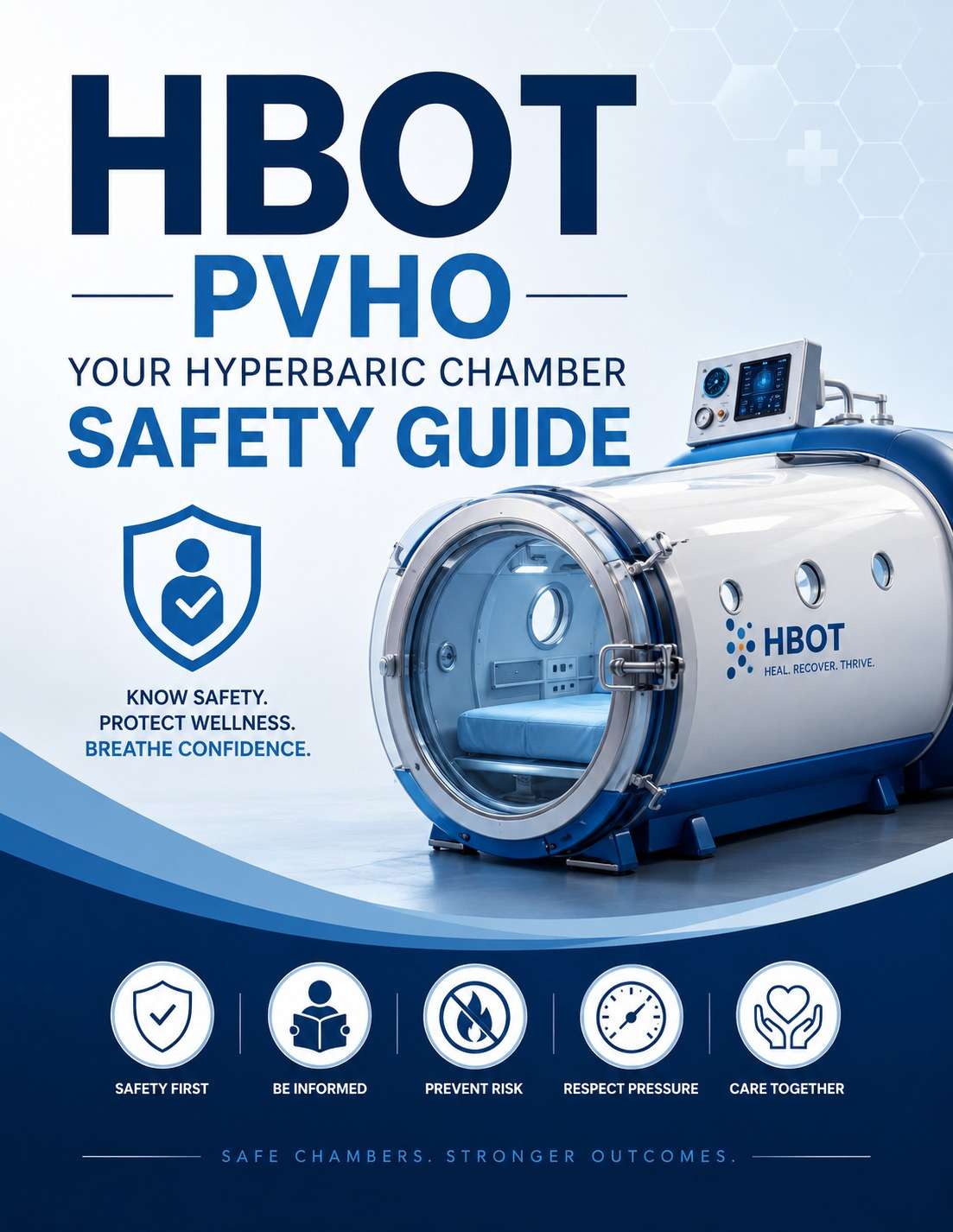
HBOT PVHO: Your Hyperbaric Chamber Safety Guide
Every HBOT PVHO — Pressure Vessel for Human Occupancy — is an engineered, certified structure that keeps a person safe under elevated atmospheric pressure. Most patients in India have never heard the term.
|
HBOT PVHO: A Pressure Vessel for Human Occupancy is any enclosed space designed to be occupied by a person at a pressure significantly above or below normal atmospheric levels. Every hyperbaric oxygen therapy chamber is classified as a PVHO under ASME engineering standards. |
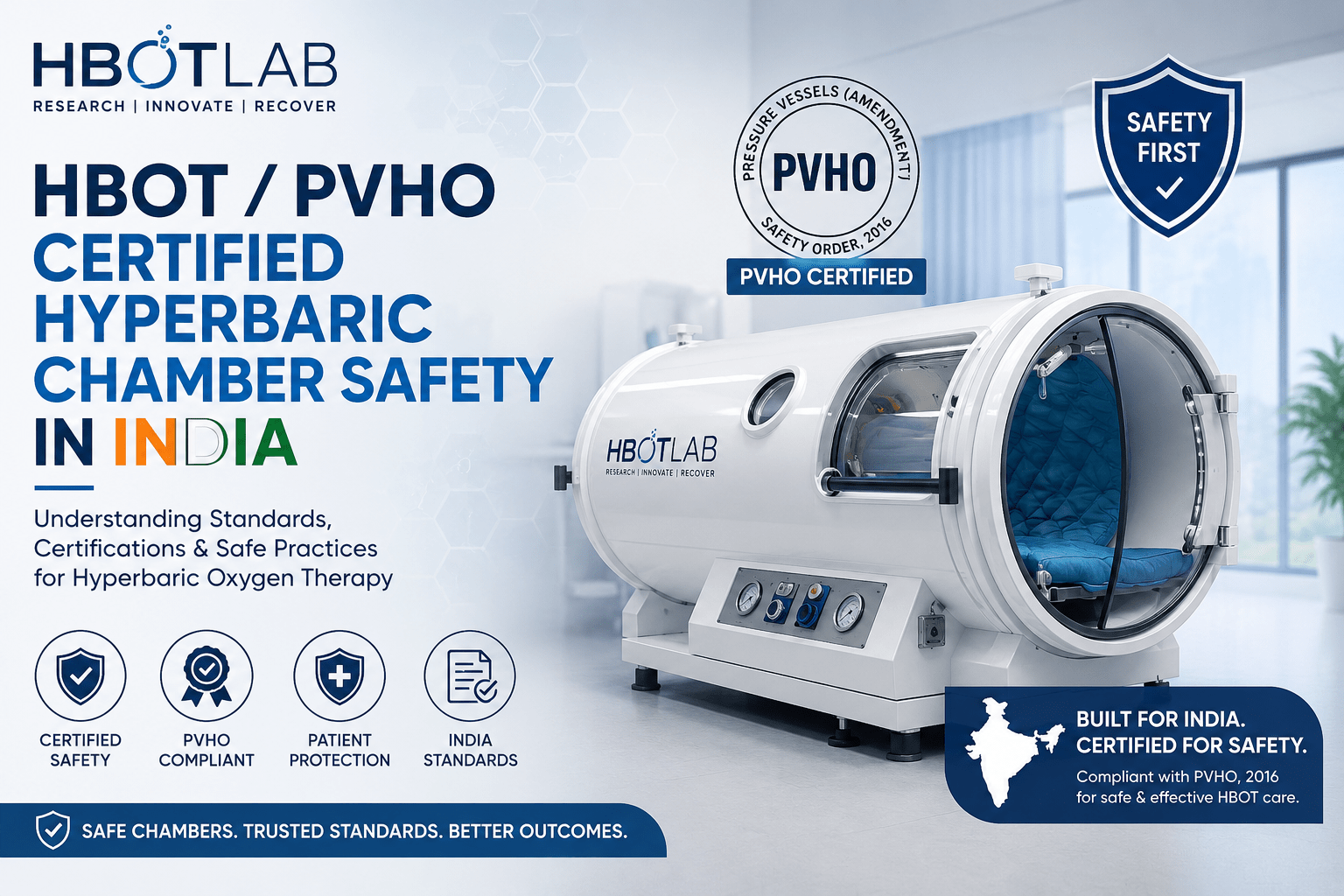
hbot pvho certified hyperbaric chamber safety india
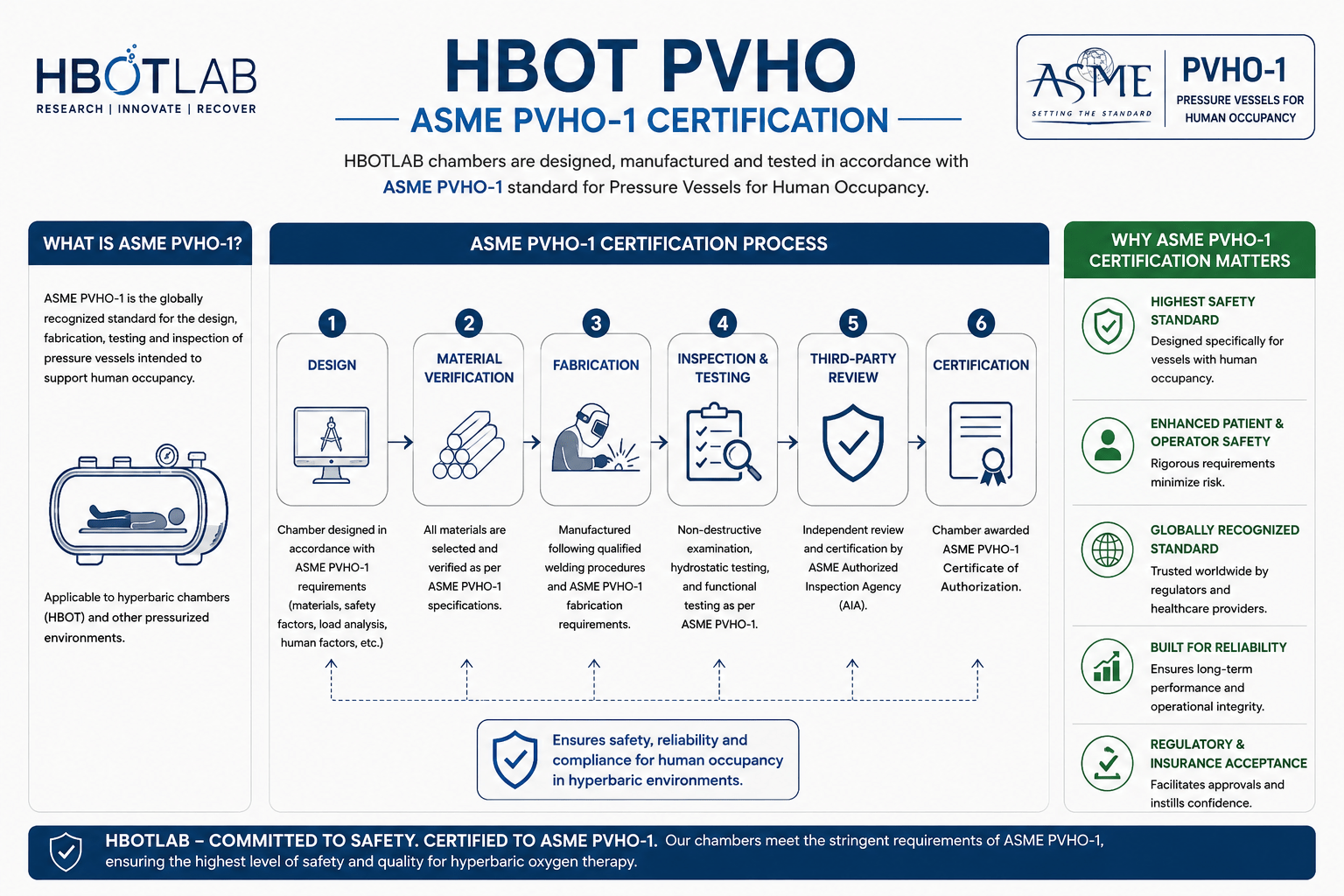
hbot pvho asme pvho-1 certification diagram
If your clinic cannot tell you whether their chamber is PVHO-certified, that is the most important safety signal you will ever receive about HBOT.
This guide explains exactly what HBOT PVHO certification means, what standard governs it, why India’s regulatory gap puts the burden on you, and the three questions that protect you before every session.
Every HBOT chamber you sit in is a Pressure Vessel for Human Occupancy. Most people in India have never heard those four words — but they matter more than the brochure ever told you.
What HBOT PVHO Stands For — And Why the Standard Exists
PVHO stands for Pressure Vessel for Human Occupancy.
The American Society of Mechanical Engineers (ASME) defines it as any container intended to be occupied by one or more persons at a pressure differing from the surrounding atmosphere by at least 2 psi. In HBOT, chambers routinely operate at 1.5 to 3.0 atmospheres absolute — well above that threshold.
The ASME PVHO committee has been publishing construction standards since 1977. The current design standard is ASME PVHO-1-2023. The companion maintenance code is ASME PVHO-2-2019.
The category includes submersibles, diving bells, decompression chambers, recompression chambers, and medical hyperbaric oxygenation facilities. The HBOT chamber at your local clinic sits on the same engineering safety continuum as a naval diving vessel.
What ASME PVHO-1 certification actually requires
- Design: wall thickness, pressure tolerances, viewport specifications, and penetration seals — all calculated and documented to ASME spec.
- Fabrication: built by personnel qualified under ASME code, with third-party inspection at every stage.
- Pressure testing: every chamber hydrostatically tested before entering service.
- Maintenance: ASME PVHO-2 governs ongoing inspection schedules — mandatory, not discretionary.
- Certification mark: a compliant chamber carries the ASME stamp, issued only after independent authority verification.
For a deeper look at what separates clinical-grade from wellness-grade equipment, what is a medical-grade HBOT chamber covers the full breakdown.
Why HBOT PVHO Certification Matters: When Chambers Fail
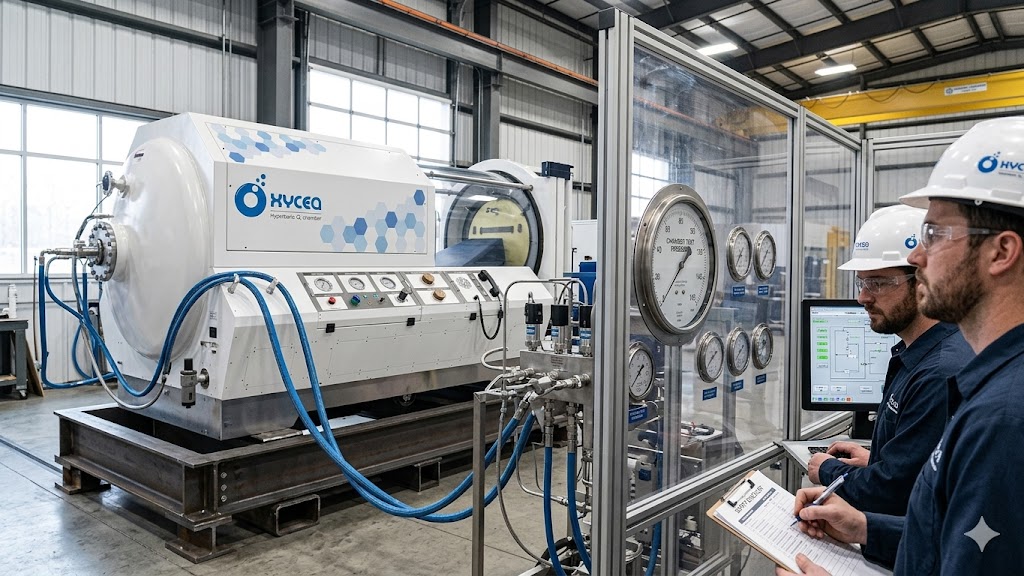
Pressure vessel failure is rare. It is not theoretical.
In September 2024, a soft-sided bag chamber ruptured while occupied in India. The event is documented by the Undersea and Hyperbaric Medical Society (UHMS). The occupant was not attended and did not receive evaluation by a hyperbaric specialist — the kind present only at a certified facility.
On 31 January 2025, a hyperbaric chamber exploded at the Oxford Center in Troy, Michigan. Five-year-old Thomas Cooper died inside. His mother, standing beside the chamber, suffered serious injuries to her arms. Four staff members — including the CEO — face second-degree murder charges. Michigan’s Attorney General stated: fires inside a hyperbaric chamber are considered a terminal event.
In August 2025, the US Food and Drug Administration issued a formal letter to all healthcare providers, citing reports of fires, injuries, and fatalities linked to HBOT devices (FDA Letter to Health Care Providers, 25 August 2025). The FDA stated it is aware of serious adverse events and deaths with use of HBOT devices. The UHMS confirmed its full support for the FDA communication, explicitly referencing NFPA 99 Chapter 14 and ASME PVHO-1 as the applicable standards.
These events are not presented to create fear. HBOT delivered in a certified chamber under trained supervision has an excellent documented safety record. They are presented because they show, without ambiguity, that a person inside a non-compliant chamber is exposed to a structurally different risk category.
The oxygen fire risk every HBOT patient must understand
Hyperbaric chambers deliver 100% oxygen at elevated pressure. Oxygen at that concentration supports combustion at levels far above normal air. The FDA letter specifically warns of heightened fire risk with high-concentration oxygen use and requires proper grounding equipment at all times.
A single spark from static electricity — from synthetic clothing, an ungrounded wristwatch, or an electronic device — can ignite a fire inside a pressurised oxygen environment in seconds. This is not a remote possibility. It is the mechanism behind both the Troy 2025 and Arizona 2025 incidents.
ASME PVHO-1 and NFPA 99 Chapter 14 both exist precisely because this risk is inherent to the environment. Compliance does not eliminate the risk. It reduces it to the lowest achievable level under verified engineering standards.
For a complete picture of known side effects and how safety is managed in certified settings, HBOT side effects explained — is hyperbaric oxygen therapy safe gives an honest, full account.
The India Reality: No Mandate, Your Responsibility
India does not currently have a regulation that explicitly requires ASME PVHO-1 certification for HBOT operators.
CDSCO regulates HBOT chambers as medical devices for import purposes under MD-15 clearance. That clearance governs import approval. It does not verify structural certification to ASME PVHO-1.
What this means in practice: two clinics in the same city can both legally operate, one running a PVHO-certified hard chamber and the other running a fabric bag with no independent safety audit — and neither is legally required to disclose the difference prominently.
A responsible Indian HBOT operator voluntarily meets internationally recognised standards regardless of what local regulation requires. These include:
- ASME PVHO-1-2023 — chamber design and fabrication certification.
- ASME PVHO-2-2019 — maintenance and operation compliance.
- ISO 13485 — quality management system for medical device manufacturers.
- CDSCO MD-15 — import clearance for the specific device in use.
- Documented annual pressure-testing records maintained on-site.
Until Indian regulation catches up, the patient’s primary protection is informed questioning before every booking.
For a structured framework to evaluate any HBOT provider in India, how to choose the best HBOT therapy centre in India walks through every verification step.
Three Questions to Ask Before Any HBOT Session
Question 1: Is this chamber ASME PVHO-1 certified?
Ask directly. A legitimate operator will answer without hesitation and can show documentation. If the person responding does not know what ASME PVHO-1 means, that is your answer.
Question 2: When was this chamber last pressure-tested?
ASME PVHO-2 requires documented inspection on a mandatory schedule. A chamber in active clinical use should have a maintenance record. No inspection record in the past 12 months is a serious warning sign regardless of how the clinic presents itself.
Question 3: What hyperbaric training does the operator hold?
A certified chamber operated by an untrained attendant remains a safety risk. The UHMS and the National Board of Diving and Hyperbaric Medical Technology (NBDHMT) both offer formal training programmes. Ask what certification the operator holds.
Before you compare clinics on price, read HBOT chamber cost in India — why cheap costs more. The cost difference between a certified and uncertified setup is real — and so are the reasons behind it.
Use the HBOT chamber checklist for India to run through every verification point before committing to a provider.
FAQ: HBOT PVHO and Chamber Safety in India
What does HBOT PVHO mean?
HBOT PVHO means a hyperbaric oxygen therapy chamber that is classified as a Pressure Vessel for Human Occupancy under ASME engineering standards. Every chamber a patient occupies at elevated pressure is legally and structurally a PVHO, whether or not the operator uses that term.
Is every hyperbaric chamber a PVHO?
Yes. Any enclosed space a human occupies at a pressure significantly above or below normal atmosphere is classified as a PVHO under ASME definitions. This applies to hard chambers, soft chambers, monoplace, and multiplace configurations — the classification is determined by use, not design.
Are soft hyperbaric chambers PVHO-certified?
Most are not. Soft chambers may hold FDA 510(k) registration for specific indications in the US, but FDA registration and ASME PVHO-1 certification are separate standards covering different things. NFPA 99 (2024) explicitly states that many commercially available soft chambers do not comply with ASME PVHO-1 requirements.
How do I check if a clinic in India uses a certified chamber?
Ask for the ASME PVHO-1 certification documentation and the most recent pressure-test inspection record. The ASME stamp should be physically present on the chamber. An operator who cannot produce either document on request should not have your trust — or your booking.
Is HBOT safe if the chamber is PVHO-compliant?
HBOT in a properly certified, maintained PVHO-compliant chamber under trained supervision is considered safe for the vast majority of patients. Serious adverse events are rare and are almost always associated with non-compliant equipment or inadequately trained operators (Goyal A et al., StatPearls, 2019). PVHO compliance is not a guarantee of outcome — it is the non-negotiable baseline for a structurally safe session.
Why does India not regulate PVHO compliance yet?
India’s medical device regulatory framework is still developing specific requirements for hyperbaric medicine facilities. CDSCO’s current MD-15 import clearance process does not mandate ASME PVHO-1. This is expected to evolve as the sector grows and incidents drive regulatory attention. Until then, verification is the patient’s responsibility.
The Bottom Line on HBOT PVHO Safety
HBOT is a well-researched therapy with a real evidence base and genuine clinical applications.
It is also a therapy that places a living person inside a pressurised, oxygen-enriched environment. That environment requires engineering that has been independently verified — not assumed, not approximated, not marketed around.
HBOT PVHO certification is that verification. ASME PVHO-1 is not paperwork. It is the difference between a chamber built to contain a person safely under pressure, and one that has not been verified to do so.
Ask before you book. Know before you enter. The three questions take under two minutes. The answers tell you everything.



Subscribe
3 Comments
Comments are closed.
[…] the full explanation of what PVHO certification requires and why it exists, our HBOT PVHO chamber safety guide covers the complete […]
[…] the full breakdown of what PVHO certification means and why it divides the Indian market, our HBOT PVHO chamber safety guide covers the standard in […]
[…] the full background on how PVHO certification differs from basic FDA registration, our HBOT PVHO chamber safety guide covers the complete […]