
HBOT and Stroke Recovery: What the Research Actually Shows
After a stroke, recovery can feel like it has a ceiling.
Physiotherapy, speech therapy, occupational therapy — all essential. But for many patients, progress slows after the initial months and families are left asking: is there anything else?
Research into HBOT and stroke recovery is one of the more compelling areas in hyperbaric medicine. Several randomised controlled trials have shown that hyperbaric oxygen therapy can induce meaningful neurological improvements in stroke patients — even years after the original event.
This article explains what the research actually shows, what to expect from treatment in India, and how to have an informed conversation with your doctor about whether HBOT belongs in your recovery plan.
| Important: HBOT is not a standalone treatment for stroke. It is used as an adjunct — alongside standard medical care, physiotherapy, and neurological rehabilitation. Nothing in this article should be read as a recommendation to replace any prescribed treatment. Always discuss HBOT with your treating neurologist before starting. |
What Happens to the Brain After a Stroke?
A stroke cuts off blood supply to part of the brain. Brain cells in the core of the affected area die quickly — within minutes. But surrounding that core is a region called the penumbra: cells that are damaged and dormant, but not dead. They are still alive — just starved of the oxygen and nutrients they need to function.
Standard stroke rehabilitation works to retrain other parts of the brain to take over lost functions. However, the dormant penumbra cells remain untreated in most conventional rehabilitation pathways.
This is where HBOT enters the picture. To understand the basic mechanism first, read our guide on what HBOT is and how it works.
How HBOT May Support Stroke Recovery
Hyperbaric oxygen therapy works by dissolving oxygen directly into blood plasma under pressure — not just binding it to red blood cells. This allows oxygen to reach areas of the brain with compromised circulation.
In stroke recovery, three mechanisms are particularly relevant:
- Reactivating dormant penumbra tissue — HBOT delivers oxygen to the ischaemic penumbra around the stroke site. Research suggests this can reactivate cells that have been dormant since the original event, even years later.
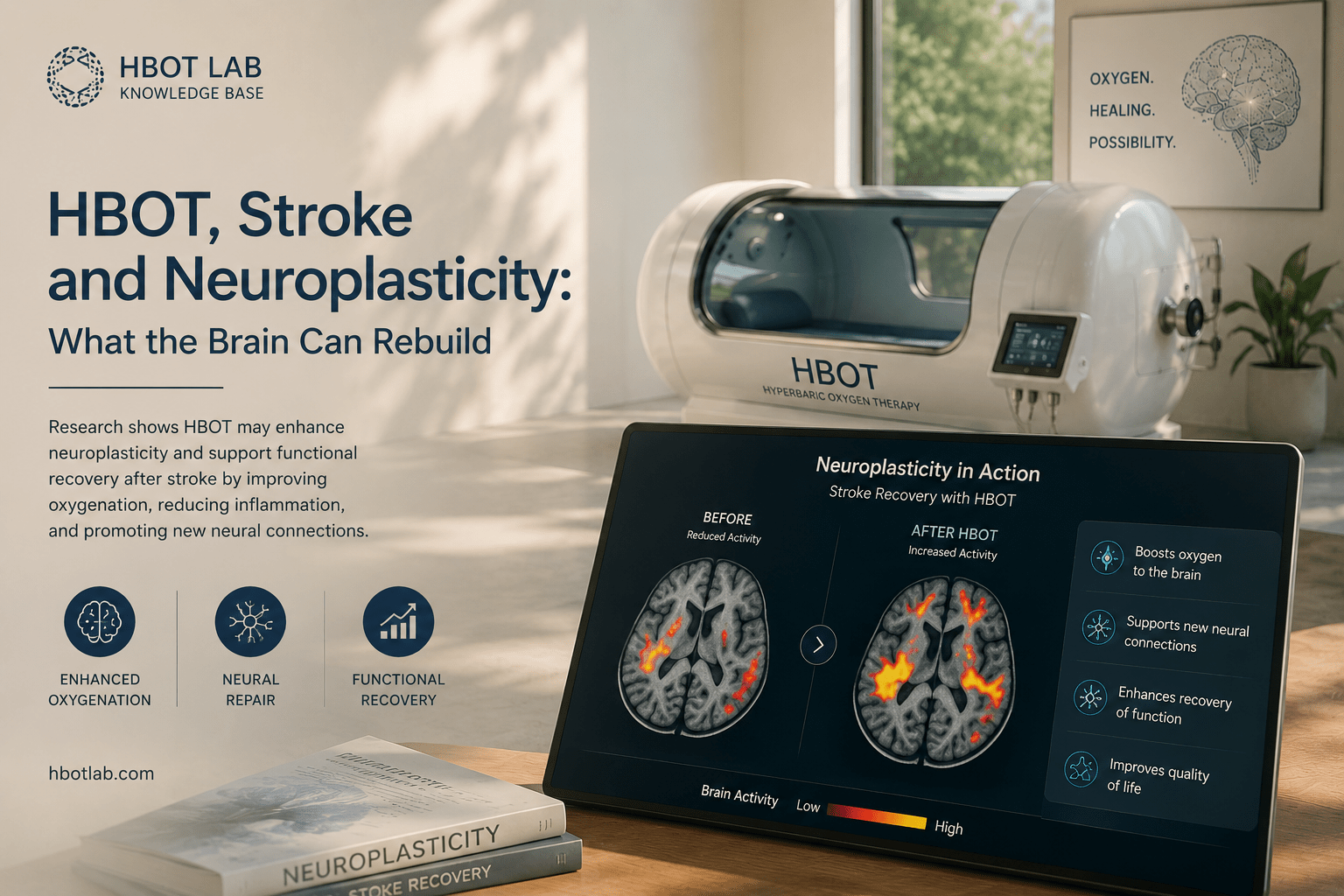
- Inducing neuroplasticity — Multiple studies have shown that HBOT triggers the growth of new blood vessels (angiogenesis) and new nerve fibres (neurogenesis) in damaged brain areas. This supports the brain’s own repair process.
- Reducing neuroinflammation — Chronic inflammation is a significant barrier to post-stroke recovery. HBOT has demonstrated anti-inflammatory effects in neural tissue, which may help clear some of this barrier.
For a deeper look at the neuroplasticity mechanism, read our article on how HBOT supports neuroplasticity.
What Does the Research Show on HBOT and Stroke?
The evidence base for HBOT and stroke is more developed than most people realise. Here are the key studies:
1. Efrati et al — Randomised Controlled Trial (PLoS ONE, 2013)
This is the most widely cited HBOT stroke trial. Seventy-four patients with chronic neurological deficits from stroke — at least six months after their event — were randomised to receive HBOT or no additional treatment.
The HBOT group showed significant improvement in neurological function, including motor function, cognitive ability, and daily living activities. Brain scans showed increased metabolic activity in areas previously considered permanently damaged.
Efrati S, Fishlev G, Bechor Y, et al. Hyperbaric oxygen induces late neuroplasticity in post stroke patients — randomised, prospective trial. PLoS ONE. 2013;8(1):e53716.
2. Rosario et al (Neurological Research International, 2018)
A retrospective analysis of patients who received HBOT following ischaemic stroke found functional improvements in motor and cognitive domains. The study noted that longer protocols showed more sustained gains.
Rosario ER, Kaplan SE, Khonsari S, et al. The effect of hyperbaric oxygen therapy on functional impairments caused by ischaemic stroke. Neurol Res Int. 2018;2018:3172679.
3. Tal et al — Angiogenesis and Nerve Regeneration (Frontiers in Human Neuroscience, 2017)
This study used advanced brain imaging to assess structural changes in TBI patients after HBOT. It found measurable growth of new blood vessels and nerve fibre regeneration in damaged areas — the first time this had been directly visualised in a clinical HBOT trial.
Tal S, Hadanny A, Sasson E, et al. Hyperbaric oxygen therapy can induce angiogenesis and regeneration of nerve fibres in traumatic brain injury patients. Front Hum Neurosci. 2017;11:508.
4. Hadanny et al — Cognitive Recovery (BMJ Open, 2018)
A retrospective analysis of 154 post-TBI patients treated with HBOT found significant improvements in cognitive function, memory, and attention — with effects sustained at follow-up. The research also showed improvements in patients treated more than one year after their original injury.
Hadanny A, Abbott S, Suzin G, et al. Effect of hyperbaric oxygen therapy on chronic neurocognitive deficits of post-traumatic brain injury patients: retrospective analysis. BMJ Open. 2018;8(9):e023387.
What Type of Stroke Does HBOT Apply To?
The research primarily covers ischaemic stroke — where a blood clot blocks blood flow to part of the brain. This is the most common type, accounting for around 85% of all strokes.
Haemorrhagic stroke — caused by a burst blood vessel — has a different profile. The evidence for HBOT here is less extensive, though some studies have shown benefits in the subacute recovery phase (Ostrowski RP et al, Arch Med Sci, 2017).
Most HBOT stroke protocols focus on the chronic phase — typically six months or more after the stroke, when the penumbra is still potentially viable but conventional rehabilitation has plateaued.
What a Typical HBOT Stroke Protocol Looks Like
There is no single universal protocol. However, the Efrati et al trial used a well-documented protocol that many clinics reference:
| Protocol Element | Efrati Trial Standard | Clinical Range |
| Pressure | 2.0 ATA | 2.0–2.4 ATA |
| Session length | 90 minutes | 60–90 minutes |
| Frequency | 5 days per week | 5 days per week |
| Total sessions | 60 | 40–60 sessions |
| Patient timing | 6+ months post-stroke | Subacute or chronic phase |
At Indian pricing, a 40-session protocol in Delhi or Bangalore would typically cost between ₹1,20,000 and ₹2,40,000. For a city-wise cost comparison, see our guide to HBOT cost in India.
What to Expect From HBOT for Stroke in India
Before starting an HBOT stroke protocol in India, here is what a responsible process looks like:
- Neurologist consultation first — HBOT for stroke should be discussed with your treating neurologist or rehabilitation specialist. HBOT is adjunctive — not a replacement for standard care.
- Brain imaging review — A reputable HBOT clinic will want to review existing MRI or CT scans before designing a protocol. This allows them to assess the penumbra region and set realistic expectations.
- Written protocol — Number of sessions, pressure, frequency, and goals should all be documented before you commit to any package.
- Mid-protocol review — Responsible clinics will reassess at the midpoint (typically after 20–30 sessions) to evaluate progress and adjust if needed.
To find certified clinics that treat stroke patients, see our guide on find a certified HBOT clinic near you. For Delhi-NCR specifically, see HBOT clinics in Delhi.
Also read our full article on HBOT and brain function recovery and our related article on HBOT for traumatic brain injury which covers overlapping neurological recovery pathways.
Frequently Asked Questions
1. Can HBOT help stroke recovery?
Research suggests yes — particularly for ischaemic stroke in the chronic phase. A randomised controlled trial by Efrati et al (PLoS ONE, 2013) showed significant neurological improvements in patients treated 6 months or more after their stroke. However, HBOT should always be used alongside standard rehabilitation, not instead of it.
2. How many HBOT sessions does a stroke patient need?
Most HBOT stroke protocols run between 40 and 60 sessions at 2.0 ATA, five days per week. The Efrati et al trial used 60 sessions as its standard protocol. Your treating team may adjust this based on your specific scan findings and response to early sessions.
3. How long after a stroke can HBOT help?
The research suggests HBOT can produce improvements even years after a stroke — not just in the acute phase. The Efrati et al trial enrolled patients at six months or more post-stroke and still found significant recovery. Some patients in observational studies have shown improvement several years after their event.
4. Is HBOT safe for stroke patients?
HBOT has a strong safety profile when administered at a certified clinic under medical supervision. For stroke patients, a pre-treatment review of existing conditions — particularly any history of seizures or pulmonary disease — is important. Read our full guide on is HBOT safe for a complete safety overview.
5. Where can stroke patients access HBOT in India?
Certified HBOT clinics that treat stroke and neurological conditions are available in Delhi NCR, Mumbai, Bangalore, Chennai, Hyderabad, and Noida. Use our resource on find a certified HBOT clinic near you to find and contact the nearest centre.


Subscribe
2 Comments
Comments are closed.
[…] See our article on HBOT and brain function recovery for more on cognitive recovery pathways. And for the closely related stroke recovery protocol, see our guide to HBOT and stroke recovery. […]
[…] see our related articles on HBOT and stroke recovery and HBOT for traumatic brain injury which cover overlapping neurological HBOT […]