Hyperbaric Oxygen Therapy and Longevity: Telomeres, Brain Health and the Anti-Ageing Evidence
| IMAGE BLOCK 1 — Hero File name: hyperbaric-oxygen-therapy-longevity-telomeres-brain-anti-ageing.jpg Alt text: hyperbaric oxygen therapy longevity telomeres brain anti-ageing evidence India Caption: Hyperbaric oxygen therapy and longevity — what the research shows for telomere length, brain health and cellular repair. Compress: Under 100KB Placement: After H1, before first paragraph |
|---|
| IMAGE BLOCK 2 — Telomere Mechanism File name: hbot-longevity-telomere-epigenetic-clock-cellular-repair.jpg Alt text: hbot longevity telomere epigenetic clock cellular repair oxygen anti-ageing mechanism Caption: How HBOT may influence the epigenetic clock and telomere dynamics — two of the most studied biological markers of ageing. Compress: Under 100KB Placement: After Section 2 telomere mechanism |
|---|
[ INSERT HERO IMAGE — hyperbaric-oxygen-therapy-longevity-telomeres-brain-anti-ageing.jpg ]
Ageing is not one process. It is the accumulation of many — telomere shortening, epigenetic drift, mitochondrial decline, chronic inflammation, and progressive vascular impairment. The most interesting longevity research of the past decade is asking whether any of these processes can be slowed, and which interventions actually move the needle.
Research on hyperbaric oxygen therapy longevity is at an early but scientifically serious stage. Several studies have looked at HBOT's effects on markers of cellular ageing — including telomere length and epigenetic clock measurements — and the results are worth understanding carefully.
This article covers what the research shows, what it cannot yet claim, and what the longevity-minded person in India should know about HBOT as a potential tool in a broader health optimisation approach.
Why Oxygen Is Central to the Ageing Conversation
Ageing at the cellular level is, in significant part, a story about oxygen. Mitochondrial dysfunction — one of the most widely accepted hallmarks of ageing — is fundamentally a failure of oxygen utilisation. Chronic low-grade inflammation (inflammageing) is driven in part by hypoxic tissue signalling. Vascular stiffening reduces oxygen delivery to every organ, including the brain.
HBOT addresses these upstream factors by dissolving oxygen under pressure directly into blood plasma — reaching hypoxic tissue that circulating blood cells cannot perfuse effectively. The physiological case for HBOT in longevity is therefore not speculative. It follows from the same mechanism documented in stroke recovery, wound healing, and brain rehabilitation.
For more on this mechanism, read our guide on hyperbaric oxygen therapy benefits. For the brain health dimension specifically, see HBOT and neuroplasticity.
The Telomere Research — What It Actually Shows
Telomeres are the protective caps at the ends of chromosomes. They shorten with each cell division and with cumulative oxidative stress. Telomere length is one of the most studied biological markers of cellular age — shorter telomeres are associated with earlier onset of age-related disease and reduced longevity.
Research has consistently linked telomere length to epigenetic markers of ageing. Banszerus VL et al (Int J Mol Sci, 2019) demonstrated a significant relationship between relative telomere length and the epigenetic clock — suggesting both are measuring related aspects of biological ageing. Mendelsohn AR and Larrick JW (Rejuvenation Res, 2017) proposed that epigenetic drift is a primary determinant of mammalian lifespan.
Harch PG (Med Gas Res, 2015) proposed that HBOT may influence gene expression patterns relevant to ageing through its effect on hypoxia-inducible factors and oxidative signalling — a mechanism that operates at the epigenetic level.
[ INSERT IMAGE — hbot-longevity-telomere-epigenetic-clock-cellular-repair.jpg ]
These studies establish the biological plausibility. They do not yet constitute proof that HBOT extends human lifespan or materially reverses biological ageing. That distinction matters.
HBOT and Brain Longevity — The Strongest Evidence
Of all the longevity applications of HBOT, the brain evidence is the most developed. Efrati S et al (PLoS ONE, 2013) demonstrated that HBOT induces late neuroplasticity in post-stroke patients — reactivating dormant brain tissue years after the original injury. This finding has profound implications for cognitive longevity.
Vadas D et al (Front Integr Neurosci, 2017) showed that HBOT enhanced brain activity and multitasking performance in healthy subjects — not injured ones. This is significant: improvements in a non-clinical population suggest that the brain's oxygen supply is a limiting factor for cognitive performance even in health, not just in disease.
Vadas D, Kalichman L, Hadanny A, et al. Hyperbaric oxygen environment can enhance brain activity and multitasking performance. Front Integr Neurosci. 2017;11:25.
For a deeper look at brain health and HBOT, read our articles on HBOT and cognitive brain function and HBOT and neuroplasticity. For the celebrity angle on HBOT and longevity, see our article on Bryan Johnson's HBOT longevity protocol.
The Five Longevity Pathways HBOT May Influence
| Longevity Pathway | HBOT's Documented Effect | Evidence Status |
|---|---|---|
| Mitochondrial function | Improves oxygen availability for ATP synthesis; reduces mitochondrial dysfunction markers | Research.docx: Palzur E 2008; Dave KR 2003 |
| Chronic inflammation | Reduces pro-inflammatory cytokines (TNF-α, IL-6); suppresses NF-κB signalling | Research.docx: Meng XE 2016; Novak S 2016 |
| Vascular health | Stimulates angiogenesis; improves endothelial function; mobilises stem cells | Fosen KM 2014; Thom SR 2006 |
| Brain cognitive reserve | Induces neuroplasticity; improves cerebral perfusion; activates BDNF pathways | Efrati S 2013; Vadas D 2017 |
| Epigenetic / cellular ageing | Influences hypoxia-inducible factor signalling; proposed effect on gene expression (Harch 2015) | Emerging — no definitive RCT yet |
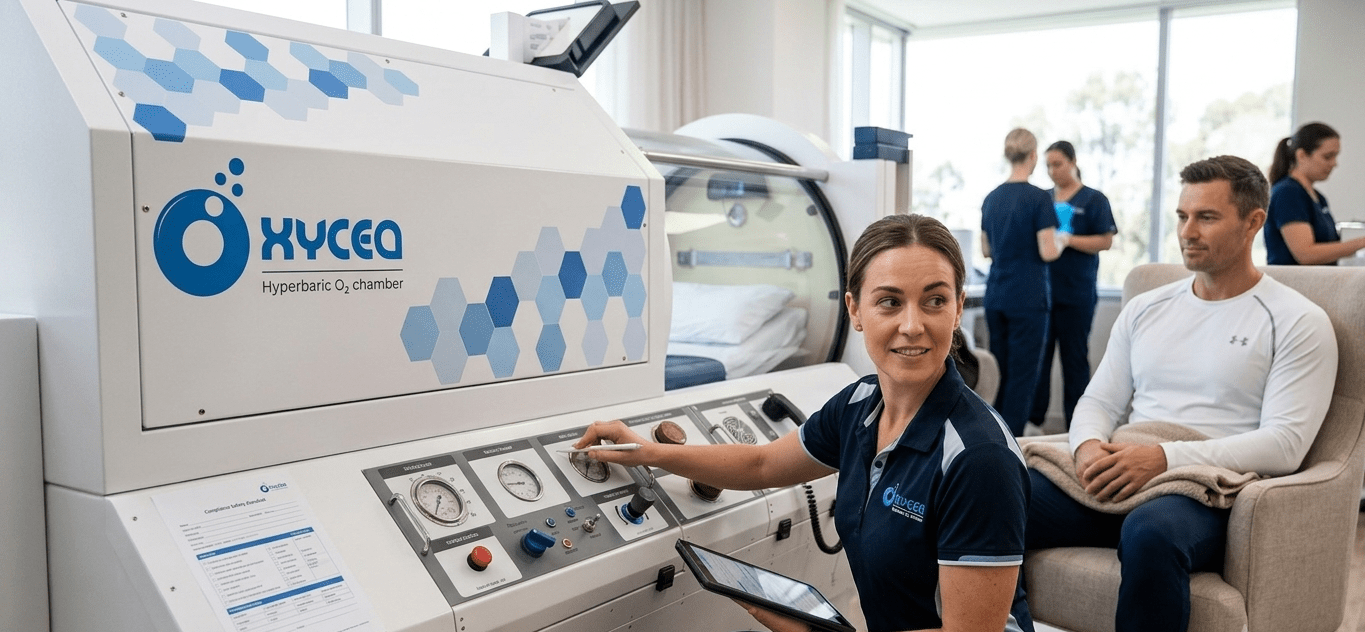
Any longevity-focused HBOT protocol must use a PVHO-certified hard chamber — a pressure vessel for human occupancy meeting ASME PVHO-1 standards — operating at 2.0 ATA minimum. The biological effects documented in research do not occur at the 1.3 ATA that soft portable chambers reach.
For PVHO certification and what to verify at any clinic see our guide on PVHO chamber certification in India. For certified clinics see find a certified HBOT clinic near you.
Being Honest About What HBOT Cannot Claim for Longevity
Longevity claims attract exaggeration. Here is what the evidence does not yet support:
- HBOT does not have proven life-extension evidence in humans — No randomised controlled trial has shown that HBOT extends human lifespan. Animal studies showing benefit in ageing models are not the same as human trials.
- The telomere research is preliminary — Studies examining HBOT and telomere dynamics are emerging but not yet at the level of established evidence. Telomere length is a biomarker, not a guaranteed proxy for lifespan.
- It is not a substitute for lifestyle fundamentals — Sleep, diet quality, resistance training, stress management, and not smoking have vastly more evidence for longevity than HBOT. These are the foundation. HBOT at best is an adjunct.
For safety before starting any protocol see our guide on is HBOT safe.
Frequently Asked Questions
Can hyperbaric oxygen therapy slow ageing?
HBOT influences several biological pathways associated with ageing — mitochondrial function, chronic inflammation, vascular health, and brain cognitive reserve. Preliminary research on telomere and epigenetic effects is promising. HBOT cannot yet claim to slow ageing in the definitive sense — but the mechanistic and early clinical evidence is serious enough to warrant attention.
What does HBOT do for telomeres?
Harch PG (2015) proposed that HBOT influences gene expression through hypoxia-inducible factor signalling — a pathway linked to telomere maintenance. Formal studies on HBOT's direct effect on telomere length in humans are at an early stage. This is an active area of longevity research.
How many HBOT sessions are used in longevity protocols?
Most longevity-focused protocols run 40 sessions at 2.0 ATA, typically 5 days per week over 8 weeks. Some practitioners use 60-session protocols for cognitive optimisation. These are adapted from neurological rehabilitation protocols rather than purpose-built longevity trials.
Who uses HBOT for longevity?
A growing number of high-information individuals — executives, athletes, biohackers, and people with a family history of neurodegenerative disease — are incorporating HBOT into longevity stacks alongside sleep optimisation, diet, and exercise. Bryan Johnson's well-documented protocol includes HBOT as a core component.
Where can I access HBOT for longevity in India?
Certified HBOT centres in Delhi NCR, Mumbai, Bangalore, Noida, Hyderabad, and Chennai can administer longevity-focused protocols. Use our guide to find a certified HBOT clinic near you to find the nearest certified centre with a PVHO-standard hard chamber.