
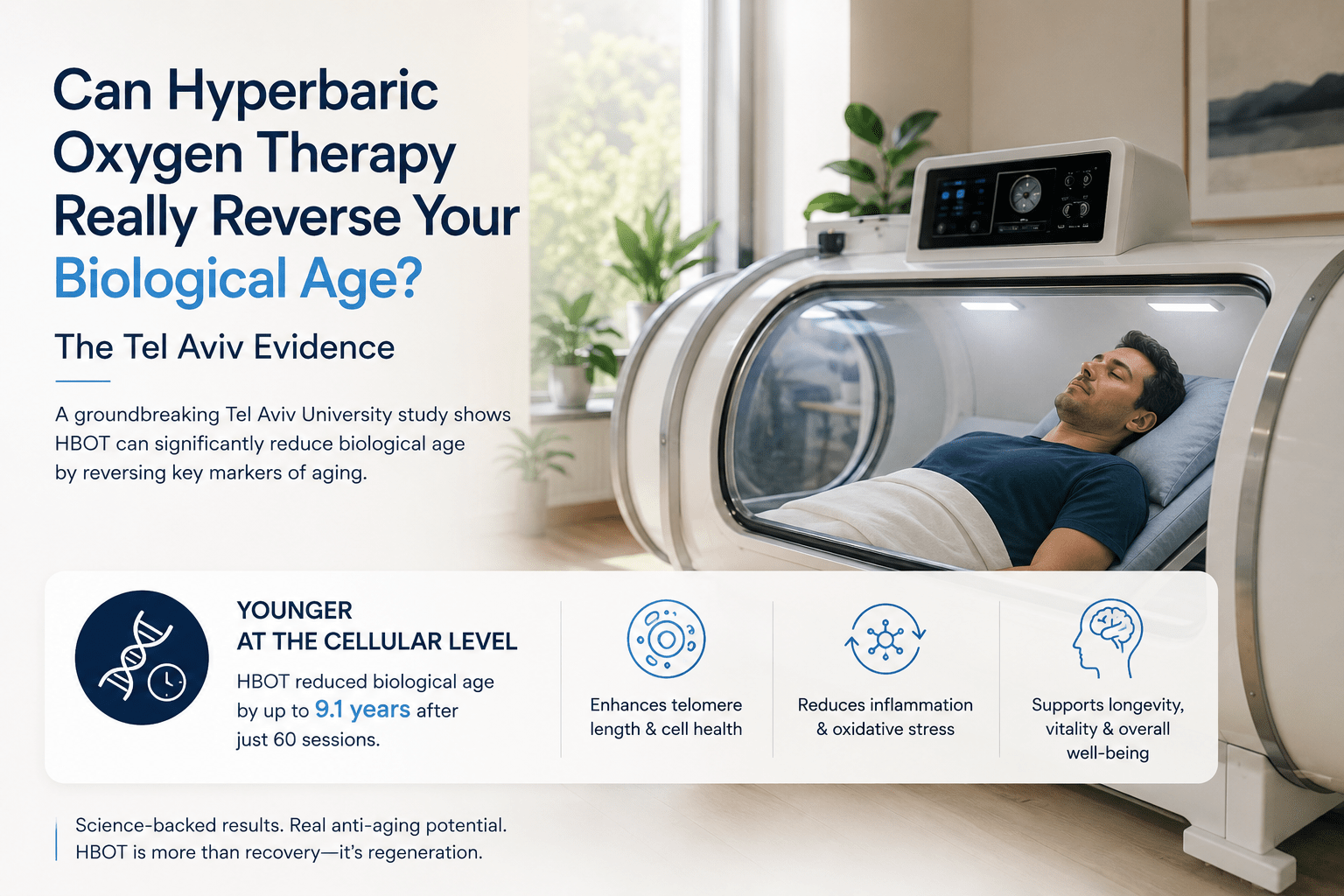
Can Hyperbaric Oxygen Therapy Really Reverse Your Biological Age? The Tel Aviv Evidence
Ageing is not a single process. It is a collection of measurable biological events. And for the first time, a randomised controlled trial has shown that some of those events can be reversed with a non-pharmaceutical intervention.
Most anti-ageing claims dissolve under scrutiny.
Can hyperbaric oxygen therapy reverse aging? Not in the way supplement companies use the word “reverse”. But in a more precise, measurable, biologically meaningful sense — the answer from peer-reviewed science is: yes, specific markers of cellular ageing can be reversed through a structured HBOT protocol.
In 2020, a team at Tel Aviv University and Shamir Medical Centre published a randomised controlled trial that showed 60 HBOT sessions at 2.0 ATA produced measurable reversal of two core biological ageing markers in healthy older adults. The findings were published in the peer-reviewed journal Aging. They have since become the most cited longevity evidence in the HBOT field.
This article explains what the study found, why the biology matters, what the findings do and do not mean, and what it takes to replicate the protocol.
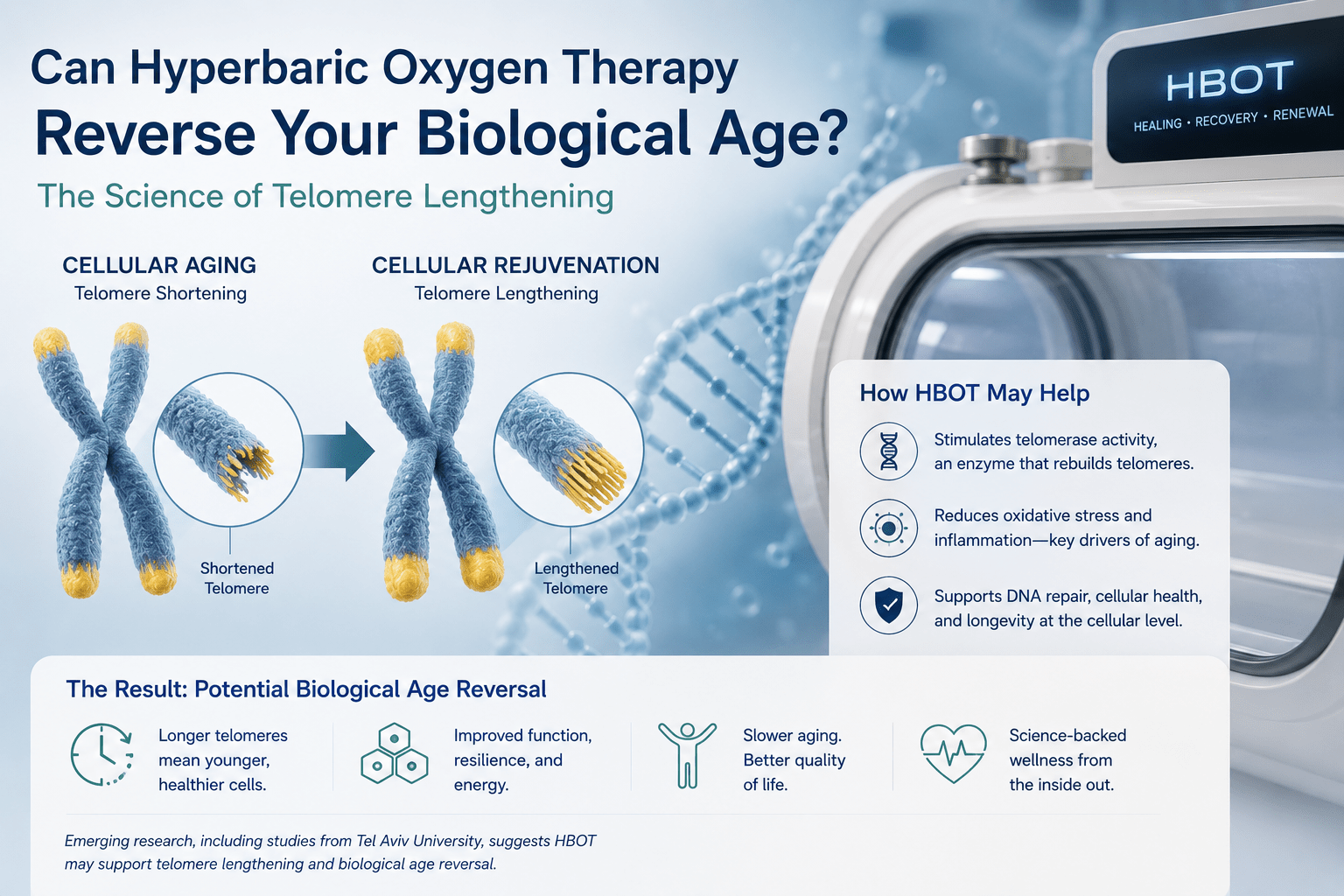 Telomere diagram or cellular ageing science visual.
can hyperbaric oxygen therapy reverse aging — telomere lengthening and biological age reversal science
What Is Hyperbaric Oxygen Therapy and How Could It Affect Ageing?
Hyperbaric oxygen therapy (HBOT) is a treatment in which you breathe pure oxygen inside a pressurised chamber at 1.5 to 2.4 times normal atmospheric pressure. At that pressure, oxygen dissolves directly into blood plasma — not relying on red blood cells — and penetrates tissues that standard circulation cannot adequately oxygenate.
The connection to ageing is not intuitive at first. Ageing is not simply the passage of time — it is a set of measurable biological processes: telomere shortening, accumulation of senescent cells, mitochondrial decline, and chronic low-grade inflammation. Each of these processes is accelerated by poor cellular oxygenation, oxidative stress, and immune dysregulation.
HBOT addresses several of these drivers simultaneously — which is why the longevity hypothesis is scientifically credible rather than speculative.
The Tel Aviv Study: What Was Actually Measured
Efrati S, Hadanny A, Hachmo Y et al. (Aging, 2020) conducted a prospective randomised controlled trial on 35 healthy adults aged 64 and older. Participants completed 60 HBOT sessions at 2.0 ATA over 12 weeks (5 sessions per week, 90 minutes per session). A control group underwent no intervention. Blood samples were analysed before, during, and after the protocol.
The primary findings:
| Marker | Change After 60 Sessions | Biological Significance |
|---|---|---|
| Telomere length — T cells | +20% to +38% | Telomere shortening is a primary marker of cellular ageing. Lengthening reverses this marker. |
| Telomere length — B cells | +25% to +38% | Consistent across immune cell types, suggesting systemic rather than localised effect. |
| Senescent T cells | −37% | Senescent cells drive chronic inflammation and tissue damage. Reduction is a direct anti-ageing effect. |
| Senescent B cells | −13% | Further evidence of systemic senolytic activity without pharmaceutical intervention. |
| B regulatory cells | Significant increase | Immune regulation improvement — associated with reduced autoimmune and inflammatory burden. |
These are statistically significant, peer-reviewed findings. They are not wellness marketing. They represent the first randomised controlled evidence that a non-pharmacological intervention can reverse telomere shortening and reduce senescent cell load in healthy older humans.
Why Telomeres and Senescent Cells Are the Right Things to Measure
Understanding why these specific markers matter requires a brief biology foundation.
Telomeres: the countdown clock of cellular life
Every time a cell divides, its telomeres — the protective end-caps on chromosomes — shorten slightly. When telomeres become critically short, the cell either stops dividing (becomes senescent) or dies. Telomere length is therefore a direct measure of how many divisions a cell has left, and by extension, how biologically old it is.
Short telomeres are associated with increased risk of cardiovascular disease, cancer, neurodegeneration, and immune dysfunction. Conversely, longer telomeres in ageing adults are associated with reduced disease risk and longer healthspan.
HBOT’s proposed mechanism for telomere lengthening involves the activation of telomerase — the enzyme responsible for rebuilding telomere ends — via hyperoxygenation of immune cells. When oxygen availability increases 20-fold at 2.0 ATA, the cellular energy available to run repair and synthesis processes increases correspondingly.
Senescent cells: the ageing body’s uninvited guests
Senescent cells are cells that have stopped dividing but refuse to die. They remain metabolically active, secreting a cocktail of inflammatory signals — known as the senescence-associated secretory phenotype (SASP) — that damage surrounding healthy tissue. This accumulation of senescent cells is now considered a primary driver of age-related disease, cognitive decline, and the chronic low-grade inflammation that characterises biological ageing.
Pharmaceutical approaches to senescent cell clearance (senolytics) are actively under development. The Efrati 2020 finding — a 37% reduction in senescent T cells after 60 HBOT sessions — suggests that HBOT achieves a senolytic effect through a non-pharmacological pathway, likely involving HBOT’s activation of apoptotic pathways in oxygen-responsive cells.
What the Evidence Shows — and What It Does Not
Precision matters here. The Efrati study is the strongest non-pharmacological longevity evidence in the HBOT field. It is not a licence to make unlimited claims.
- What it shows: HBOT at 2.0 ATA over 60 sessions reverses measurable biological markers of cellular ageing in immune cells of healthy older adults. This is peer-reviewed, randomised, and replicable.
- What it does not show: Extended lifespan, reversal of all ageing processes, or clinical benefit in younger populations or those with chronic disease. Long-term health outcomes were not measured.
- What it does not apply to: Soft chamber HBOT at 1.3 ATA. The study protocol used 2.0 ATA hard chamber. Lower pressure sessions do not replicate the oxygen saturation levels required to activate the proposed mechanisms.
- What it is: The most significant longevity finding in HBOT research to date, conducted by a credible academic institution, published in a peer-reviewed journal, and independently cited by researchers globally.
The Protocol: What Is Required to Replicate the Findings
The Efrati protocol is specific. These are the requirements:
| Parameter | Study Protocol | Why It Matters |
|---|---|---|
| Chamber type | Hard chamber | Soft chambers cannot reach 2.0 ATA — essential for plasma oxygen dissolution |
| Pressure | 2.0 ATA | The 20-fold plasma oxygen increase occurs at 2.0 ATA, not at 1.3–1.5 ATA |
| Session duration | 90 minutes at pressure | Duration at pressure drives cumulative oxygen exposure to cells |
| Session frequency | 5 per week | Frequency maintains elevated cellular oxygen environment between sessions |
| Total sessions | 60 | Telomere and senescent cell effects were measured at session 60 — not before |
| Duration | 12 weeks | Consistent weekly protocol for 3 months |
Accessing the Protocol in India
The 60-session longevity protocol at 2.0 ATA hard chamber is available in India. It is not a futuristic treatment. It is available today in Delhi, Mumbai, Bangalore, Hyderabad, and Chennai at dedicated wellness HBOT centres.
The total investment for a 60-session protocol in India ranges from approximately ₹1,40,000 to ₹6,00,000 depending on city and facility. Bangalore currently has the most active longevity-focused HBOT infrastructure. See our complete guide to HBOT longevity protocols in India and what to look for before committing to a facility.
Three questions to ask any facility before booking a longevity protocol:
- Does your hard chamber reach and sustain 2.0 ATA for 90 minutes at pressure?
- Do you offer a 60-session structured protocol with a consistent weekly frequency?
- Do you recommend baseline biomarker testing before starting and at session 30 and 60?
A facility that cannot answer all three clearly is not running the Efrati protocol. They are selling wellness sessions.
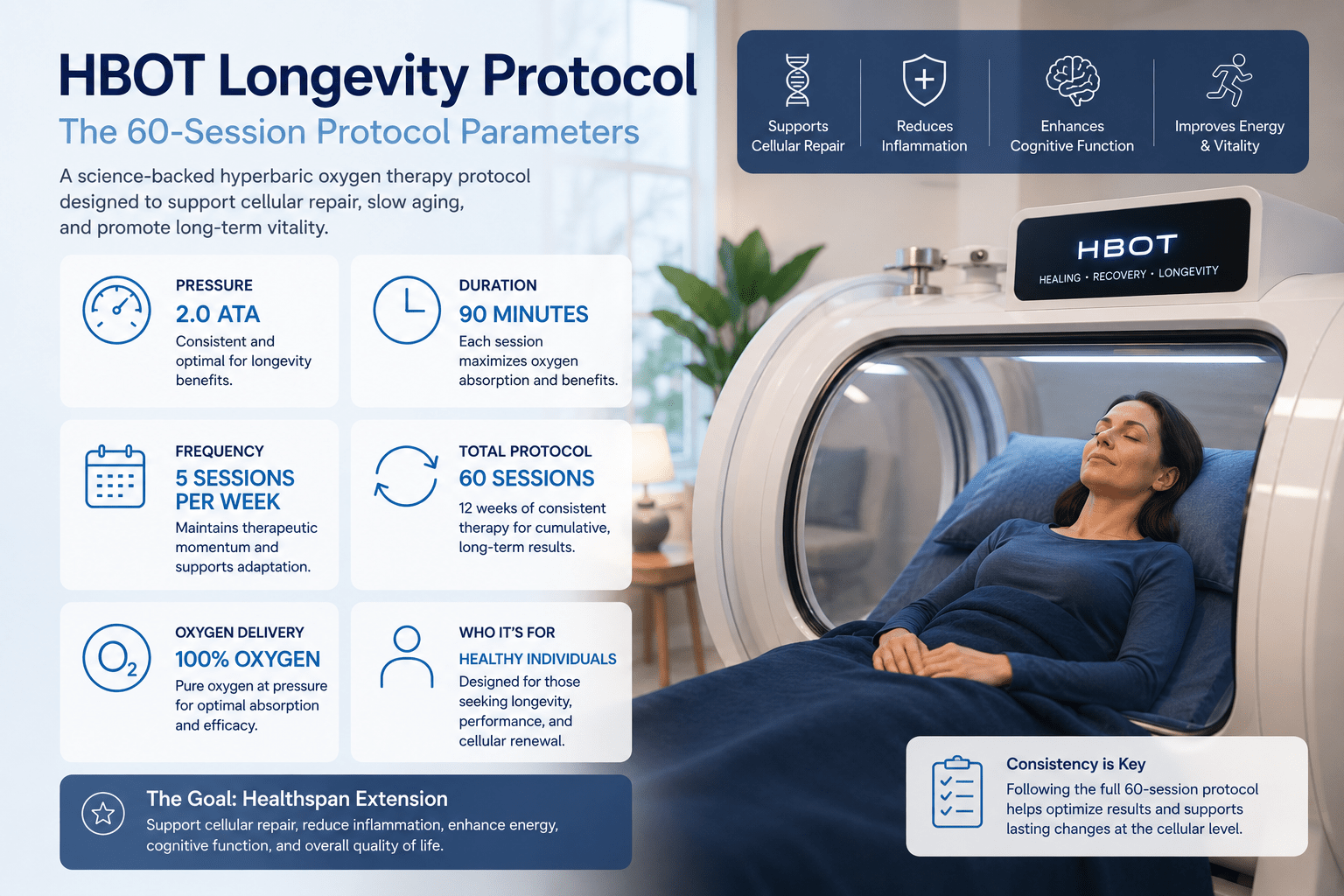 HBOT longevity protocol infographic — the 60-session protocol parameters.
can hyperbaric oxygen therapy reverse aging — the 60-session 2.0 ATA longevity protocol
Frequently Asked Questions About HBOT and Biological Age Reversal
Can hyperbaric oxygen therapy reverse aging?
In a specific, measurable biological sense — yes. The 2020 Efrati et al. Tel Aviv University study showed that 60 HBOT sessions at 2.0 ATA reversed telomere shortening in immune cells (by up to 38%) and reduced senescent T cells (by 37%) in healthy older adults. These are core biological markers of cellular ageing. Whether this translates to extended lifespan or disease prevention in humans has not been established in long-term trials.
What does the Tel Aviv University HBOT study actually show?
The 2020 study by Efrati S, Hadanny A et al. (published in Aging) was a prospective randomised controlled trial on 35 healthy adults aged 64 and above. After 60 HBOT sessions at 2.0 ATA over 12 weeks, participants showed statistically significant increases in telomere length and reductions in senescent immune cell populations. The control group showed no such changes. It is the most rigorous HBOT longevity evidence to date.
Does soft chamber HBOT have the same anti-ageing effect?
No. The Efrati protocol used hard chamber HBOT at 2.0 ATA. Soft chambers operate at 1.3 to 1.5 ATA. At lower pressure, the plasma oxygen dissolution required to activate the proposed telomerase and apoptotic mechanisms does not occur at the same magnitude. Soft chamber sessions may have general wellness benefits, but they do not replicate the longevity findings of the Tel Aviv study.
How long does the protocol take and what does it cost in India?
The Efrati protocol requires 60 sessions over 12 weeks (5 sessions per week, 90 minutes per session). In India, a 60-session hard chamber protocol costs approximately ₹1,40,000 to ₹6,00,000 depending on city and facility. Bangalore, Mumbai, and Delhi have facilities capable of running the full protocol.
What biomarkers should I test before starting a longevity HBOT protocol?
To measure meaningful before-and-after outcomes, useful baseline markers include: telomere length assay (available through specialist labs in Mumbai, Delhi, and Bangalore), inflammatory markers (hsCRP, IL-6, TNF-α), metabolic panel (HbA1c, fasting glucose, lipids), and a complete blood count. Test at baseline, at session 30, and at session 60. Without baseline testing, you will not know what changed.
The Science Is Not Speculation. The Protocol Is Replicable.
For decades, the idea that ageing could be measurably reversed by any intervention was dismissed as wishful thinking. The Efrati study changed that. Not with promises, not with marketing language, but with randomised controlled data published in a peer-reviewed journal.
Telomeres lengthened. Senescent cells cleared. In healthy older adults. With no pharmaceutical intervention.
The protocol is available in India. The question is whether the facility you choose can actually deliver it.
When you are ready to understand exactly what happens inside your body during a session —


Subscribe
One Comment
Comments are closed.
[…] HBOT can reverse biological age whether HBOT can reverse biological age explains, the findings of that study do not apply to chambers operating below that pressure […]