Hyperbaric Oxygen Therapy for Alzheimer’s Patients: What Families Need to Know
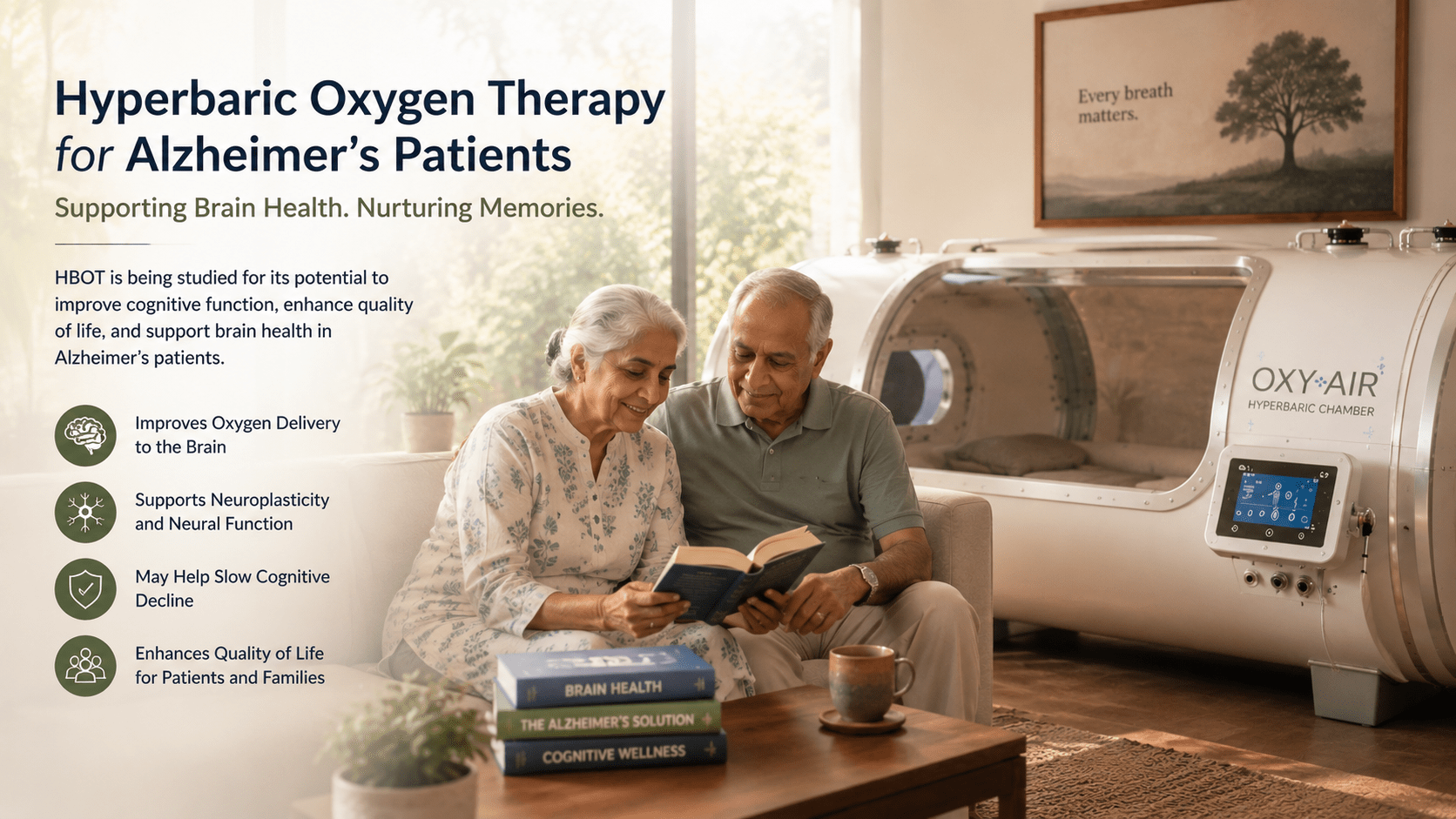
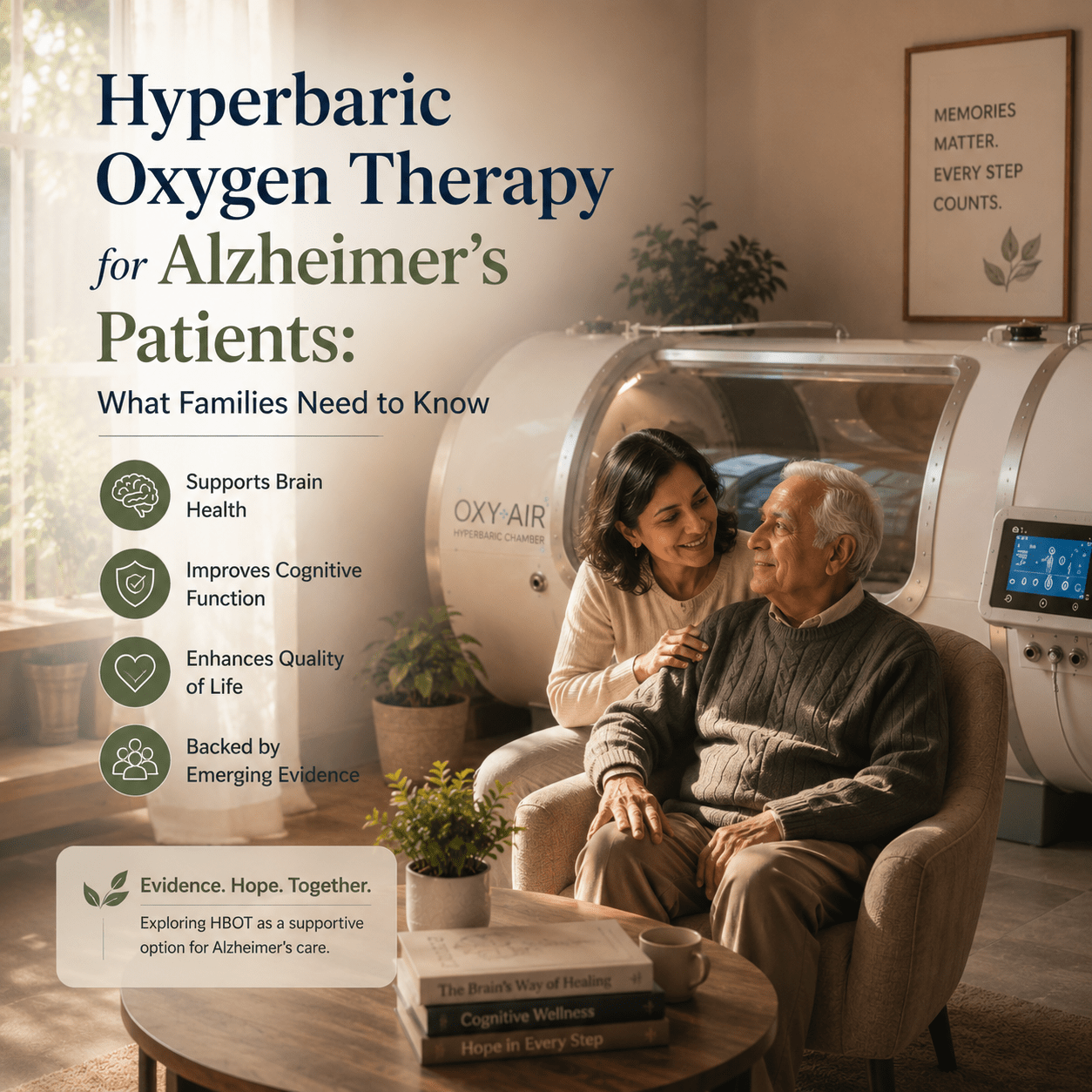
hyperbaric oxygen therapy for alzheimer’s patients brain oxygenation India caregiver guide Caption: HBOT for Alzheimer’s patients — how improved brain oxygenation may support cognitive function in dementia care.
Watching someone you love lose their memory is one of the most painful experiences in human life. Alzheimer’s disease does not have a cure. But it does have a growing body of researchers asking whether the right interventions — applied early and consistently — might slow its progress or support the brain function that remains.
Research on hyperbaric oxygen therapy for Alzheimer’s patients is at an early but meaningful stage. Several studies have identified brain-level mechanisms that HBOT may influence — and at least one published case report has shown measurable cognitive improvement.
This guide is for families and caregivers — not to raise false hope, but to give you an accurate picture of where the science is and what questions to ask if you are considering HBOT as part of a broader care approach.
| Important: HBOT is not a treatment for Alzheimer’s disease and is not approved for this condition. Evidence is investigational and preliminary. Always make any decision about adjunctive therapies in consultation with your neurologist or specialist. |
|---|
Why Oxygen Matters to the Alzheimer’s Brain
The brain in Alzheimer’s disease operates under conditions of progressive hypoxia — reduced oxygen delivery to neural tissue. This is not a side effect of the disease: it is a contributing driver of it.
Research has identified several mechanisms linking brain hypoxia to Alzheimer’s pathology:
- Amyloid accumulation accelerates in low-oxygen environments — Hypoxia upregulates the enzymes that produce amyloid-beta, the protein that forms the plaques associated with Alzheimer’s. Improving oxygen delivery may interrupt this cycle.
- Reduced cerebral blood flow is an early Alzheimer’s marker — Brain imaging studies consistently show reduced perfusion in Alzheimer’s patients years before symptom onset. Improving that perfusion is a logical therapeutic target.
- Mitochondrial dysfunction impairs neural energy production — Neurons in Alzheimer’s brains show impaired mitochondrial function. HBOT has demonstrated the ability to support mitochondrial energy pathways in stressed neural tissue.
HBOT dissolves oxygen directly into blood plasma under pressure — bypassing the haemoglobin-bound limit — allowing it to reach hypoperfused brain regions. For a plain explanation of this mechanism, read our guide on how HBOT supports neuroplasticity.
What the Research Shows for HBOT and Alzheimer’s
The Harch and Fogarty case report — brain imaging evidence
The most striking published evidence comes from a 2019 case report by Harch PG and Fogarty EF (Med Gas Res, 2019). A patient with diagnosed Alzheimer’s dementia underwent 40 HBOT sessions. PET imaging before and after showed measurable increases in cerebral metabolic activity in specific brain regions.
Alongside the imaging changes, the patient demonstrated improvements in cognitive test scores, activities of daily living, and self-reported quality of life. The authors noted that the improvements were consistent with the oxygen-driven mechanism and called for controlled trials.
Harch PG, Fogarty EF. Hyperbaric oxygen therapy for Alzheimer’s dementia with positron emission tomography imaging: a case report. Med Gas Res. 2019;8(4):181–184.
Shapira and Efrati — a theoretical and mechanistic framework
Shapira R, Efrati S, Ashery U (Neural Regen Res, 2018) published a review proposing HBOT as a new approach to Alzheimer’s. The authors outlined how HBOT’s effects on neuroinflammation, amyloid clearance pathways, and brain perfusion align with known Alzheimer’s pathology — and called for clinical trials to test this systematically.
Shapira R, Efrati S, Ashery U. Hyperbaric oxygen therapy as a new approach for Alzheimer’s disease. Neural Regen Res. 2018;13(5):817–818.
Vascular dementia — a more developed evidence base
For vascular dementia — where reduced blood flow to the brain is the primary driver — the evidence is stronger. Qiang et al (Front Aging Neurosci, 2019) conducted a meta-analysis of HBOT as adjunctive therapy for vascular dementia and found significant improvements in cognitive outcomes including MMSE scores, cognitive assessment, and daily functioning.
Qiang et al. Meta-Analysis on the Efficacy and Safety of Hyperbaric Oxygen as Adjunctive Therapy for Vascular Dementia. Front Aging Neurosci. 2019;11:86.

hbot alzheimers dementia amyloid plaque brain oxygen neuroplasticity mechanism Caption: How HBOT targets the hypoxic brain environment that accelerates amyloid accumulation in Alzheimer’s disease.
Honest Gaps — What the Evidence Cannot Yet Claim
There are currently no large randomised controlled trials of HBOT specifically for Alzheimer’s disease. The Harch 2019 finding is a single case report — important as a signal, but not proof of efficacy. The mechanistic reasoning is compelling, but mechanism is not the same as clinical outcome.
What families should understand:
- HBOT is not approved for Alzheimer’s disease anywhere in the world
- The evidence is investigational — it supports further research, not clinical adoption
- Vascular dementia has a more developed evidence base than Alzheimer’s specifically
- Any improvement seen in individual patients may reflect the general benefits of improved brain oxygenation rather than specific Alzheimer’s pathology modification
For the broader picture on HBOT and cognitive recovery, see our article on HBOT and cognitive brain recovery. And for the longevity angle on HBOT and brain health, see our article on Bryan Johnson and HBOT for longevity.
What Families Considering HBOT for an Alzheimer’s Patient Should Know
If you are exploring HBOT as a complementary option for a family member with Alzheimer’s or dementia, these are the essential steps:
- Consult the neurologist first — HBOT should only be considered alongside, not instead of, the neurologist’s care plan. Share any research you have read and get their view before proceeding.
- Choose early-to-mid stage Alzheimer’s if possible — The most plausible window for HBOT to have impact is when some functional neural tissue remains. Late-stage Alzheimer’s has limited structural basis for improvement.
- Insist on a PVHO-certified hard chamber — A pressure vessel for human occupancy meeting ASME PVHO standards operating at 2.0 ATA is required for any neurological protocol. A soft portable chamber at 1.3 ATA is not appropriate.
- Document baseline function — Before starting HBOT, document the patient’s cognitive scores, daily living capabilities, and communication function. Without a baseline, any observed change cannot be meaningfully attributed.
- Set a review point — Agree with the clinic on a midpoint review — typically after 20 sessions — to assess whether any meaningful change has occurred.
For PVHO safety and what to verify at any clinic, see our article on PVHO chamber safety in India. For session costs across India, see HBOT session cost in India.
Frequently Asked Questions
Can hyperbaric oxygen therapy help Alzheimer’s disease?
Early research suggests HBOT may support brain oxygenation and cognitive function in some Alzheimer’s patients. A published case report showed measurable PET imaging changes and cognitive improvements following 40 HBOT sessions. However, HBOT is not an approved treatment for Alzheimer’s and evidence remains investigational.
What does HBOT do in the Alzheimer’s brain?
HBOT dissolves oxygen directly into blood plasma, allowing it to reach brain regions with reduced blood flow — a core feature of Alzheimer’s disease. It may also reduce neuroinflammation, support mitochondrial function in neurons, and interrupt the hypoxic conditions that accelerate amyloid accumulation.
Is HBOT more effective for Alzheimer’s or vascular dementia?
The evidence base for vascular dementia is more developed. A 2019 meta-analysis found significant cognitive improvements with HBOT in vascular dementia patients. For Alzheimer’s specifically, evidence is limited to case reports and mechanistic research — larger trials are needed.
How many HBOT sessions would an Alzheimer’s patient need?
The only published case report used 40 sessions at 1.5 ATA. Vascular dementia protocols in published research have used 20–40 sessions at 1.5–2.0 ATA. Any protocol should be designed in consultation with a neurologist and reviewed at session 20.
Is HBOT safe for elderly patients with Alzheimer’s?
HBOT is generally safe for elderly patients at certified PVHO-standard clinics, though pre-existing cardiac, pulmonary, or ear conditions require individual assessment. The treating neurologist should review the patient’s profile before any HBOT protocol begins.