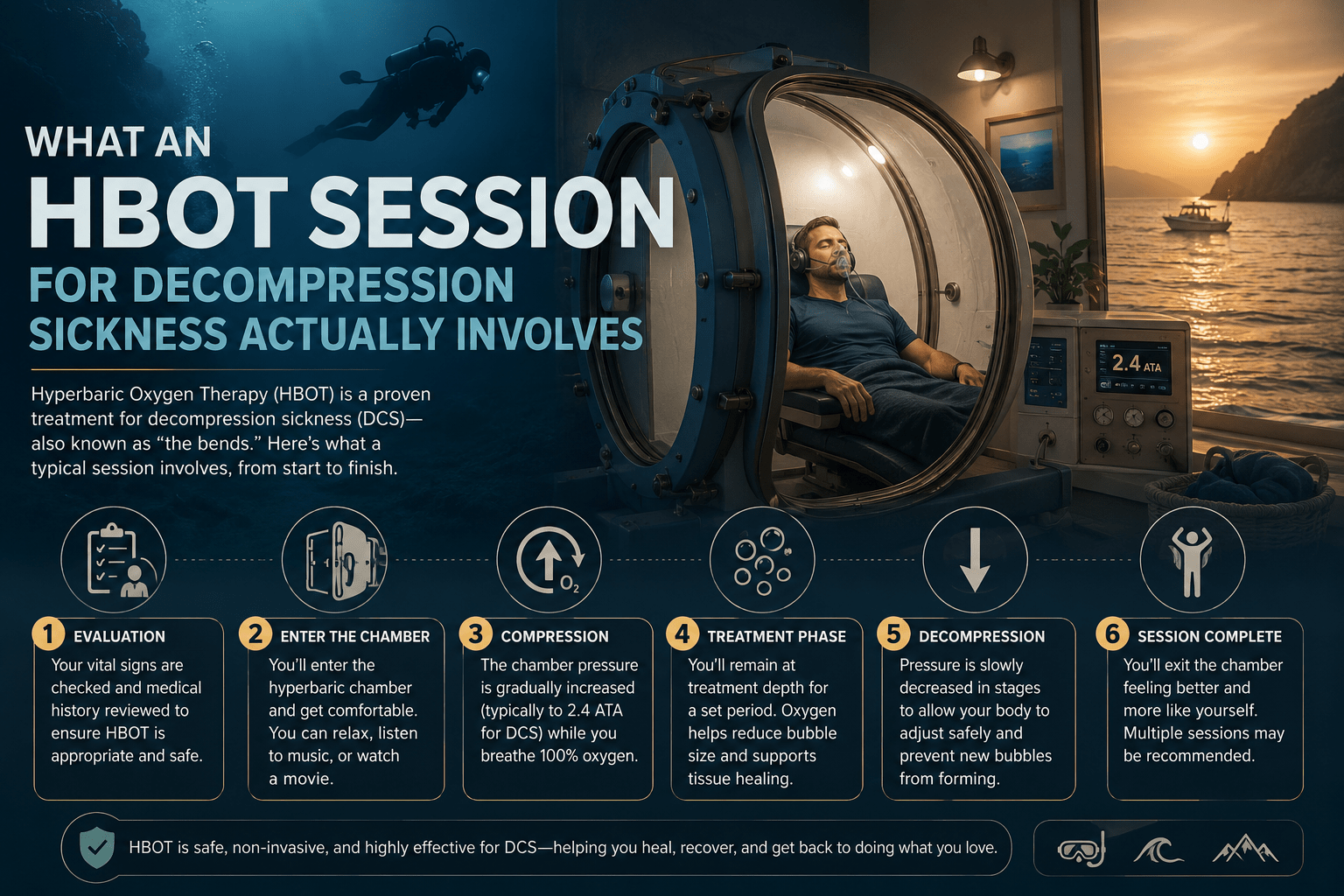
What an HBOT Session for Decompression Sickness Actually Involves
Most divers know they need a chamber after the bends. Very few know what actually happens inside one — or why a single session runs nearly five hours. This is the US Navy Treatment Table explained in plain language.
 hbot session decompression sickness — US Navy Treatment Table hyperbaric oxygen DCS protocol
An HBOT session for decompression sickness is not like any other medical appointment.
It lasts nearly five hours. The pressure changes twice. You breathe oxygen in intervals broken by air breaks. There is a specific reason for every element of the protocol — and that reason is the nitrogen bubble sitting in your tissue that standard medical treatment cannot touch.
Understanding exactly what happens during an HBOT session for DCS removes the fear, sets the right expectations, and helps divers make faster decisions when symptoms appear. The session is not complicated. But it is precise — and that precision is what makes it work.
For the complete clinical evidence behind why HBOT works for DCS, see our guide on decompression sickness HBOT treatment.
HBOT session: A single treatment episode of hyperbaric oxygen therapy — the patient breathes 100% pure oxygen inside a pressurised chamber at a prescribed atmospheric pressure for a prescribed duration. For decompression sickness, the standard session follows the US Navy Treatment Table 6 — running 4 hours and 45 minutes at a peak pressure of 2.8 ATA.
Before the HBOT Session Begins — Assessment and Preparation
No HBOT session for DCS begins without a clinical assessment. This is not bureaucracy — it determines which US Navy Treatment Table you receive, whether any contraindications need to be managed, and what monitoring will be in place during treatment.
Initial Medical Assessment
- Full neurological examination — documenting baseline function for comparison during and after treatment
- Chest assessment — pneumothorax must be excluded before pressurisation; chest X-ray if lung overexpansion is suspected
- Dive profile review — depth, bottom time, ascent rate, surface interval, any previous DCS history
- Symptom timeline — time of symptom onset is recorded; determines urgency and Treatment Table selection
- Vital signs — blood pressure, oxygen saturation, heart rate
- Medication review — relevant interactions checked before chamber entry
What You Change and Remove
Before entering the chamber, all synthetic clothing is replaced with 100% cotton — polyester and nylon carry static electricity risk in an oxygen-enriched environment. All cosmetics, perfume, hair products, and body lotions are removed for the same reason. Jewellery, watches, and electronic devices stay outside.
A member of the hyperbaric team walks you through ear equalisation — the technique for managing the pressure change during descent. This is the most common point of discomfort for first-time patients and takes thirty seconds to understand.
Inside the HBOT Session — What Happens Minute by Minute
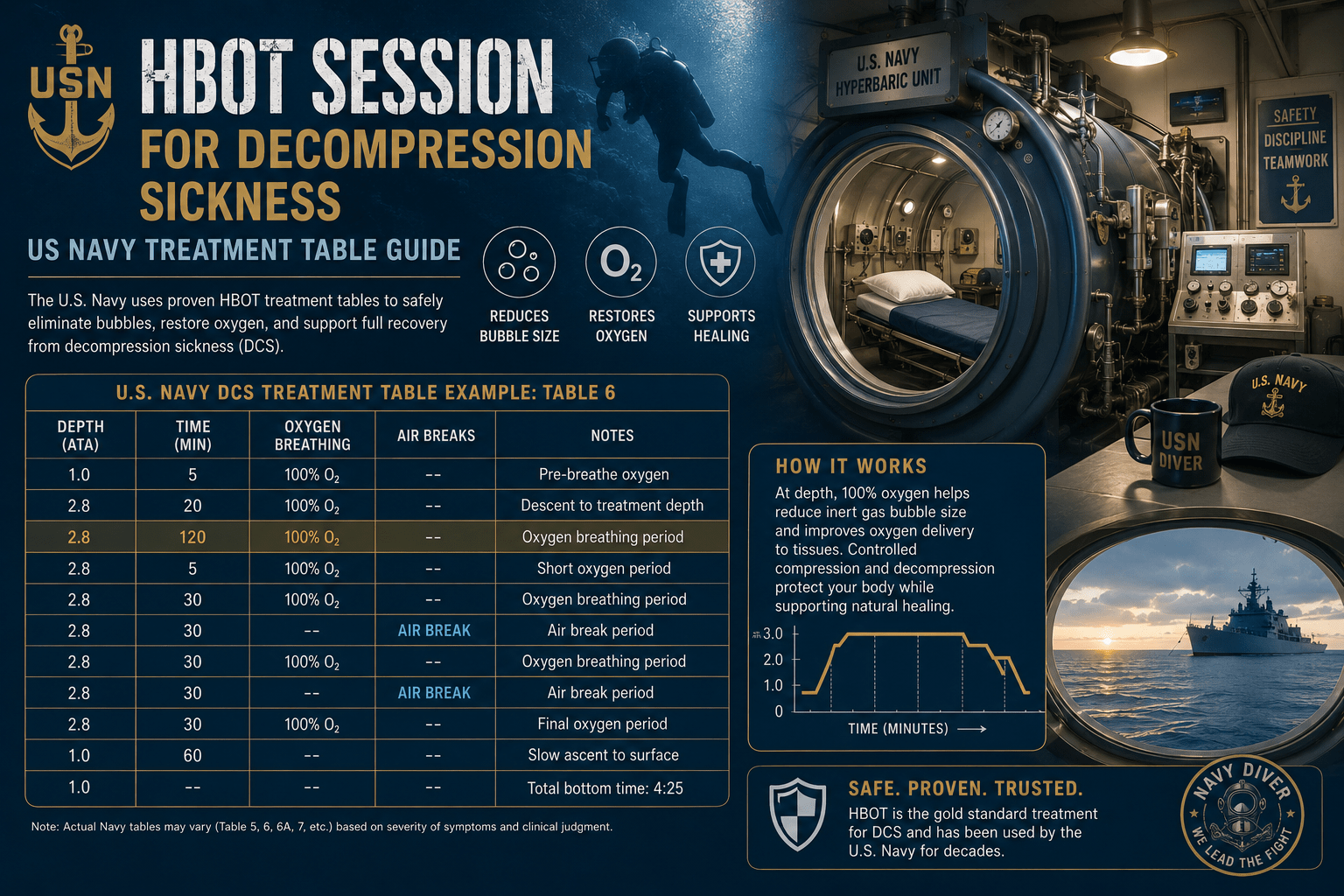
The US Navy Treatment Table 6 is the global standard for DCS. It runs 4 hours and 45 minutes. Every element of the timeline is built around the physics of nitrogen bubble compression and elimination.
| Phase | Duration | Pressure | What Is Happening |
| Descent | ~10 mins | 1.0 → 2.8 ATA | Chamber pressurises. Ears equalise. Nitrogen bubbles begin to compress under Boyle’s Law. |
| Oxygen Period 1 | 20 mins | 2.8 ATA | 100% O₂ breathing. Plasma oxygenation begins. Nitrogen washout accelerates. |
| Air Break 1 | 5 mins | 2.8 ATA | Patient breathes air. Prevents oxygen toxicity accumulation. Bubble compression continues. |
| Oxygen Period 2 | 20 mins | 2.8 ATA | 100% O₂ resumed. Further bubble compression and nitrogen elimination. |
| Air Break 2 | 5 mins | 2.8 ATA | Second rest from O₂. Toxicity risk reset. Chamber holds pressure. |
| Oxygen Period 3 | 20 mins | 2.8 ATA | Third O₂ period. Peak plasma oxygen concentration sustained. |
| Ascent to 1.9 ATA | ~8 mins | 2.8 → 1.9 ATA | Controlled decompression. Bubbles expand slightly but remain sub-occlusive. |
| Oxygen Period 4 | 60 mins | 1.9 ATA | Extended O₂ at reduced pressure. Nitrogen washout from tissue continues. |
| Air Break 3 | 15 mins | 1.9 ATA | Third air break. Allows further nitrogen diffusion from tissue to blood. |
| Oxygen Period 5 | 60 mins | 1.9 ATA | Final extended O₂ period. Tissue nitrogen reaches safe levels for ascent. |
| Ascent to surface | ~30 mins | 1.9 → 1.0 ATA | Slow controlled decompression. Remaining dissolved nitrogen exits safely. |
| Total Session Time | US Navy Treatment Table 6 — standard DCS session: 4 hours 45 minutes. For serious neurological DCS with incomplete response, the table may be extended by one or two additional 25-minute oxygen-air cycles at 1.9 ATA — adding up to 50 minutes. The treating physician decides extension at the 1.9 ATA stage based on symptom response. |
The five oxygen periods are not arbitrary. They are the intervals at which plasma oxygen reaches maximum concentration, drives maximum nitrogen washout from tissue, and compresses maximum bubble volume — with air breaks between them to prevent the oxygen toxicity that sustained exposure would otherwise risk.
Why Each Part of the HBOT Session Is Designed the Way It Is
Why 2.8 ATA — Not Higher, Not Lower
2.8 ATA compresses nitrogen bubbles to approximately 36% of their surface volume — enough to restore blood flow around the remaining bubble and allow tissue oxygenation to begin. Higher pressures increase oxygen toxicity risk without proportional therapeutic benefit for DCS. Lower pressures produce insufficient bubble compression to restore flow in serious neurological DCS.
The physics of bubble compression at different pressures is covered in our article on arterial gas embolism HBOT treatment — which uses the same Boyle’s Law mechanism.
Why the Air Breaks Are Mandatory
Breathing pure oxygen continuously at 2.8 ATA would produce central nervous system oxygen toxicity within approximately 30 minutes in susceptible individuals. The 5-minute air breaks reset the exposure clock — allowing the full oxygen exposure protocol to be delivered safely over the session length required for adequate nitrogen elimination.
The air breaks do not pause treatment. At 2.8 ATA, nitrogen bubble compression continues during air breaks regardless of what the patient is breathing. The breaks solely manage oxygen toxicity risk.
Why the Ascent to 1.9 ATA Is Not the End
The most common misunderstanding about the session is why so much time is spent at 1.9 ATA — 135 minutes — when the bubble compression work happens at 2.8 ATA. The answer is nitrogen elimination from tissue.
Bubble compression restores blood flow. But dissolved nitrogen in blood and tissue still needs to be washed out before the patient can ascend to surface pressure safely. The 1.9 ATA phase allows this washout at a pressure where oxygen can continue to accelerate it — without re-expanding bubbles to their original size.
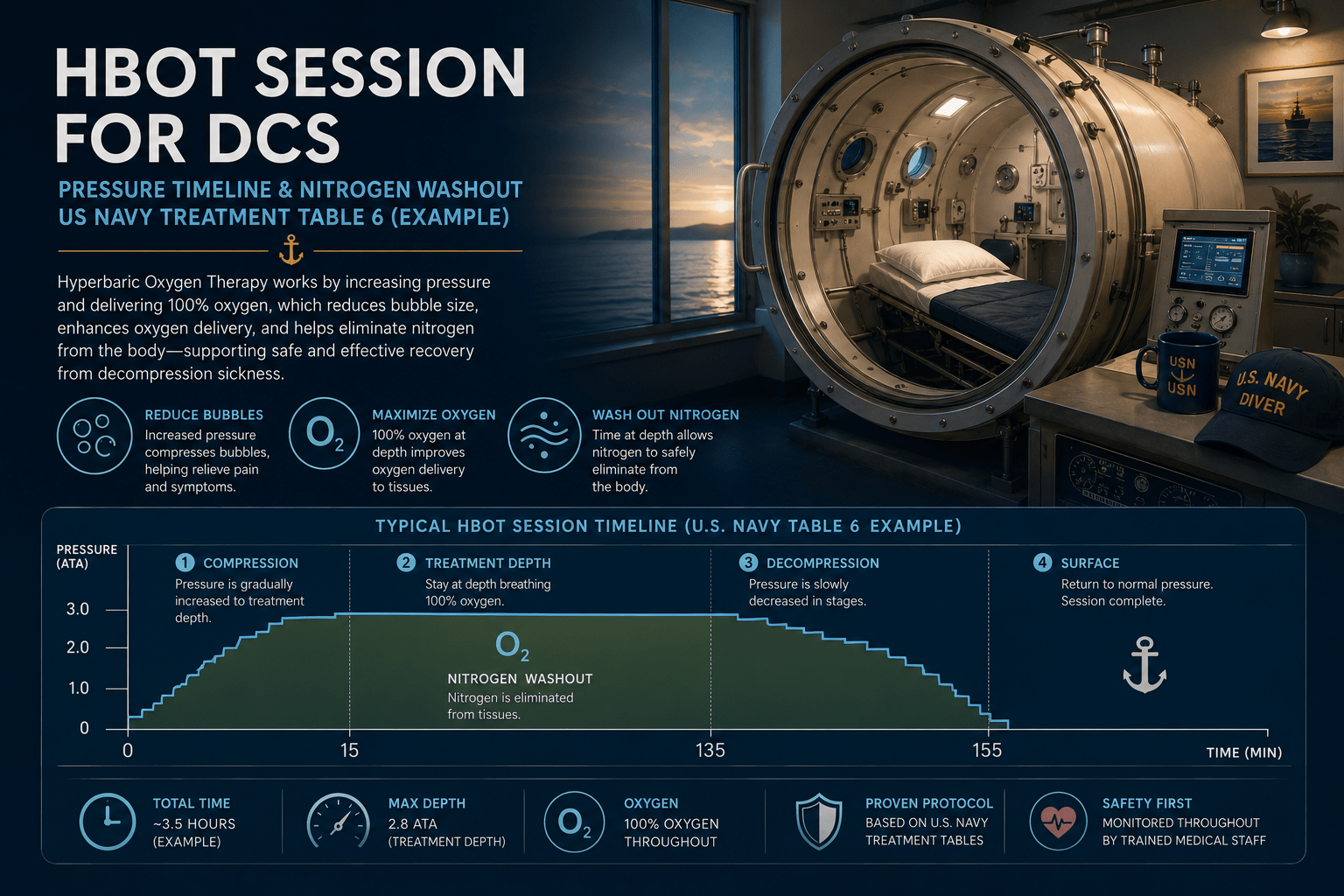
hbot session dcs — pressure timeline nitrogen washout US Navy Table 6 decompression sickness
After the HBOT Session — What to Expect
Immediate Post-Session
Most DCS patients notice symptom improvement during the session itself — often within the first 20 to 30 minutes at 2.8 ATA. Full resolution of symptoms in a single session is achievable for Type I DCS (pain-only) and mild Type II cases. Neurological DCS typically requires multiple sessions for full recovery.
How Many Sessions Are Needed
- Type I DCS (joint pain, skin) — typically 1 to 2 sessions; most cases resolve fully
- Type II DCS (neurological) — typically 3 to 5 sessions; some complex cases require more
- Residual neurological deficits — additional sessions on standard US Navy Table 6A or Table 9 protocol; assessed after initial course
- Delayed presentation (24+ hours) — longer course required; improvement still documented up to 24 hours post-symptom onset
Between Sessions
Rest, hydration, and no diving are the requirements between sessions. Alcohol must be avoided — it impairs nitrogen elimination. Physical exertion should be limited. Symptoms should be monitored and any new or worsening symptoms reported immediately to the treating team.
For guidance on how long overall results take across conditions, see our article on how long HBOT results take.
HBOT Sessions for DCS in India — What Indian Divers Need to Know
The Andaman Islands, Lakshadweep, and India’s growing coastal dive sites produce DCS cases that require emergency hyperbaric treatment. The critical gap is time — the nearest chamber to most Indian dive sites requires transport measured in hours, not minutes.
For Indian divers, the pre-dive protocol is as important as the post-DCS response. Know the nearest chamber. Know the transport time. Carry a non-rebreather mask and oxygen. And know that symptom improvement on the surface does not mean bubble resolution — the session is still needed.
For HBOT facility locations in India, see our guides to HBOT in Delhi and HBOT in Bangalore. For a national facilities guide, see our HBOT near me India guide.
Frequently Asked Questions
Can I eat before an HBOT session for DCS?
Light meals are acceptable. Heavy meals should be avoided in the 2 to 3 hours before a session — they increase nausea risk during pressurisation. For emergency DCS sessions where the patient has recently eaten, the treating team makes a clinical judgement. DCS is an emergency — the session should not be delayed for meal timing except in cases of significant risk.
What does pressurisation feel like?
The descent phase — approximately 10 minutes — produces the same ear pressure sensation as aircraft descent. The equalisation technique (swallowing, yawning, or Valsalva manoeuvre) manages this comfortably in most patients. Chamber staff guide first-time patients through this before the session begins. The pressure sensation stops once the target depth is reached and does not continue during the main treatment phases.
Can I sleep during the session?
Yes. Many patients sleep during the extended oxygen periods at 1.9 ATA. Sleeping does not reduce treatment efficacy — the physiological processes of nitrogen washout and bubble compression continue regardless of consciousness. Chamber staff monitor patients throughout and can wake them for air breaks and ascent phases.
What if my symptoms return after the session?
Symptom recurrence after initial improvement — sometimes called the ‘slide back’ phenomenon — can occur in neurological DCS, typically within 12 to 24 hours of the first session. This is a known response that indicates additional sessions are needed, not treatment failure. Any return or worsening of symptoms after an HBOT session should be reported immediately to the treating team.
Is there a difference between monoplace and multiplace chambers for DCS?
For standard DCS treatment, both chamber types deliver equivalent outcomes when operated at the correct pressure and duration. Multiplace chambers allow a trained inside attendant — important for patients who are seriously unwell, paediatric patients, or those requiring active medical management during the session. Monoplace chambers are effective for stable patients. The treating team selects the appropriate chamber based on patient status, not preference.
The Session Is Precise. That Precision Is What Saves Tissue.
Nothing in the US Navy Treatment Table 6 is arbitrary. The pressure. The duration. The alternating oxygen and air periods. The two-stage ascent. Each element exists because the physics and biology of nitrogen bubble elimination demand it.
A diver who understands what the HBOT session involves makes better decisions — faster decisions — when symptoms appear. They do not wait to see if things improve. They do not cut the session short when they start feeling better. They know why four hours and forty-five minutes is the minimum, not the maximum.
The session works because the protocol is followed exactly. That is the knowledge that protects neurological outcomes.
For the full decompression sickness treatment evidence, visit our guide on decompression sickness HBOT treatment. For the safety profile of HBOT for divers, see our article on is HBOT safe for divers. For the full conditions evidence base, see our HBOT conditions reference.
Know the protocol. Know the timing. Know the nearest chamber.