
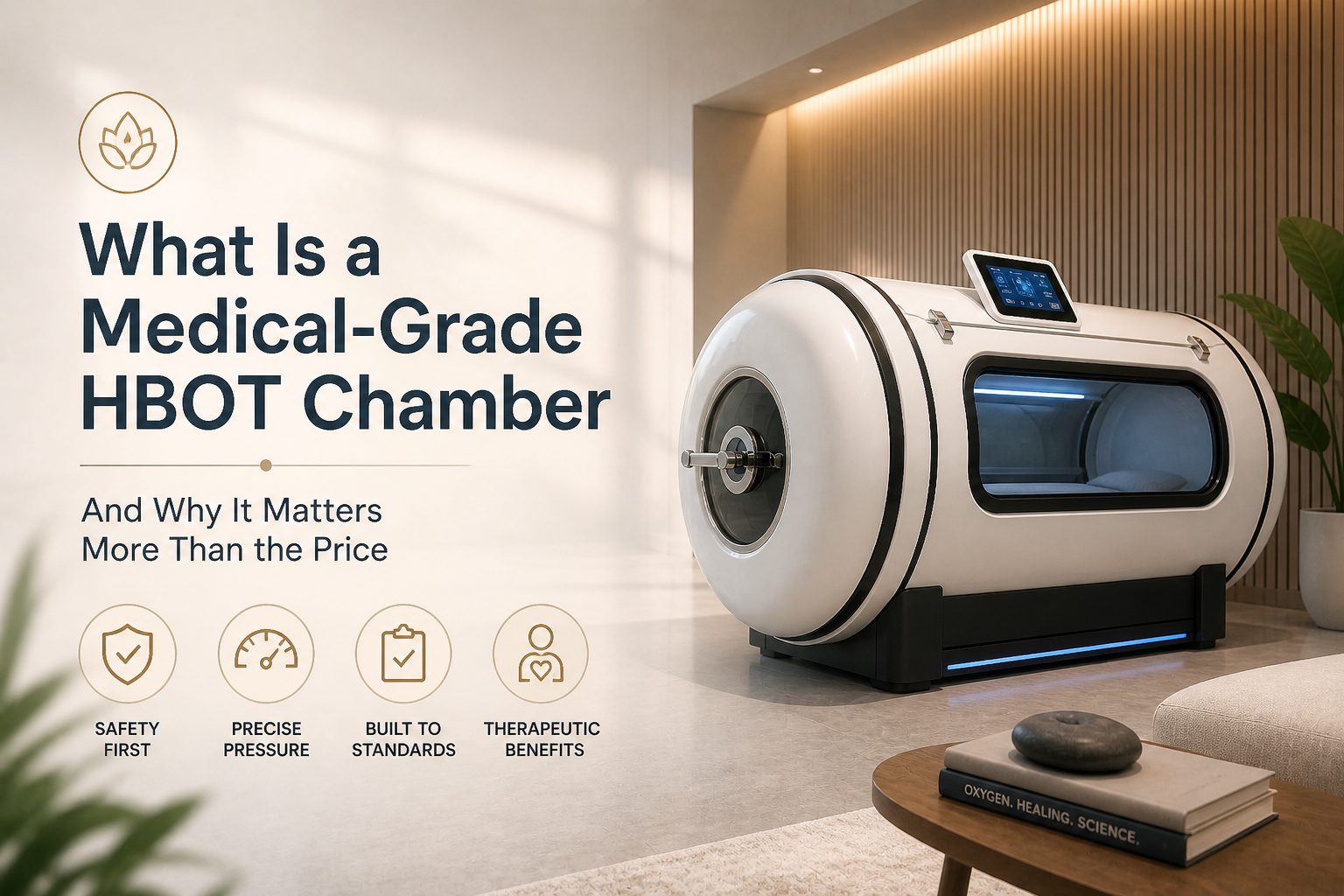
What Is Medical-Grade HBOT — And Why the Cost Gap Is Real
“Not all HBOT chambers are the same. The pressure a chamber reaches determines everything about what it can and cannot do inside your body. HBOT machine cost in India varies significantly based on capability—not margin.”
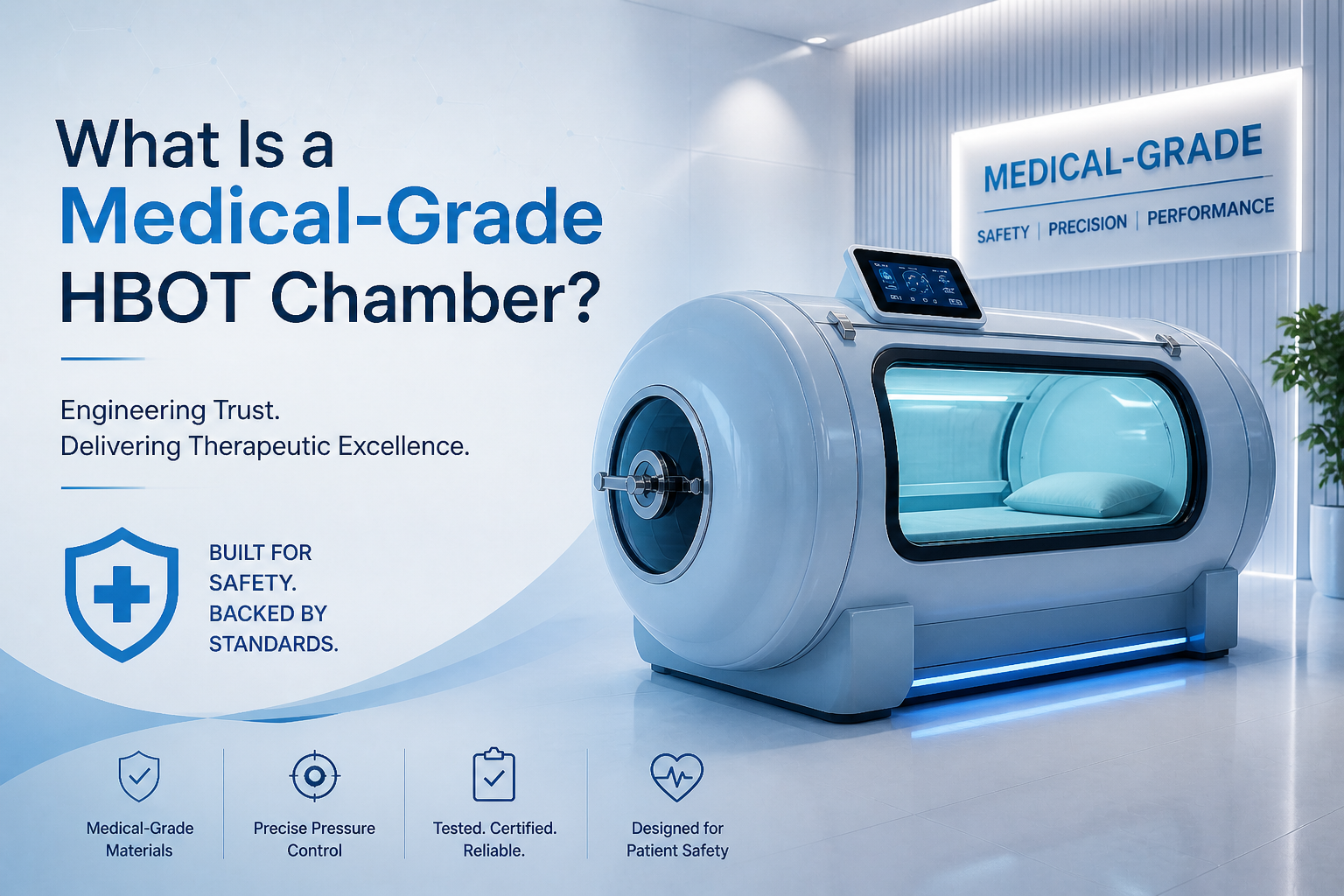
what is medical grade hbot chamber — hyperbaric oxygen therapy pressure vessel standards India
You are looking at HBOT options. The prices vary wildly. Nobody is explaining why.
Two chambers. Both called HBOT. One costs ₹8 lakh. One costs ₹40 lakh. The seller of the cheaper one tells you the results are the same. You have no framework to evaluate that claim — and that is the actual problem.
This is not a conversation about brand names or country of origin. It is a conversation about pressure — because pressure is the only variable that determines whether oxygen dissolves into your blood plasma at levels that produce the biological outcomes the research describes.
Before you book a session or evaluate a chamber purchase, one framework matters above everything else: what does “medical grade” actually mean — and how do you know whether the chamber in front of you meets that standard?
“A chamber that cannot reach 2.0 ATA cannot deliver the science. That is not an opinion. That is physics.”
What “Medical Grade” Actually Means in HBOT
The term “medical grade” is used freely in the HBOT market. It rarely comes with a definition. Here is a precise one.
A medical-grade HBOT chamber is a pressure vessel that can reach and sustain a minimum of 2.0 atmospheres absolute (ATA) of pressure, deliver 100% pure oxygen to the occupant throughout the session, and meet structural and safety certifications appropriate for a pressurised clinical or wellness environment.
Each element of that definition matters. None of it is arbitrary.
It Starts With Pressure Capability
Atmospheric pressure at sea level is 1.0 ATA. At 2.0 ATA, you are breathing in an environment at twice that pressure. At that level, oxygen no longer relies solely on red blood cells to move through the body. It dissolves directly into blood plasma — a process that does not occur in meaningful quantities at lower pressures.
This plasma dissolution is the mechanism that drives HBOT’s clinical outcomes. Thom SR (Plastic and Reconstructive Surgery, 2011) established the mechanism clearly: it is the increase in dissolved plasma oxygen — not simply elevated breathing oxygen — that activates the cascade of wound healing, angiogenesis, stem cell mobilisation, and anti-inflammatory responses that HBOT produces.
A chamber that cannot reach and sustain 2.0 ATA cannot initiate this mechanism at therapeutic levels. The outcome claims associated with clinical HBOT do not apply to it.
Oxygen Delivery System — Pure O₂ vs Pressurised Air
The second element is what the patient breathes inside the chamber. Medical-grade HBOT delivers 100% pure oxygen. Some chambers pressurise the environment with ambient air — which is 21% oxygen — rather than pure oxygen.
Gill and Bell (QJM: An International Journal of Medicine, 2004) documented the distinction clearly: the therapeutic oxygen partial pressure required for plasma dissolution is achieved when 100% oxygen is delivered at 2.0 ATA. Ambient air at the same pressure produces a fraction of that partial pressure and does not replicate the clinical mechanism.
This is why two chambers at the same pressure — one delivering pure oxygen, one pressurising with air — can produce fundamentally different physiological outcomes.
Structural Certification
A pressure vessel is a sealed container holding gas at pressures substantially above ambient. Chamber shells that are not engineered and certified as pressure vessels carry structural risk — deformation, seal failure, or catastrophic pressure release under sustained use.
Medical-grade chambers carry pressure vessel certification — which means the shell, valves, seals, and pressure management systems have been independently evaluated against engineering standards. This is the baseline for any chamber used in a clinical or commercial wellness setting.
The Five Criteria That Define a Medical-Grade HBOT Chamber
Fife CE et al. (Plastic and Reconstructive Surgery, 2016) — a systematic review of appropriate clinical HBOT — outlines the equipment standards on which reliable outcomes depend. The five criteria below translate that clinical framework into practical evaluation terms.
| # | Criterion | What It Means | Why It Matters |
| 1 | Maximum ATA Reached and Sustained | The chamber must reach 2.0 ATA and hold that pressure for a full 90-minute session without pressure bleed. | Plasma oxygen dissolution — the mechanism behind therapeutic outcomes — occurs at 2.0 ATA or above. |
| 2 | Oxygen Delivery System | Pure 100% oxygen must be delivered — not pressurised ambient air. | Ambient air is only 21% oxygen. Pure O₂ at pressure drives the biological response. |
| 3 | Pressure Vessel Certification | The chamber must be a certified pressure vessel meeting structural standards. | Uncertified shells risk deformation or failure under pressure. |
| 4 | Monitoring and Safety Systems | Continuous pressure monitoring, emergency release, O₂ sensors, operator control. | Without monitoring, the system cannot respond to failure or patient distress. |
| 5 | Operator Training and Service Infrastructure | Training, calibration schedules, and ongoing maintenance support. | Unmaintained chambers degrade silently over time. |
Every criterion on this list is verifiable. You can ask a facility or supplier for documentation on each one. A qualified provider will answer without hesitation.
Why This Matters for the Outcome You Are Paying For
The clinical protocols behind HBOT’s most significant research findings specify exact chamber parameters. These are not general guidelines — they are the conditions under which the outcomes were measured.
Efrati S et al. (Aging, 2020) demonstrated 38% telomere lengthening and 37% reduction in senescent T cells after 60 sessions at 2.0 ATA — the most significant longevity evidence in the HBOT field to date. The protocol required a hard chamber reaching and sustaining 2.0 ATA for 90 minutes per session. As our article on
whether HBOT can reverse biological age whether HBOT can reverse biological age explains, the findings of that study do not apply to chambers operating below that pressure threshold.
Boussi-Gross R et al. (PLoS ONE, 2013) showed measurable improvement in post-concussion syndrome years after mild traumatic brain injury — using hard chamber HBOT at 1.5 ATA. The outcomes were pressure-specific and protocol-specific. A chamber that reaches 1.3 ATA is not delivering the intervention that produced those results.
This is not a nuance. It is the central issue in HBOT evaluation. The research is real. The results are documented. The chamber has to be the right chamber — or the research does not apply.
A question forming? Most people reading this have a specific situation in mind — a facility they are considering, a chamber they have been quoted on, a question their seller could not answer clearly. If that is you, the fastest way to get a straight answer is to ask us directly. No sales pitch. Just a clear answer.
What HBOT Machine Cost Is Actually Telling You
HBOT chambers in India range from approximately ₹6 lakh to ₹45 lakh. That range is not arbitrary — it reflects genuine capability differences. Understanding what drives cost tells you what you are actually comparing.
Compressor Quality and Pressure Sustain Duration
The compressor is the core of the chamber’s pressure system. A high-specification compressor reaches 2.0 ATA quickly and holds it without pressure bleed across a 90-minute session. A lower-specification compressor may reach nominal pressure but lose it gradually — reducing the effective oxygen partial pressure during the session without triggering any visible alert.
Shell Material and Certification
Certified pressure vessel shells are constructed from materials specified for sustained high-pressure environments — typically high-strength acrylic or steel depending on chamber type. The engineering, welding, sealing, and testing of these shells carries cost. Uncertified alternatives reduce that cost at the expense of the structural guarantee.
Oxygen Delivery System Components
Pure oxygen delivery requires an oxygen supply system — either an onsite concentrator producing medical-grade oxygen or a cylinder supply — plus a delivery circuit, flow regulation, and mask or hood system rated for hyperbaric use. These components add to chamber cost but are not optional if the chamber is to deliver the mechanism that the research describes.
Service and Calibration Infrastructure
A medical-grade chamber requires scheduled calibration, pressure testing, seal maintenance, and oxygen system servicing. Bhutani and Vishwanath (Indian Journal of Plastic Surgery, 2012) noted in their review of HBOT in India that consistent therapeutic outcomes depend on equipment that is regularly maintained to its clinical specification. A chamber with no service infrastructure will drift from its rated performance over time.
When you see a significant price gap between two chambers both described as HBOT, you are most likely looking at a gap in one or more of these four areas. Price is not a guarantee of quality — but a dramatically lower price is almost always a signal of a compromised capability.
Three Questions to Ask Before You Book or Buy
These three questions are verifiable. Any qualified facility or supplier can answer all three without hesitation. If any answer is unclear, incomplete, or deflected — that is important information.
- What is the maximum ATA this chamber reaches — and can it sustain that pressure for a full 90-minute session without pressure loss?
This is the single most important question. Ask for a specific number. 1.3 ATA and 2.0 ATA are not interchangeable — and you now know why.
- Does this chamber deliver 100% pure oxygen, or does it pressurise the environment with ambient air?
If the answer is ambient air, the chamber is not delivering the mechanism that clinical HBOT research describes. It may have wellness applications — but it is not medical-grade HBOT.
- What certifications does this chamber hold — and can you provide documentation?
Pressure vessel certification, CE marking, or equivalent national certification should be available in documentation. If a supplier cannot produce it, the certification does not exist.
Understanding how HBOT works at a cellular level — and why pressure is the mechanism, not a setting — gives these questions their full weight. Our guide to
how HBOT works inside the body how HBOT works inside the body covers the plasma dissolution mechanism in full.
Frequently Asked Questions
1. What is the difference between a hard chamber and a soft chamber?
2. Is a more expensive HBOT chamber always better?
3. How do I know if an HBOT facility in India is using a medical-grade chamber?
4. Does it matter which condition I am using HBOT for?
The Chamber Is Not the Treatment. The Pressure Is.
Every claim you will read about HBOT — the wound healing data, the neuroplasticity findings, the longevity research — was produced in chambers that met specific pressure, oxygen delivery, and session parameters. The science does not transfer automatically to any device marketed with the same name.
A medical-grade HBOT chamber delivers 2.0 ATA of sustained pressure, 100% pure oxygen, and certified structural integrity. That combination is not a premium feature. It is the minimum requirement for the mechanism to work.
You now have the five criteria and the three questions. That is the framework. Use it before you commit to anything.
Not sure if what you have been told adds up? If you are evaluating an HBOT provider or chamber and want a second opinion on what you have been told — we are here.


Subscribe
4 Comments
Comments are closed.
[…] medical-grade HBOT chambers actually require what medical-grade HBOT chambers actually require explains, pressure alone is not sufficient. The chamber must deliver pure oxygen — not […]
[…] For the complete framework behind these standards — what medical grade actually means and the five criteria that define it — read our guide to what makes an HBOT chamber medical-grade. […]
[…] For the full picture of what makes a chamber capable of delivering that mechanism — the five criteria and why each one matters — read our guide to what a medical-grade HBOT chamber requires. […]
[…] drives chamber cost what drives chamber cost makes the price signal […]