
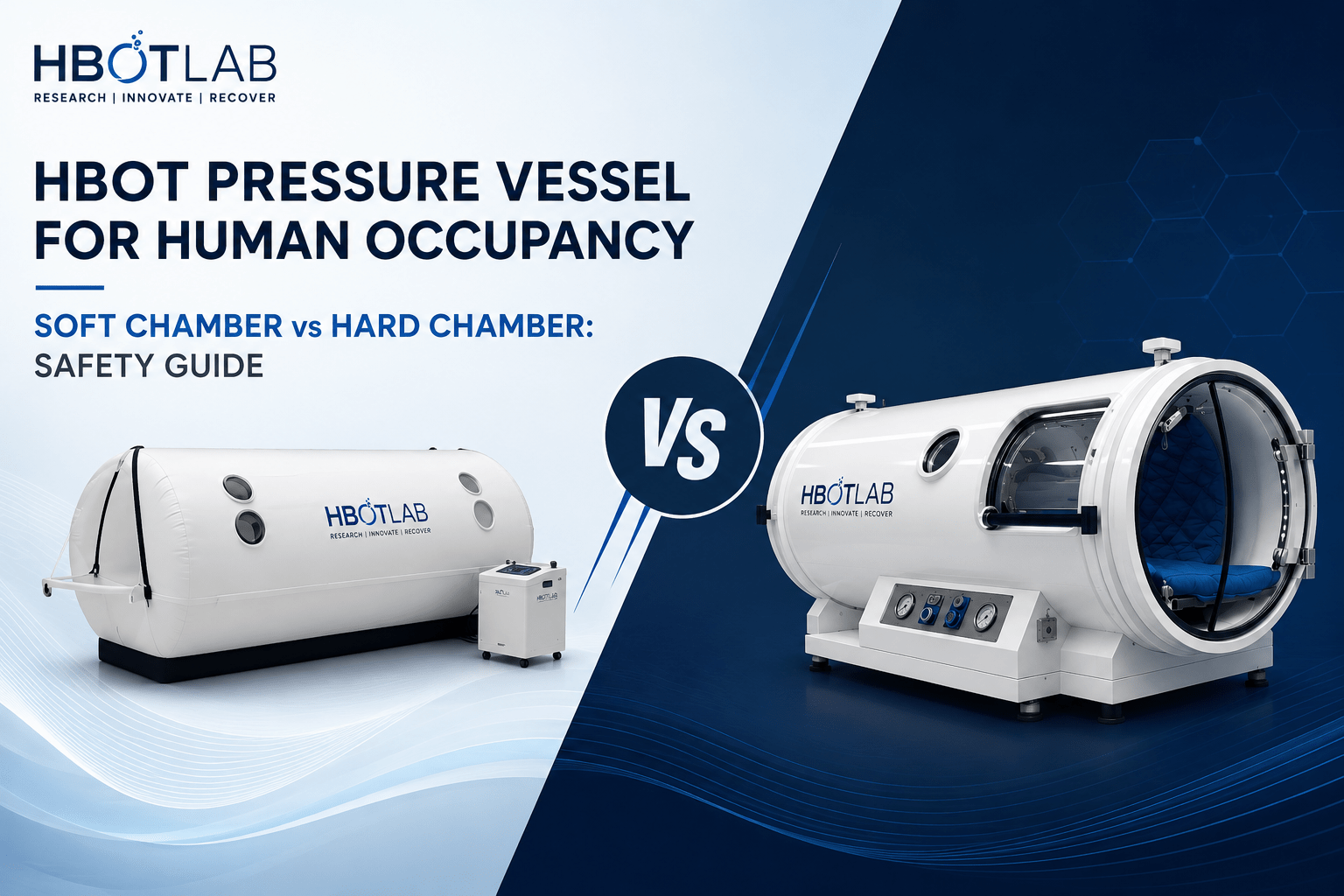
HBOT pressure vessel for human occupancy Soft Chamber vs Hard Chamber: Safety Guide
An HBOT soft chamber and a certified hard chamber are two structurally different things. The choice between them is not about preference or budget — it is about engineering, certification, and what the chamber is actually built to withstand.
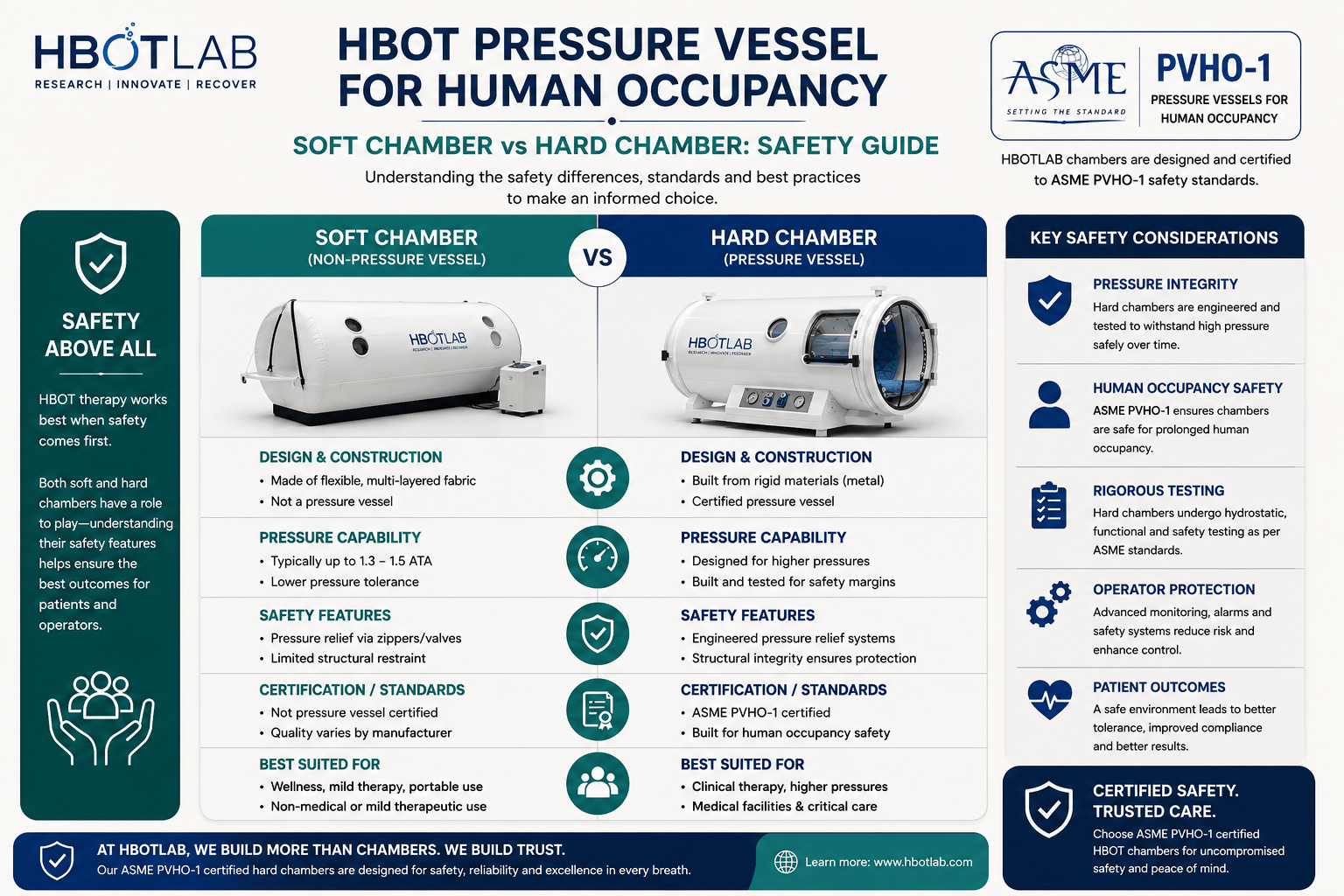
hbot soft chamber versus hard chamber safety comparison india
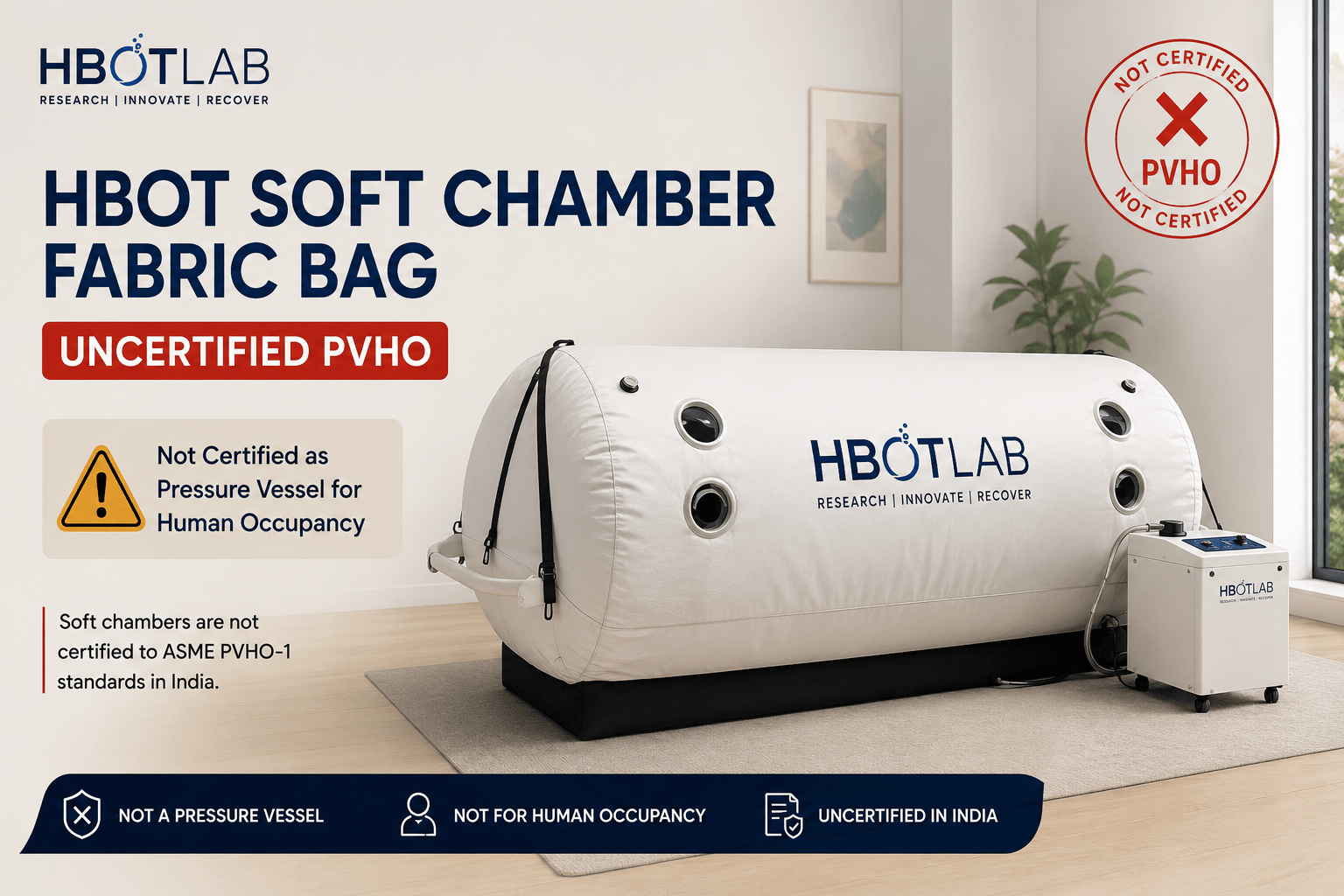
hbot soft chamber fabric bag uncertified pvho india
| HBOT soft chamber pressure vessel for human occupancy : A flexible fabric enclosure pressurised to between 1.3 and 1.5 atmospheres absolute (ATA), typically using compressed air rather than pure oxygen. Not built to ASME PVHO-1 certification standards. Used for mild wellness applications at lower pressures. |
If you are booking HBOT in India and nobody has told you which type of chamber you are entering, that conversation needs to happen before you close the door.
The price difference between an HBOT soft chamber and a hard chamber is real as they are pressure vessel for human occupancy. So is the engineering difference. Most people in India are only told about one of them.
What an HBOT Soft Chamber pressure vessel for human occupancy (PVHO) Is
An HBOT soft chamber is a fabric-walled inflatable enclosure. It operates at mild pressure — typically 1.3 to 1.5 ATA — and uses compressed air, sometimes supplemented by an oxygen concentrator.
Soft chambers are lighter, portable, and significantly cheaper than hard chambers. These qualities have driven their adoption across wellness centres, home-use markets, and lower-cost clinics.
Some soft chambers carry FDA 510(k) registration in the US as Class II medical devices under product code CBF, cleared for specific indications at mild pressure. In India, imported chambers require CDSCO MD-15 clearance.
What an HBOT soft chamber is not
An HBOT soft chamber is not ASME PVHO-1 certified. PVHO-1 is the engineering standard that governs the design, fabrication, and testing of Pressure Vessels for Human Occupancy. Hard chambers are built to this standard. Legitimate soft chamber manufacturers do not claim otherwise.
The US National Fire Protection Association’s NFPA 99 (2024 edition) states explicitly that many commercially available soft chambers — even those with FDA registration — do not meet NFPA 99 Chapter 14 requirements and are not designed, fabricated, or certified to ASME PVHO-1.
This is not a loophole. A soft chamber at 1.3 ATA carries different structural demands than a hard chamber at 2.4 ATA. But different demands is not the same as no demands — and the absence of independent structural certification is a real safety distinction.
For the full explanation of what PVHO certification requires and why it exists, our HBOT PVHO chamber safety guide covers the complete standard.
What a Hard HBOT Chamber Delivers That a Soft Chamber Cannot
A hard HBOT chamber is a rigid steel or acrylic pressure vessel engineered to ASME PVHO-1, operating at 1.5 to 3.0 ATA with pure medical-grade oxygen.
Every FDA-recognised HBOT indication — from decompression sickness and carbon monoxide poisoning to diabetic foot ulcers and necrotising fasciitis — is validated at pressures achievable only in a certified hard chamber (Fife CE et al., Plast Reconstr Surg, 2016). The evidence base for HBOT was built on hard chambers at therapeutic pressure.
Five things hard chambers provide that soft chambers do not
- Operating pressure of 2.0 to 3.0 ATA — required for all clinically recognised HBOT indications.
- 100% medical-grade oxygen delivery — not compressed air at mild enrichment.
- ASME PVHO-1 certification — independent structural verification at every stage of fabrication.
- NFPA 99 compliance — the fire safety standard applied to hospital-grade hyperbaric facilities.
- ASME PVHO-2 maintenance records — mandatory documented inspection history on a regulated schedule.
To understand what separates clinical-grade from wellness-grade equipment in practical terms, what is a medical-grade HBOT chamber explains the distinction clearly.
When Soft Chambers Fail: What the India Incident Tells Us
In September 2024, a soft-sided bag chamber ruptured while occupied in India. The incident is documented by the Undersea and Hyperbaric Medical Society (UHMS). The occupant was not attended and did not receive evaluation by a hyperbaric specialist after the rupture.
In January 2025, a hard chamber fire at the Oxford Center in Troy, Michigan killed five-year-old Thomas Cooper. Four staff members — including the CEO — face second-degree murder charges. Michigan’s Attorney General described fires inside hyperbaric chambers as terminal events.
On 25 August 2025, the US FDA issued a formal letter to all healthcare providers citing fires, injuries, and deaths linked to HBOT devices. The UHMS responded in full support, explicitly referencing ASME PVHO-1 and NFPA 99 Chapter 14 as the standards that govern safe chamber operation.
Two different chamber types. Two different failure modes. The same underlying point: the structure around a person under pressure must be independently verified — not assumed based on cost or appearance.
Hard vs HBOT Soft Chamber: An Honest Side-by-Side
Pressure range
HBOT soft chamber: 1.3 to 1.5 ATA. Hard chamber: 1.5 to 3.0 ATA. Higher pressure is not a luxury upgrade — it is the clinical requirement for every recognised HBOT indication.
Oxygen delivery
Soft chambers use compressed air, sometimes with an oxygen concentrator raising the percentage. Hard chambers deliver 100% medical-grade oxygen. The therapeutic mechanism of HBOT — dissolving oxygen into blood plasma — depends on both high pressure and high oxygen concentration together.
Structural certification
Hard chambers: ASME PVHO-1 certified, pressure-tested, third-party verified. HBOT soft chambers: not PVHO-1 certified. This does not mean poorly made — it means not independently verified to the engineering standard for pressurised human occupancy.
Clinical use cases
Soft chambers suit mild wellness applications where lower pressure is appropriate and agreed between patient and provider. Hard chambers are required for all medical indications, all hospital protocols, and any supervised clinical setting.
Cost signal
A significantly lower session price at an Indian clinic almost always signals an HBOT soft chamber rather than a certified hard chamber. The cost difference exists because the engineering, certification, and maintenance requirements are genuinely different.
For a clear explanation of what drives chamber pricing in India, HBOT chamber cost in India — why cheap costs more breaks down the economics.
Three Questions to Ask Your Clinic Before Booking
One: Is this an HBOT soft chamber or a certified hard chamber?
Ask directly. A clinic running a hard chamber will say so clearly and can show documentation. If the response is evasive or reframes the question, that is meaningful information.
Two: Is the chamber ASME PVHO-1 certified?
Ask for the documentation. The ASME stamp should be on the chamber itself. If the operator does not know what ASME PVHO-1 means, proceed with serious caution.
Three: When was the chamber last inspected?
ASME PVHO-2 mandates a documented maintenance schedule. A chamber with no inspection record within the past 12 months is a chamber whose safety status is unverified — regardless of what the marketing says.
Run through every verification point with the HBOT chamber checklist for India before confirming any provider.
For the full side effect and safety profile of HBOT in certified settings, HBOT side effects explained — is hyperbaric oxygen therapy safe gives a complete, honest picture.
FAQ: HBOT Soft Chamber vs Hard Chamber
Which is better — an HBOT soft chamber or a hard chamber?
For all medically recognised indications, a certified hard chamber at 2.0 to 3.0 ATA is the appropriate choice. For mild wellness applications at lower pressure, soft chambers are used by some providers. The right answer depends on your goal and whether it requires therapeutic pressure or mild pressure.
Is an HBOT soft chamber safe?
HBOT soft chambers at their intended pressure range carry lower structural demands than hard chambers at high ATA. However, they are not ASME PVHO-1 certified. The 2024 India rupture incident involved a soft bag chamber. Safety depends on the specific product, the operator’s training, and how the chamber is used.
Can an HBOT soft chamber deliver the same results as a hard chamber?
No. The therapeutic mechanism of HBOT for clinically recognised indications requires dissolving oxygen into blood plasma at pressures above 1.5 ATA with 100% oxygen. An HBOT soft chamber at 1.3 to 1.5 ATA using compressed air cannot replicate this. Any benefit from mild-pressure sessions is a different physiological proposition from the evidence base supporting clinical HBOT.
How do I know which type of chamber a clinic in India uses?
Ask directly: is this a hard chamber or an HBOT soft chamber? Is it ASME PVHO-1 certified? A legitimate operator answers both questions clearly and can provide documentation. If they cannot, that is your answer.
Are HBOT soft chambers legal in India?
Imported HBOT soft chambers require CDSCO MD-15 clearance for the device to enter India legally. This covers the import process but does not mandate ASME PVHO-1 certification. Legal to import and certified to the engineering standard for human occupancy are two different things.
The Straightforward Answer on HBOT Soft Chamber vs Hard Chamber
An HBOT soft chamber and a hard chamber are not the same device using different packaging.
They operate at different pressures. They deliver oxygen differently. They are certified to different standards — or in the case of soft chambers, not certified to the PVHO standard at all.
The clinical evidence for HBOT was built on hard chambers at therapeutic pressure. The safety certification framework was built around hard chambers at therapeutic pressure. That history matters.
You deserve to know which type of chamber you are entering, what it is certified to, and what that means for your session. Ask before you book. Know before you enter.



One Comment
Comments are closed.


[…] understand the specific structural differences between certified and uncertified chambers, hard vs HBOT soft chamber — the safety truth breaks down exactly what you are […]