
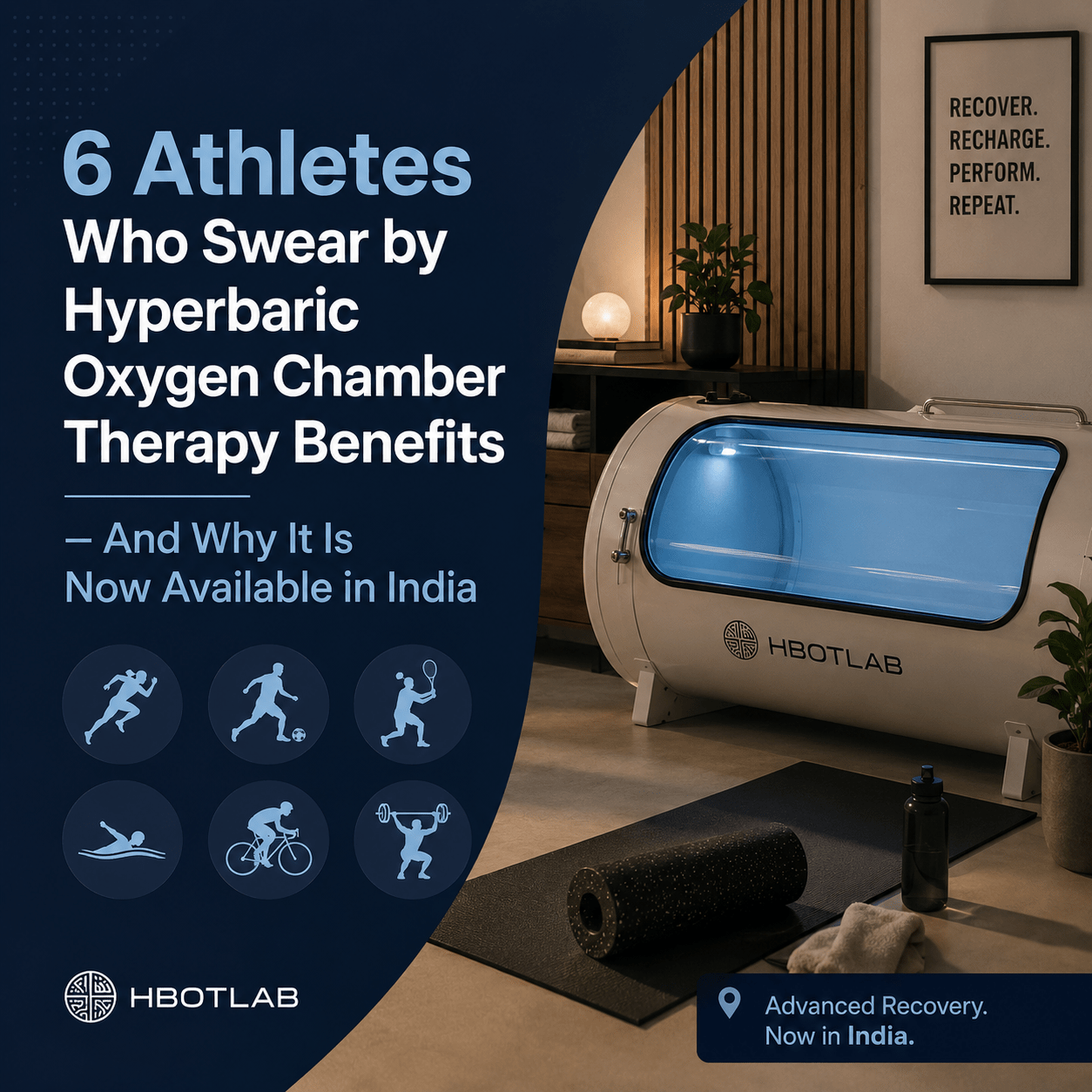
6 Athletes Who Swear by hyperbaric oxygen chamber therapy benefits — And Why It Is Now Available in India
The world’s greatest athletes don’t recover by accident. They recover by design. And HBOT is now central to that design.
The gap between elite and ordinary is not just talent. It is recovery.
The best athletes in the world train harder than anyone. But the reason they can sustain that training — across seasons, across decades — is not just fitness. It is how quickly and completely their bodies recover between sessions. And recovery, at the elite level, is now a science.
Hyperbaric oxygen chamber therapy benefits have become central to that science. At least 6 of the world’s most recognised athletes use hyperbaric oxygen therapy as a structured part of their recovery protocols. Here is who they are, why they use it, and what the peer-reviewed research says about the mechanisms behind it.
Why Elite Athletes Are All Using the Same Recovery Tool
Hyperbaric oxygen therapy — HBOT — is a treatment in which a person breathes pure oxygen inside a pressurised chamber at 1.5 to 3.0 atmospheres absolute. Under this pressure, oxygen dissolves directly into blood plasma at concentrations far beyond what normal breathing achieves. This plasma-dissolved oxygen reaches tissues that red blood cells cannot adequately supply — including damaged muscle, inflamed joints, and healing connective tissue.
The result is a simultaneous activation of multiple repair mechanisms: reduced inflammation, stem cell mobilisation, new blood vessel growth, and accelerated tissue regeneration. For athletes, these mechanisms translate directly into faster recovery, reduced injury risk, and extended career longevity.
The convergence of HBOT use across football, basketball, tennis, cricket, swimming, and American football is not coincidental. The biology is consistent. For a detailed breakdown of the science, see our guide on how hyperbaric oxygen therapy works.
Athlete 1 — Cristiano Ronaldo (Football)
Cristiano Ronaldo is the most documented celebrity HBOT user in professional sport. He has used hyperbaric oxygen therapy since at least 2016, when ESPN reported that he visited a specialist clinic in Ibiza twice during his recovery from a knee injury sustained in the Euro 2016 final. By 2022, he had installed a custom HBOT chamber as a permanent fixture at his home.
His primary use case is dual: acute injury recovery and ongoing performance maintenance. The biological mechanism most relevant to Ronaldo’s use is HBOT’s effect on wound healing and tissue repair. Research by Eskes et al., published in World Journal of Surgery in 2011, reviewed the evidence base for hyperbaric oxygen in wound and tissue healing, confirming that HBOT accelerates healing through improved oxygenation, reduced infection risk, and enhanced collagen synthesis.
Eskes AM, Ubbink DT, Lubbers MJ, et al. Hyperbaric oxygen therapy: solution for difficult to heal acute wounds? Systematic review. World J Surg. 2011;35(3):535–542. [View Study]
For the full breakdown of the 9 mechanisms behind Ronaldo’s HBOT protocol, read our dedicated article on the 9 hyperbaric oxygen therapy benefits Cristiano Ronaldo trusts.
Athlete 2 — Novak Djokovic (Tennis)
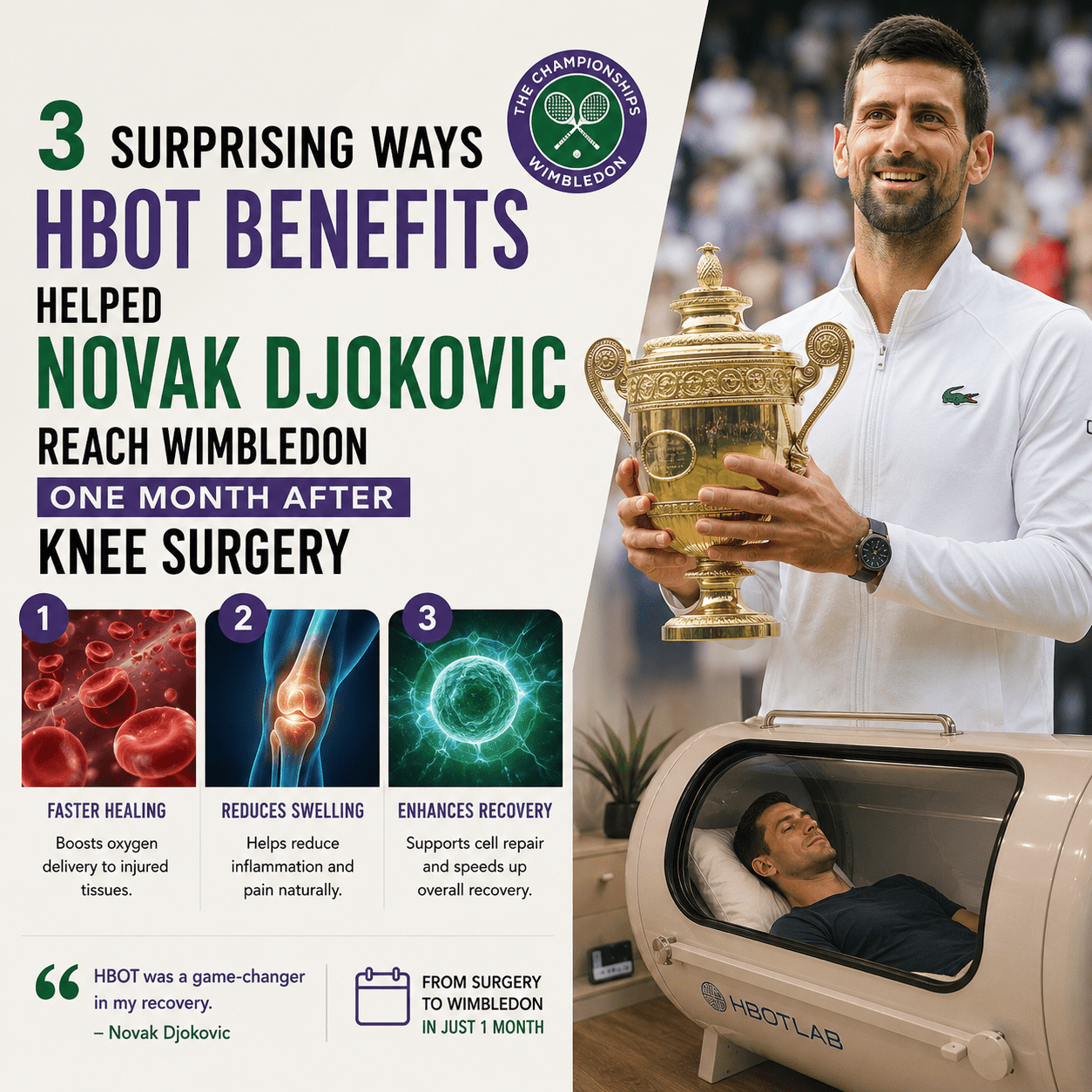
Novak Djokovic brought a personal hyperbaric chamber to the 2019 US Open in a trailer parked near Arthur Ashe Stadium. In 2024, he tore his right medial meniscus during the French Open quarterfinal, underwent emergency surgery in Paris the following morning, and reached the Wimbledon final four weeks later.
HBOT was central to that recovery. The mechanism most relevant to Djokovic’s meniscus repair is HBOT’s anti-inflammatory and vascular effect. Thom SR’s foundational research, published in Plastic and Reconstructive Surgery in 2011, established that HBOT modulates pro-inflammatory cytokines while simultaneously stimulating the vascular growth that accelerates tissue repair in poorly-vascularised structures like cartilage.
Thom SR. Hyperbaric oxygen: its mechanisms and efficacy. Plast Reconstr Surg. 2011;127 Suppl 1:131S–141S. [View Study]
For the complete story of Djokovic’s recovery timeline and the three specific HBOT mechanisms that made it possible, read our article on how HBOT helped Djokovic reach Wimbledon.
Athlete 3 — LeBron James (Basketball)
LeBron James has used HBOT for over a decade. His recovery infrastructure reportedly costs approximately $1.5 million per year and includes daily 90-minute hyperbaric sessions, cryotherapy, nutritional programming, and structured sleep protocols. He continues playing elite-level professional basketball at 41 — an age at which most NBA careers ended decades earlier.
LeBron’s primary use is performance maintenance and career longevity — not acute injury recovery. The mechanism most relevant here is HBOT’s effect on muscle regeneration and inflammation reduction between training sessions. Research by Oyaizu et al., published in Scientific Reports in 2018, demonstrated that HBOT reduces inflammation, oxygenates injured muscle, and regenerates skeletal muscle via macrophage and satellite cell activation — the precise mechanisms that allow an athlete to arrive at each session less fatigued than the one before.
Oyaizu T, Enomoto M, Yamamoto N, et al. Hyperbaric oxygen reduces inflammation, oxygenates injured muscle, and regenerates skeletal muscle via macrophage and satellite cell activation. Sci Rep. 2018;8(1):1288. [View Study]
Athlete 4 — Neymar Jr. (Football)
Neymar Jr. has openly documented his HBOT use across multiple injury recovery periods. His physiotherapist Rafael Martini confirmed that Neymar uses a hyperbaric chamber for up to 90 minutes daily during training periods, and twice daily during injury recovery. He has posted from inside the chamber on Instagram on multiple occasions, with his official club website also covering the practice.
Neymar’s use pattern — daily maintenance sessions plus intensive injury recovery — reflects the most demanding application of HBOT in professional sport. The mechanism underpinning this frequency is stem cell mobilisation. Research by Thom SR et al., published in the American Journal of Physiology in 2006, demonstrated that each HBOT session triggers the release of stem cells from bone marrow into circulation — and that this effect is cumulative across sessions, with daily exposure producing significantly greater mobilisation than intermittent use.
Thom SR, Bhopale VM, Velazquez OC, et al. Stem cell mobilization by hyperbaric oxygen. Am J Physiol Heart Circ Physiol. 2006;290(4):H1378–H1386. [View Study]
Athlete 5 — Michael Phelps (Swimming)
Michael Phelps — 23 Olympic gold medals, the most decorated Olympian in history — used a pressurised recovery environment across multiple Olympic cycles. Phelps told the Associated Press in 2012 that he had been sleeping at altitude-simulated pressure for almost a year leading into the London Olympics. His use of pressurised recovery technology reflects the same biological principle underlying HBOT: increasing oxygen availability to accelerate tissue repair and reduce fatigue accumulation.
The mechanism most relevant to Phelps’s swimming-specific demands is HBOT’s effect on post-exercise recovery at the vascular and cellular level. Fife et al., writing in Plastic and Reconstructive Surgery in 2016, reviewed the evidence base for hyperbaric oxygen across multiple applications, confirming that HBOT’s role in tissue oxygenation, anti-inflammation, and angiogenesis supports faster recovery in athletes with high training volumes.
Fife CE, Eckert KA, Carter MJ. An update on the appropriate role for hyperbaric oxygen: indications and evidence. Plast Reconstr Surg. 2016;138(3 Suppl):107S–116S. [View Study]
Athlete 6 — Rishabh Pant (Cricket — India)
In February 2026, a video of Rishabh Pant using hyperbaric oxygen therapy as part of his IPL 2026 preparation circulated widely across Indian sports media. Pant, who suffered life-threatening injuries in a car accident in December 2022 — including ligament damage, lacerations, and a fractured skull — has made one of the most remarkable recoveries in Indian cricket history.
His documented use of HBOT brings the global athlete recovery conversation directly into the Indian context. The mechanisms that accelerated Ronaldo’s knee recovery, Djokovic’s meniscus repair, and LeBron’s muscle maintenance are the same mechanisms that supported Pant’s return from catastrophic trauma to international cricket.
Pant’s case matters for Indian athletes and fitness enthusiasts because it removes the perception that HBOT is an imported luxury available only to European and American sports stars. The biology is universal. For a breakdown of what to expect from a structured protocol, see our guide on the HBOT results timeline.
What These 6 Athletes Have in Common
Six athletes. Six sports. Six countries. One therapy.
The pattern across Ronaldo, Djokovic, LeBron, Neymar, Phelps, and Pant is consistent. None of them use HBOT as a one-off intervention after a single injury. All of them use it as a structured, repeated protocol — either daily during injury recovery or multiple times per week as ongoing maintenance. The biology demands repetition. Each session builds on the last.
This is why the longevity data from Bryan Johnson’s 60-session protocol is so relevant to understanding what elite athletes are doing. His Bryan Johnson HBOT longevity protocol produced measurable changes in inflammation, vascular biology, and cellular ageing markers — all of which are the same mechanisms these athletes are leveraging for performance. The difference is that Johnson measured them with biomarkers. Athletes measure them with performance data.
For a detailed breakdown of when these benefits begin to accumulate across sessions, read our guide on when HBOT benefits begin.
Hyperbaric Oxygen Chamber Therapy Benefits — The Science Behind the Athletes
Every athlete in this list is leveraging the same five core biological mechanisms. Understanding them helps explain why HBOT produces results across such different sports and such different injury profiles.
Mechanism 1 — Anti-inflammation: HBOT reduces TNF-α and IL-6 cytokine production, creating a controlled anti-inflammatory environment that supports healing without suppressing it. Mechanism 2 — Stem cell mobilisation: Each session releases bone marrow stem cells into circulation. They migrate to injury sites and initiate repair. Mechanism 3 — Angiogenesis: HBOT triggers VEGF production and new capillary formation into poorly-vascularised tissue. Mechanism 4 — Muscle regeneration: Macrophage and satellite cell activation accelerates the clearance of damaged tissue and the synthesis of new muscle fibre. Mechanism 5 — Mitochondrial repair: HBOT preserves mitochondrial membrane integrity, improving cellular energy production and reducing oxidative waste.
All five mechanisms are documented in peer-reviewed research referenced across this article. For the full science, read our foundational guide on what is hyperbaric oxygen therapy.
Now Available in India — What This Means for You
Ronaldo’s home chamber cost tens of thousands of dollars. LeBron’s annual recovery budget exceeds a million. Djokovic travels with his own equipment. These numbers are not the point.
The point is the biology. The hyperbaric oxygen chamber therapy benefits these athletes access are produced by the same mechanisms that operate in every human body. The pressure. The oxygen concentration. The session frequency. These are replicable. And they are now available in India.
Whether you are a professional cricketer, a competitive club athlete, a recreational runner, or simply someone who wants to recover better and perform more consistently — the science that underpins elite athletic recovery is now within reach.
India’s wellness infrastructure is developing rapidly. The therapy that Rishabh Pant used for his IPL 2026 preparation, that Ronaldo uses in his home, that Djokovic brings to Grand Slams — is now organised, accessible, and available through HBOTLAB — India’s first organised wellness HBOT franchise network.
Frequently Asked Questions
Which athletes use hyperbaric oxygen therapy?
Among the most documented users are Cristiano Ronaldo (football), Novak Djokovic (tennis), LeBron James (basketball), Neymar Jr. (football), Michael Phelps (swimming), and Rishabh Pant (cricket). Beyond these six, documented or credibly reported users include Tom Brady, Aaron Rodgers, Russell Wilson, Derrick Henry, Neymar, Marcus Rashford, Serena Williams, Tiger Woods, Lindsey Vonn, and Justin Bieber. HBOT is now sufficiently mainstream in elite sport that the absence of a particular athlete from this list does not mean they do not use it — team recovery protocols often incorporate HBOT without public disclosure.
What are the main hyperbaric oxygen chamber therapy benefits for athletes?
The five primary hyperbaric oxygen chamber therapy benefits for athletes are faster muscle recovery, reduced post-exercise inflammation, accelerated injury healing through angiogenesis and stem cell mobilisation, improved oxygen delivery to muscle tissue, and extended career longevity through cellular repair. Each of these mechanisms is backed by peer-reviewed research. For a detailed breakdown, read our guide on how hyperbaric oxygen therapy works.
Is hyperbaric oxygen therapy available in India?
Yes. HBOT is available in India through a growing number of wellness and clinical providers. HBOTLAB — India’s first organised wellness HBOT franchise network — provides access to structured, protocol-based HBOT sessions across multiple cities. For information on locations, session formats, and what to expect from a structured course, visit HBOTLAB or read our guide on the HBOT results timeline.



One Comment
Comments are closed.
[…] For a broader view of how athletes around the world — including Indian cricketers — are using HBOT, read our article on the 6 athletes who use hyperbaric oxygen therapy. […]