
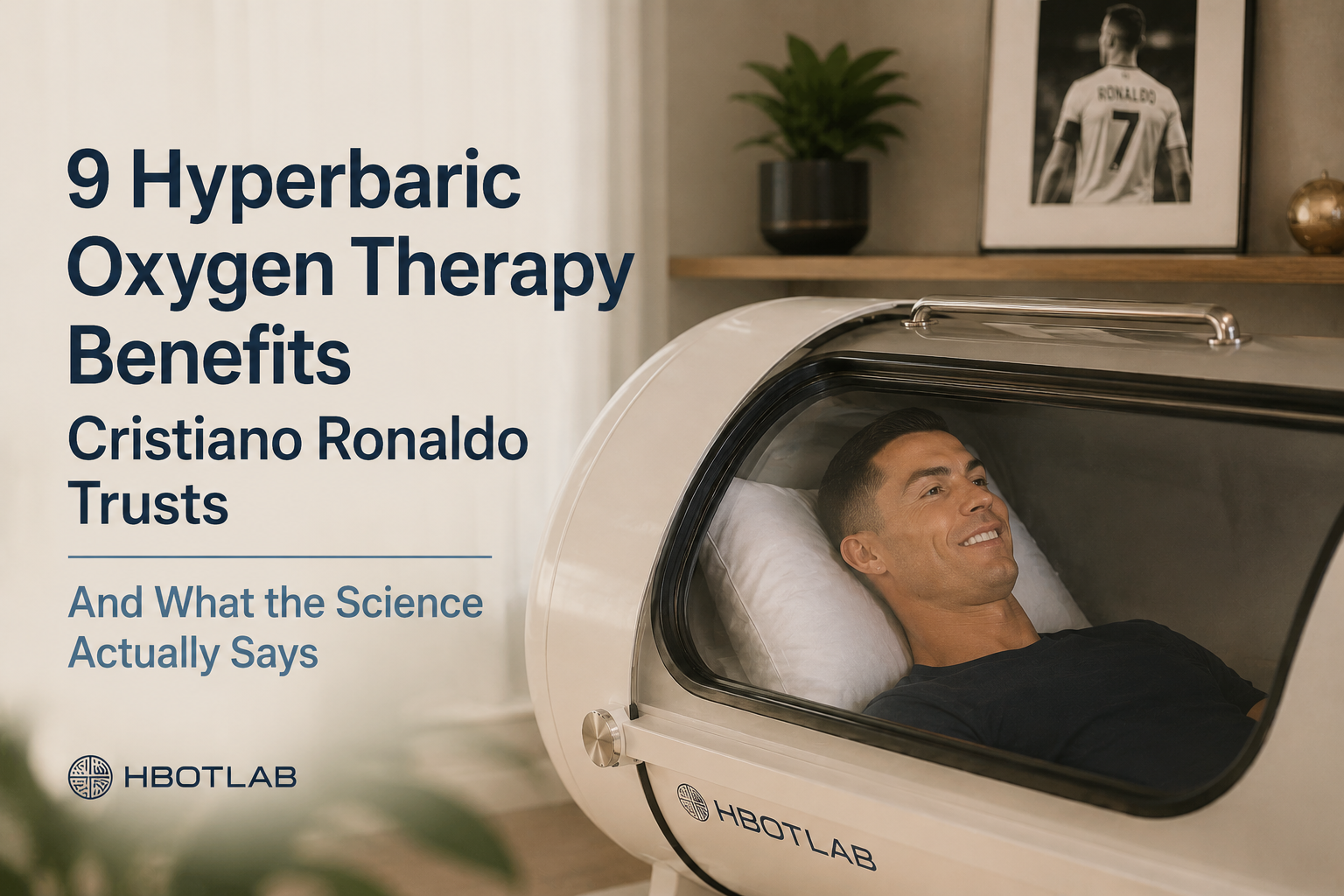
9 Hyperbaric Oxygen Therapy Benefits Cristiano Ronaldo Trusts — And What the Science Actually Says
When the world’s most scrutinised athlete installs a hyperbaric chamber at home, it stops being a trend. It becomes a question worth answering.
You train hard. You recover badly. And somewhere between the match, the flight, and the next morning’s session, your body quietly falls behind the pace you are asking it to keep.
Most athletes accept this as the cost of performance. Cristiano Ronaldo does not. At 40 years old, he continues performing at an elite level — in a sport that routinely ends careers a decade earlier. The reason is not just genetics. It is a recovery system built around one tool most people have only recently heard of.
Ronaldo has used hyperbaric oxygen therapy since at least 2016, when he was photographed at a clinic in Ibiza recovering from a knee injury sustained during Euro 2016. He later installed a personal HBOT chamber at his home in Alderley Edge. Here are the 9 hyperbaric oxygen therapy benefits his protocol is built on — and what the peer-reviewed science says about each one.
Why Cristiano Ronaldo Uses Hyperbaric Oxygen Therapy
In 2016, during Euro 2016, Ronaldo sustained a knee injury in the final against France. During his recovery in Ibiza, reports confirmed he visited a specialist clinic twice for HBOT sessions. ESPN covered the story. By 2022, he had installed a custom chamber at home — not rented, not borrowed. Purchased and installed as a permanent fixture in his recovery infrastructure.
This is not celebrity wellness theatre. Athletes at this level do not spend on equipment that does not produce measurable results. Every recovery tool Ronaldo uses is validated by his performance data — and the performance data speaks for itself.
To understand why it works, you first need to understand how hyperbaric oxygen therapy works at the cellular level. The short version: under increased atmospheric pressure, oxygen dissolves into blood plasma at concentrations far beyond what normal breathing achieves. This oxygen reaches tissues that standard circulation cannot adequately supply — damaged muscle, inflamed joints, healing ligaments.
What Is Hyperbaric Oxygen Therapy — A Plain-Language Definition
Hyperbaric oxygen therapy (HBOT) is a medical treatment in which a person breathes pure oxygen inside a pressurised chamber. The pressure is typically set between 1.5 and 3 ATA — atmospheres absolute — which is significantly above normal atmospheric pressure at sea level.
Under this pressure, oxygen dissolves directly into blood plasma, cerebrospinal fluid, and lymphatic fluid — not just into haemoglobin, which is already close to saturation under normal conditions. This plasma-dissolved oxygen can reach tissues that red blood cells cannot penetrate, including compressed, inflamed, or poorly vascularised areas.
The result is a systemic increase in available oxygen that drives several simultaneous biological processes — each of which maps directly to one of the 9 benefits below. For a detailed breakdown of the timeline across which these benefits appear, see our guide on when HBOT benefits begin.
Benefit 1 — Faster Muscle Recovery After Training
Professional football involves repeated explosive efforts — sprints, jumps, tackles, direction changes — across 90-plus minutes, multiple times per week. The microtrauma this creates in muscle fibres is cumulative. Without adequate recovery, it compounds into fatigue, reduced power output, and eventually injury.
HBOT accelerates muscle recovery by delivering oxygen directly to damaged fibres and activating the satellite cells responsible for muscle repair. Research by Oyaizu et al., published in Scientific Reports in 2018, demonstrated that hyperbaric oxygen reduces inflammation, oxygenates injured muscle, and regenerates skeletal muscle via macrophage and satellite cell activation — three simultaneous mechanisms, not one.
Oyaizu T, Enomoto M, Yamamoto N, et al. Hyperbaric oxygen reduces inflammation, oxygenates injured muscle, and regenerates skeletal muscle via macrophage and satellite cell activation. Sci Rep. 2018;8(1):1288.
For Ronaldo, this translates to being ready for the next training session faster — and arriving at it with less accumulated damage than his opponents.
Benefit 2 — Reduced Inflammation After Matches
Inflammation is the body’s first response to physical stress. In controlled doses it is necessary — it initiates repair. But chronic or excessive post-match inflammation slows recovery, increases injury risk, and degrades performance across a season.
HBOT modulates the inflammatory response without suppressing it entirely. It reduces the production of pro-inflammatory cytokines including TNF-α and IL-6 while preserving the early-phase inflammatory signals that trigger repair. Thom SR’s foundational research, published in Plastic and Reconstructive Surgery in 2011, established this mechanism clearly — HBOT creates a precise anti-inflammatory environment that supports healing rather than stalling it.
Thom SR. Hyperbaric oxygen: its mechanisms and efficacy. Plast Reconstr Surg. 2011;127 Suppl 1:131S–141S.
This is why athletes like Ronaldo use HBOT after matches, not just during injury recovery. The anti-inflammatory effect is preventive, not just curative.
Benefit 3 — Accelerated Injury Healing
The 2016 Euro final knee injury is the most documented example of Ronaldo using HBOT for injury recovery. He was back on the pitch for Real Madrid’s pre-season within weeks of the final. The speed of that recovery was widely reported. HBOT was part of the protocol.
The mechanism is well established. HBOT stimulates collagen synthesis — the structural protein that forms the foundation of ligaments, tendons, and connective tissue. It also promotes angiogenesis — the growth of new blood vessels into healing tissue — which is the primary rate-limiting factor in soft tissue repair.
Research by Bhutani and Vishwanath, published in the Indian Journal of Plastic Surgery in 2012, reviewed the evidence for hyperbaric oxygen in wound healing and confirmed that HBOT enhances collagen deposition, reduces infection risk in compromised tissue, and accelerates the closure of wounds and tissue defects.
Bhutani S, Vishwanath G. Hyperbaric oxygen and wound healing. Indian J Plast Surg. 2012;45(2):316–324.
Benefit 4 — Stem Cell Mobilisation for Tissue Repair
One of HBOT’s most remarkable and least-discussed mechanisms is its effect on stem cell mobilisation. Every session of hyperbaric oxygen therapy triggers the release of stem cells from bone marrow into circulation — stem cells that then migrate to sites of tissue damage and initiate repair.
Fosen and Thom, writing in Antioxidants and Redox Signalling in 2014, reviewed this mechanism in detail. Their analysis confirmed that HBOT stimulates vasculogenic stem cells — stem cells specifically responsible for forming new blood vessels and repairing vascular tissue — and drives their differentiation at injury sites.
Fosen KM, Thom SR. Hyperbaric oxygen, vasculogenic stem cells, and wound healing. Antioxid Redox Signal. 2014;21(11):1634–1647.
For an athlete managing multiple micro-injuries across a long season, this stem cell mobilisation effect means the body’s repair resources are continuously being replenished and redirected to where they are needed most.
Benefit 5 — Improved Oxygen Delivery to Muscles
Athletic performance is ultimately an oxygen equation. The faster your muscles receive oxygen, the longer they can sustain high-intensity output before fatigue sets in.
HBOT increases oxygen delivery through two mechanisms. First, it saturates haemoglobin to maximum capacity. Second — and more significantly — it dissolves oxygen directly into plasma, which can reach capillary beds and tissue spaces that red blood cells cannot access. At 2.0 ATA, plasma oxygen concentration increases by approximately 10 to 15 times compared to normal breathing.
This enhanced oxygen availability improves aerobic capacity during training and accelerates recovery between efforts. For athletes wondering how quickly these benefits accumulate across sessions, our HBOT results timeline breaks down what changes at each stage of a structured course.
Benefit 6 — Reduced Muscle Fatigue Between Sessions
Training twice daily — which elite footballers routinely do during pre-season — creates a fatigue debt that compounds if recovery between sessions is incomplete. HBOT directly addresses this by accelerating the clearance of metabolic waste products and restoring cellular oxygen balance.
Research by Fujita et al., published in PLoS ONE in 2014, investigated the effects of hyperbaric oxygen on macrophage infiltration during skeletal muscle regeneration. Their findings demonstrated that HBOT at 1.25 ATA significantly increased macrophage number and activity in regenerating muscle — accelerating the clearance of cellular debris and the transition from inflammatory to regenerative phase.
Fujita N, Ono M, Tomioka T, et al. Effects of hyperbaric oxygen at 1.25 atmospheres absolute with normal air on macrophage number and infiltration during rat skeletal muscle regeneration. PLoS One. 2014;9(12):e115685.
The practical result for an athlete like Ronaldo: arriving at the second session of the day with muscles that have cleared more of the previous session’s fatigue than they would have without HBOT.
Benefit 7 — Enhanced Sleep and Recovery Quality
Sleep is when the body does its most significant repair work. Growth hormone release, protein synthesis, immune function, memory consolidation — all of these peak during deep sleep. Any intervention that improves sleep quality directly amplifies every other recovery mechanism.
HBOT supports sleep quality through its effect on the parasympathetic nervous system. By reducing systemic inflammation and increasing oxygen availability to brain tissue, it creates the physiological conditions associated with deeper, more restorative sleep cycles.
Users consistently report improved sleep as one of the earliest and most consistent HBOT benefits — often appearing within the first three to five sessions. For Ronaldo, who is known for his disciplined sleep routine, HBOT likely serves as an amplifier of recovery processes already optimised through sleep hygiene.
Benefit 8 — Immune System Support During Heavy Training Loads
Intense training is immunosuppressive. The physical stress of elite-level football chronically elevates cortisol, reduces natural killer cell activity, and creates windows of immune vulnerability that leave athletes susceptible to infections, colds, and systemic fatigue — particularly during periods of fixture congestion.
HBOT supports immune function by modulating oxidative stress pathways and providing tissues with the oxygen required for optimal immune cell activity. Macrophages, neutrophils, and natural killer cells all function more effectively in oxygen-rich environments — which is precisely what HBOT creates.
This immune support function is increasingly recognised in longevity research. Bryan Johnson’s 60-session protocol, which we covered in detail in our article on the Bryan Johnson HBOT longevity protocol, produced complete elimination of measurable systemic inflammation — a result with direct implications for immune resilience as well as recovery.
Benefit 9 — Longevity of Athletic Career
This is the benefit that makes Ronaldo’s use of HBOT most compelling for anyone thinking beyond the next training session. The question is not just whether HBOT helps you recover faster today. It is whether it helps you still be performing at the highest level in five, ten, fifteen years.
The answer, based on both the biological evidence and Ronaldo’s own career trajectory, is yes. By continuously reducing inflammation, regenerating tissue, mobilising stem cells, and maintaining cellular oxygen availability, HBOT slows the accumulation of the biological damage that ends athletic careers prematurely.
Ronaldo is the most visible example of this. But the biology is not exclusive to him. Every athlete faces the same mechanisms of decline. And the same mechanisms that HBOT addresses in Ronaldo’s body operate in yours.
For a deeper understanding of how HBOT supports long-term cellular health beyond athletic performance, visit HBOTLAB — India’s first organised wellness HBOT franchise network.
What Indian Athletes and Fitness Enthusiasts Can Take From This
Ronaldo’s recovery infrastructure costs millions. His personal chamber, his medical team, his monitoring technology — none of this is accessible to most people.
But the biology is. The 9 hyperbaric oxygen therapy benefits documented above are not exclusive to elite athletes. They are the product of a well-understood biological mechanism that operates the same way in every human body — regardless of fitness level, age, or performance goal.
Whether you are a competitive athlete, a recreational runner, or simply someone who wants to recover better and perform more consistently, the science behind hyperbaric oxygen therapy benefits applies to you. The question is where you access it and how seriously you take the protocol.
India’s wellness infrastructure is now sophisticated enough to support serious HBOT protocols. The gap between what Ronaldo accesses and what you can access is narrowing. For more on what to expect from a structured course, read our guide on the HBOT results timeline.
Frequently Asked Questions
1. Does Cristiano Ronaldo really use hyperbaric oxygen therapy?
Yes. Ronaldo’s use of HBOT is documented. In 2016, ESPN reported that he visited a clinic in Ibiza for HBOT sessions during his recovery from a knee injury sustained in the Euro 2016 final. He subsequently installed a personal hyperbaric chamber at his home in Alderley Edge, England. His use of HBOT is part of a broader recovery infrastructure that includes cryotherapy, nutritional programming, and structured sleep protocols.
2. What are the main hyperbaric oxygen therapy benefits for athletes?
The primary hyperbaric oxygen therapy benefits for athletes are faster muscle recovery, reduced post-exercise inflammation, accelerated injury healing, stem cell mobilisation, improved oxygen delivery to muscles, reduced fatigue between sessions, better sleep quality, immune support during heavy training, and extended career longevity. Each of these benefits is backed by peer-reviewed research. For the full scientific breakdown, see our guide on how hyperbaric oxygen therapy works.
3. How many HBOT sessions do athletes typically need?
The number of sessions depends on the goal. For acute injury recovery, protocols of 10 to 20 sessions are common, often scheduled daily or five times per week. For ongoing performance maintenance — the model Ronaldo uses — athletes integrate HBOT as a regular part of their recovery routine, using it after matches and heavy training blocks. Longevity-focused protocols, like Bryan Johnson’s 60-session experiment, run for 12 weeks at five sessions per week. Most users notice meaningful improvements within the first 5 to 10 sessions, with deeper physiological changes emerging after 20 or more.


Subscribe
One Comment
Comments are closed.
[…] For the full breakdown of the 9 mechanisms behind Ronaldo’s HBOT protocol, read our dedicated article on the 9 hyperbaric oxygen therapy benefits Cristiano Ronaldo trusts. […]