
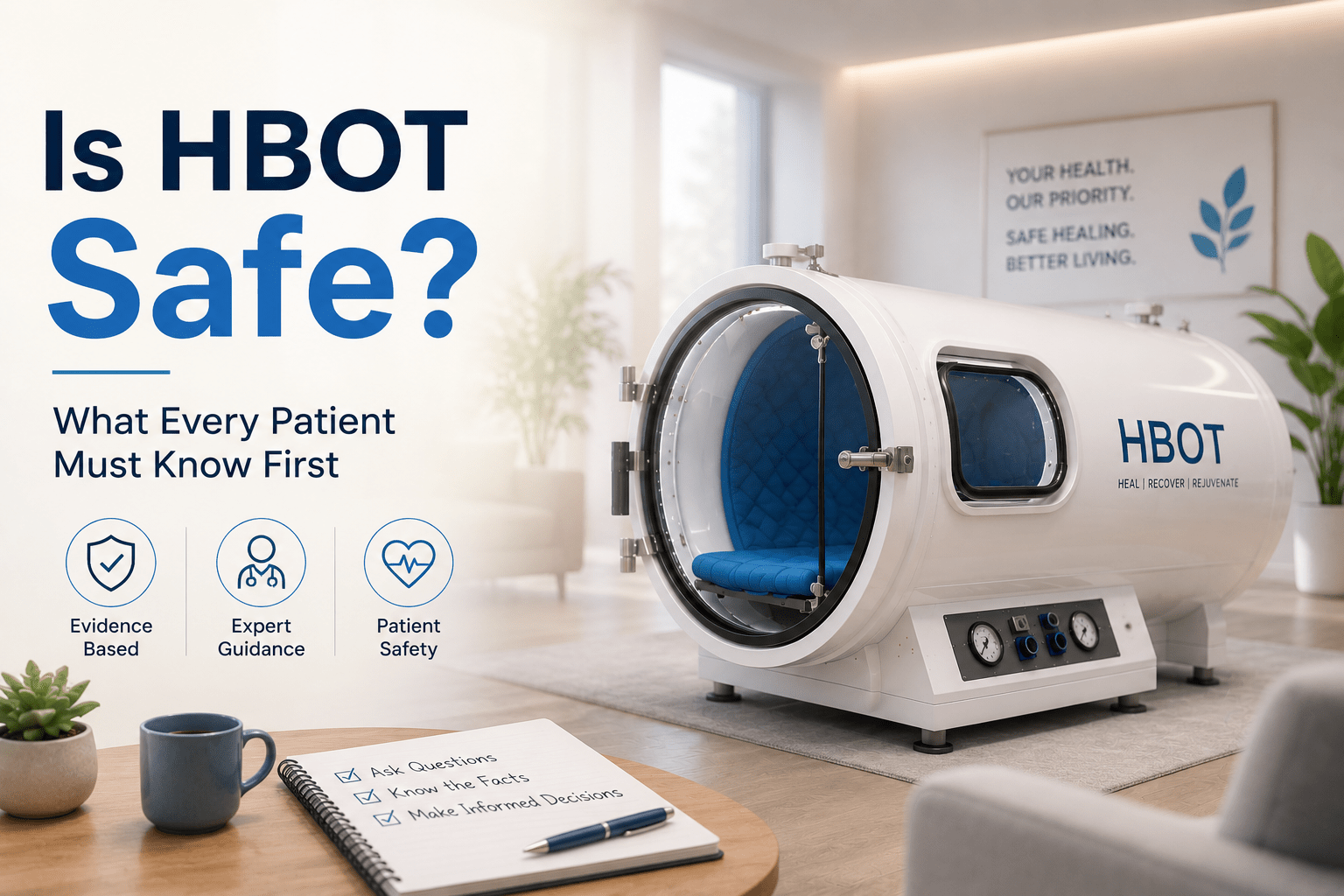
Is HBOT Safe? What Every Patient Must Know First
Is HBOT safe? Yes — when delivered in a certified chamber, under trained supervision, with proper safety protocols in place. That conditional is not a disclaimer. It is the entire answer.
| Is HBOT safe?: HBOT delivered in an ASME PVHO-1 certified hard chamber, under continuous trained supervision, with no prohibited items inside and verified fire-prevention protocols active, is considered safe for the vast majority of patients. Serious adverse events are rare and are almost always associated with non-compliant equipment or undertrained operators (Goyal A et al., StatPearls, 2019). |
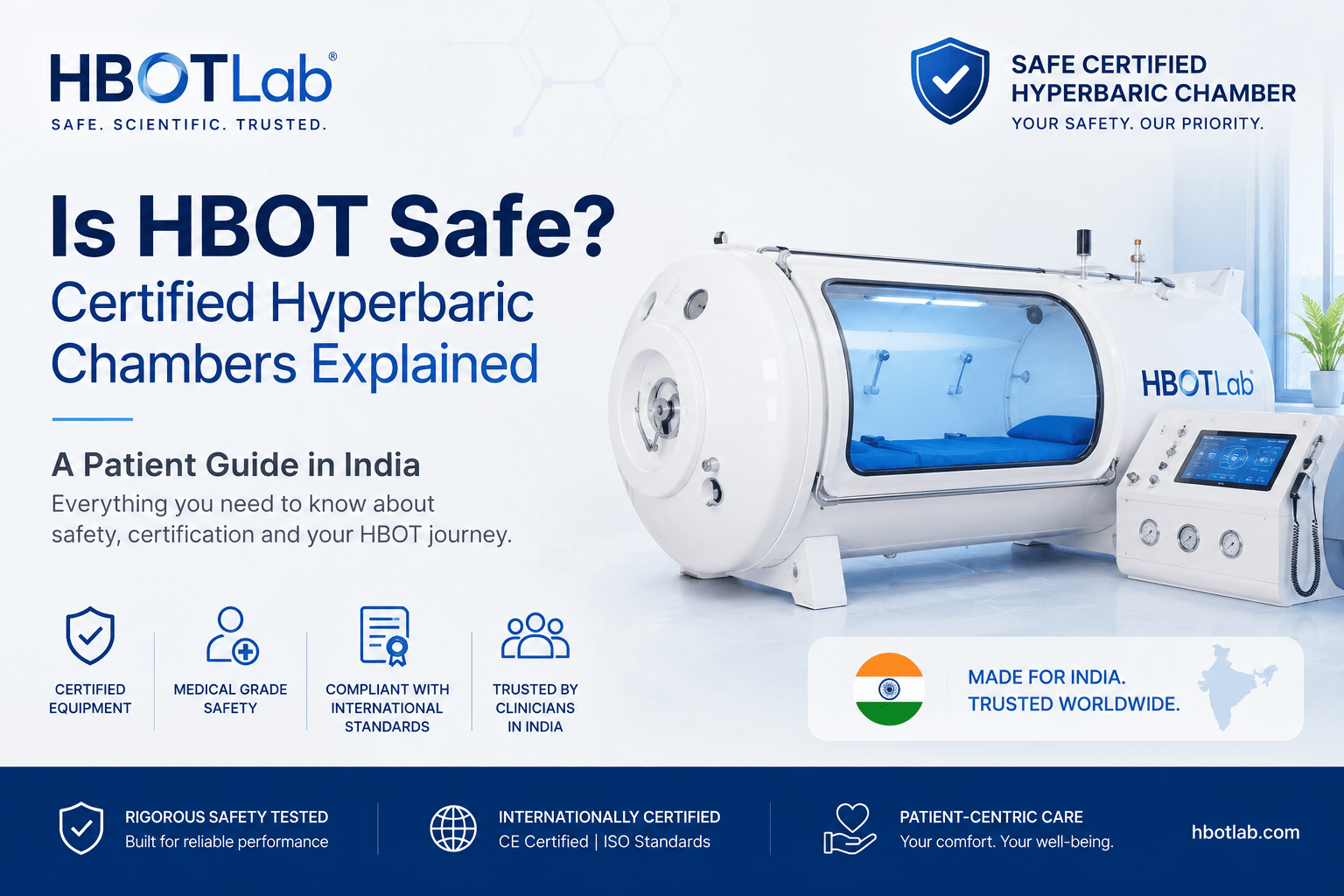
is hbot safe certified hyperbaric chamber patient guide india
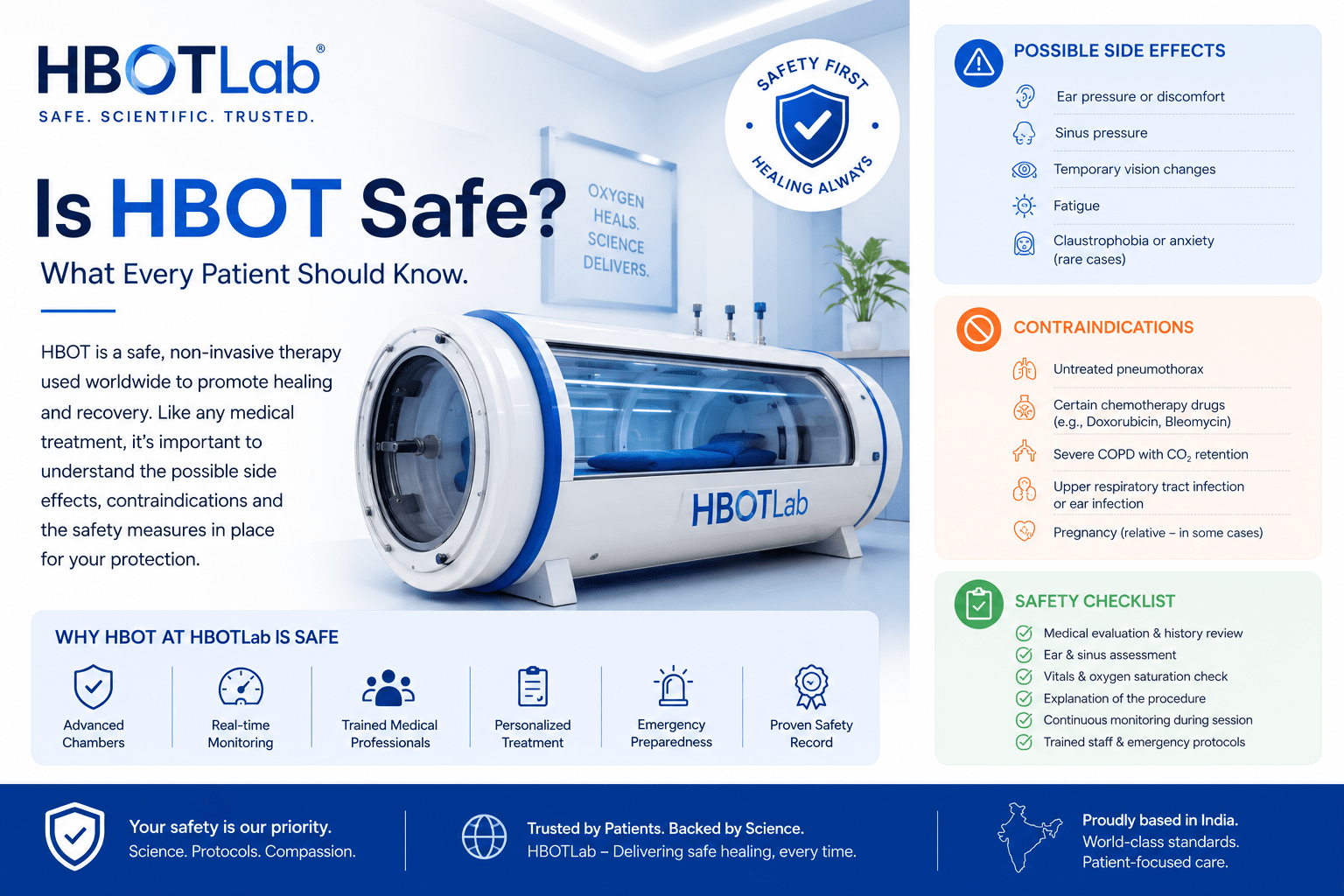
is hbot safe side effects contraindications safety checklist
The risk is not HBOT itself. The risk is HBOT delivered in the wrong chamber, by undertrained staff, without the safety standards that exist precisely to protect you.
This guide covers exactly what makes an HBOT session safe, what the known risks are, who should not undergo HBOT, and the verification steps every patient in India must complete before booking.
HBOT has an excellent safety record built over decades of clinical use. That record was built inside certified chambers, under trained supervision. The chamber is not a detail — it is the foundation everything else rests on.
Is HBOT Safe? What the Research Actually Shows
HBOT has been in clinical use for over 60 years. The evidence base for its safety in certified settings is substantial.
The most common side effect is mild ear and sinus pressure during pressurisation — the same sensation as descending in an aircraft. This resolves within the session for most patients and is managed by slowing the pressurisation rate or teaching equalisation techniques (Goyal A et al., StatPearls, 2019).
Temporary changes in vision — typically mild myopia — can occur in patients undergoing long courses of treatment. These changes resolve spontaneously in the weeks following the end of treatment in the vast majority of cases.
Oxygen toxicity — the most serious potential complication of HBOT — occurs when the brain or lungs are exposed to very high oxygen concentrations for extended periods. In clinical practice, this risk is managed through treatment protocols that keep session length and pressure within established safety parameters. Oxygen toxicity seizures are rare in supervised clinical HBOT and are not associated with lasting harm (Fife CE et al., Plast Reconstr Surg, 2016).
Serious adverse events including death are documented — but almost exclusively in settings involving non-certified equipment, absent or undertrained supervision, or explicit safety protocol failures. The 2025 chamber fires in the United States are the clearest examples of what happens when those fundamentals are absent.
Is HBOT safe compared to other medical interventions?
HBOT in a certified facility compares favourably in safety terms to many common medical interventions. The absolute risk of serious harm in a properly run HBOT session is low. The qualifier ‘properly run’ is doing significant work in that sentence — and it is why chamber certification, operator training, and safety protocol verification are not optional considerations.
For a complete breakdown of what side effects to expect and how they are managed in certified settings, HBOT side effects — what you need to know before treatment gives the full picture.
Is HBOT Safe in Every Chamber? No — and This Is Why
The question ‘is HBOT safe’ cannot be answered without asking a second question: in what chamber, operated by whom, to what standard?
Every HBOT chamber is classified as a Pressure Vessel for Human Occupancy — a PVHO — under ASME engineering standards. A PVHO-certified hard chamber is independently designed, fabricated, pressure-tested, and maintained to ASME PVHO-1-2023. A soft bag chamber is not.
The difference matters because the chamber is the environment. At elevated atmospheric pressure, with oxygen at concentrations five times normal air, every structural and procedural detail of that environment carries weight. A chamber that has not been independently verified to contain a person safely under pressure is not a certified safe environment.
In September 2024, a soft-sided bag chamber ruptured while occupied in India. In January 2025, a child died in a hyperbaric chamber fire in Michigan. In August 2025, a second fatal fire occurred in Arizona. In each case, the failure was not HBOT — it was the environment in which HBOT was delivered.
What ‘is HBOT safe’ actually means for the Indian patient
India has no regulation that currently mandates ASME PVHO-1 certification for HBOT operators. Two clinics in the same city can both legally operate — one in a certified hard chamber with documented inspection records, one in an uncertified soft bag with no independent safety audit — and neither is required to prominently disclose which is which.
So when you ask ‘is HBOT safe?’ and receive a reassuring answer without being told what chamber the clinic uses — that answer is incomplete. Safe HBOT and HBOT are not the same thing in the Indian market right now.
For the full breakdown of what PVHO certification means and why it divides the Indian market, our HBOT PVHO chamber safety guide covers the standard in detail.
To understand the specific structural differences between certified and uncertified chambers, hard vs HBOT soft chamber — the safety truth breaks down exactly what you are comparing.
Who Should Not Have HBOT — Absolute Contraindications
Is HBOT safe for everyone? No. There are absolute contraindications that rule out HBOT for specific patients regardless of the chamber or operator.
Absolute contraindications — do not proceed without specialist review
- Untreated pneumothorax (collapsed lung): the pressure changes of HBOT can worsen a pneumothorax and create a life-threatening tension pneumothorax. This is the only absolute contraindication recognised universally across all HBOT guidelines.
- Certain chemotherapy agents: bleomycin and doxorubicin have documented interactions with hyperbaric oxygen. Patients currently receiving or recently treated with these agents must discuss HBOT with their oncologist before proceeding.
- Uncontrolled high fever: elevated body temperature increases the risk of oxygen toxicity. HBOT should be deferred until fever resolves.
Relative contraindications — discuss with a hyperbaric specialist before booking
- Chronic obstructive pulmonary disease (COPD) with high CO2 retention — requires specialist assessment.
- Claustrophobia — manageable in some chamber configurations but must be disclosed before booking.
- Active upper respiratory infection — eustachian tube blockage makes ear equalisation painful or impossible.
- Pregnancy — limited safety data; use only when benefit clearly outweighs risk, under specialist guidance.
- History of ear surgery — may affect ability to equalise pressure; requires specialist assessment.
- Certain seizure disorders — increased oxygen concentrations can lower seizure threshold in susceptible patients.
- Implanted devices — pacemakers, cochlear implants, and some drug delivery pumps must be reviewed for HBOT compatibility before any session.
This list is not exhaustive. Any patient with an existing medical condition, taking prescription medication, or with a history of chest or ear surgery should discuss their specific situation with a qualified hyperbaric medicine specialist before booking HBOT in India.
Is HBOT Safe? Your Pre-Session Verification Checklist
Knowing that HBOT is safe in the right conditions is only useful if you can verify those conditions before entering the chamber. Here is the complete checklist.
| Chamber verification — ask before you book
✓ Is this a certified hard chamber or a soft bag chamber? ✓ Does the chamber carry ASME PVHO-1-2023 certification? (Ask to see the documentation.) ✓ When was the chamber last pressure-tested and inspected under ASME PVHO-2? ✓ Is the ASME certification stamp physically present on the chamber? |
| Operator verification — ask at the facility
✓ What hyperbaric medicine training does the operator hold? (UHMS or NBDHMT certification) ✓ Will I be under continuous supervision throughout the session? ✓ Is a grounding wrist strap mandatory for all patients? ✓ Are electronic devices — phones, smartwatches, tablets — prohibited inside the chamber? |
| Patient self-verification — complete before booking
✓ I do not have an untreated pneumothorax. ✓ I am not currently receiving bleomycin or doxorubicin chemotherapy. ✓ I do not have an active high fever. ✓ I have disclosed all existing medical conditions and medications to the provider. ✓ I have confirmed any implanted devices are HBOT-compatible with my physician. |
For the complete provider evaluation framework — not just chamber safety but full clinic assessment — how to choose the best HBOT therapy centre in India walks you through every step.
To understand why 2025’s chamber incidents matter for India specifically and what they revealed about the safety gap, pressure vessel for human occupancy and HBOT safety covers the documented incidents and their implications.
Is HBOT Safe for Specific Conditions? A Quick Reference
Is HBOT safe for diabetic patients?
HBOT is considered safe and is supported by clinical evidence for diabetic foot ulcers in patients who can equalise ear pressure and do not have uncontrolled very high blood sugar at the time of treatment. Diabetic patients should have their glucose levels checked before each session and should disclose all medications including insulin to the operator.
Is HBOT safe for heart patients?
HBOT causes a mild, transient decrease in cardiac output due to the vasoconstrictive effect of high oxygen concentrations. For most patients this is clinically insignificant. Patients with severe congestive heart failure or unstable angina require specialist cardiology review before beginning HBOT. Stable cardiac patients tolerate HBOT well in supervised settings (Goyal A et al., StatPearls, 2019).
Is HBOT safe during pregnancy?
Pregnancy is a relative contraindication. There is limited human safety data for HBOT in pregnancy. Animal studies have not shown consistent harm, but the data is insufficient to consider HBOT routine in pregnancy. It should be considered only when the medical indication is serious and the benefit to the mother clearly outweighs the uncertain risk to the foetus, under specialist supervision.
Is HBOT safe for children?
HBOT is used in children for several clinical indications including carbon monoxide poisoning, gas gangrene, and decompression sickness. For these conditions, the risk-benefit profile supports use under appropriate clinical supervision. For off-label wellness applications in children, the evidence base is weaker and the decision requires careful specialist assessment rather than a general safety assurance.
Is HBOT safe for claustrophobic patients?
Mild to moderate claustrophobia can be managed in many certified facilities through gradual acclimatisation, transparent chamber designs, communication systems, and in some cases mild anxiolytic medication prescribed by a physician. Severe claustrophobia may make HBOT impractical. Disclose this to the provider before booking — not after arriving at the chamber.
FAQ: Is HBOT Safe?
Is HBOT safe for first-time patients?
Yes, for most patients with no contraindications, in a certified hard chamber under trained supervision. The most common experience for first-time patients is mild ear pressure during pressurisation, which resolves quickly. A reputable facility will conduct a pre-treatment health screening and explain what to expect before your first session.
Is HBOT safe long-term?
Long-term HBOT courses — often 20 to 40 sessions for conditions like chronic wound healing — are well-tolerated in the majority of patients. The risk of temporary mild myopia increases with longer courses but resolves after treatment ends. There is no documented evidence of cumulative harm from HBOT delivered within clinical protocols in a certified chamber.
Is HBOT safe if I have metal implants?
HBOT does not use magnetic fields, so it is not contraindicated in the same way MRI is for metal implants. However, implanted devices with electronic components — pacemakers, cochlear implants, intrathecal drug pumps — must be reviewed for HBOT pressure compatibility before any session. Disclose all implanted devices to the provider and confirm with your specialist before proceeding.
Is HBOT safe if I take prescription medications?
Most common medications are compatible with HBOT. Two drug classes require explicit attention: bleomycin and doxorubicin (chemotherapy agents with documented HBOT interactions) and disulfiram (used for alcohol dependence). Patients on these medications should not undergo HBOT without specific guidance from their prescribing physician and the hyperbaric specialist.
Is HBOT safe at home with a soft chamber?
Soft chambers for home use operate at lower pressures and use compressed air rather than pure oxygen at therapeutic concentrations. The documented India 2024 rupture incident involved a soft bag chamber. For home use: verify the specific device has CDSCO clearance for India, follow manufacturer protocols exactly, never use alone, and consult a hyperbaric medicine specialist before purchasing. Home HBOT is not a substitute for clinical HBOT in a certified hard chamber for any recognised medical indication.
Is HBOT Safe? The Complete Answer
Yes. HBOT is safe — with one non-negotiable condition: it must be delivered in a certified chamber, by trained personnel, with safety protocols that match the environment.
The chamber is not a detail. It is the entire premise. A certified ASME PVHO-1 hard chamber with documented maintenance, operated by a trained hyperbaric technician, with grounding equipment and continuous supervision — that is what makes HBOT safe. Remove any element of that and the answer to ‘is HBOT safe?’ changes.
In India, where regulation does not yet mandate PVHO certification, the verification burden sits with you. The checklist in this article takes under five minutes to complete. Use it every time.


Subscribe
5 Comments
Comments are closed.
[…] check our guide to is HBOT safe before your first visit to understand what safety standards should look […]
[…] changes that resolve after treatment ends. Serious side effects are rare. Read our full guide on is HBOT safe and our detailed article on HBOT side effects and what to expect before your first […]
[…] pressure vessel without proper monitoring is a genuine safety concern. Read our guide on is HBOT safe for what safe HBOT should look […]
[…] our guide on is HBOT safe for a full checklist of what safe HBOT looks like at a certified […]
[…] For a broader checklist of what safe HBOT looks like, read our guide on is HBOT safe. […]