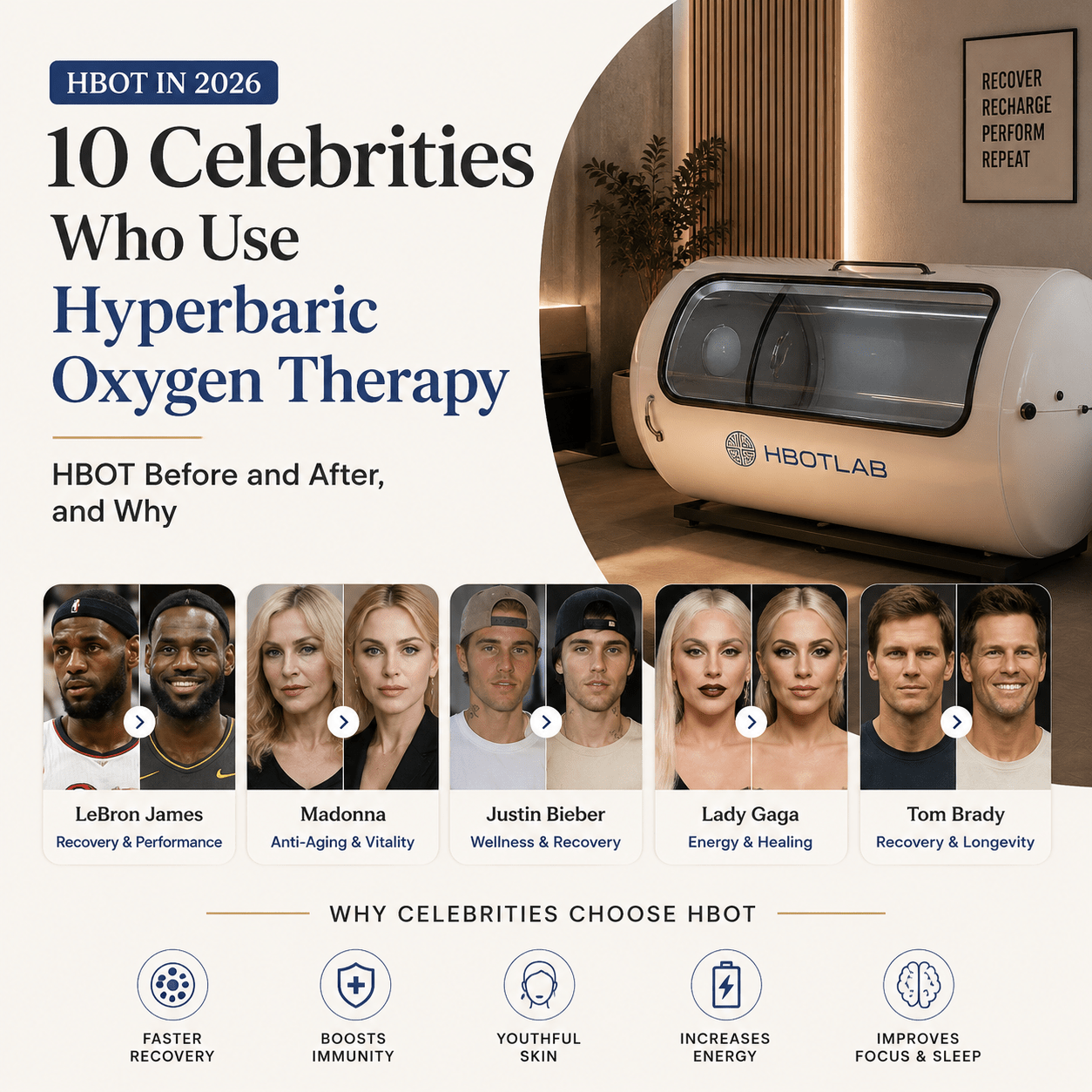
10 Celebrities Who Use Hyperbaric Oxygen Therapy in 2026 — hbot before and after, and Why
When ten people from completely different worlds all arrive at the same therapy, it stops being a trend. It becomes a signal worth paying attention to.
A tech billionaire tracking his telomeres. A footballer who won’t retire. A tennis champion who reached a Grand Slam final four weeks after knee surgery. A pop star sleeping in an oxygen chamber every night. An NBA legend playing at 41.
These are not the same person. They do not live in the same world. They have different bodies, different health challenges, different goals. And they all use the same therapy.
Hyperbaric oxygen therapy — HBOT — is a treatment in which a person breathes pure oxygen inside a pressurised chamber at 1.5 to 3.0 atmospheres absolute. The increased pressure dissolves oxygen directly into blood plasma at concentrations far beyond what normal breathing achieves. This plasma-dissolved oxygen reaches tissues that red blood cells cannot adequately supply, driving multiple simultaneous repair mechanisms. Here are the 10 most documented HBOT before and after stories from public figures in 2026 — with what the science says about each.
Why Celebrity HBOT Use Matters — And the Important Caveat
Celebrity endorsements are not scientific evidence. They are signals — evidence that people with the means to access any therapy in the world, advised by the best medical teams money can buy, are consistently choosing this one.
Every person on this list is documented through a primary source — their own words in a docuseries, a published interview, a medical centre they founded, or footage they shared publicly. None of these claims come from industry marketing or unverifiable third-party reports.
The caveat is equally important: what works for Bryan Johnson’s longevity protocol, Djokovic’s surgical recovery, and Bieber’s anxiety management are three different applications of the same underlying mechanism. HBOT is not one thing. It is one tool with multiple applications. For the full science of how it works, read our guide on how hyperbaric oxygen therapy works.
1. Bryan Johnson — The Longevity Biohacker
Bryan Johnson completed a publicly documented 60-session HBOT protocol in early 2025 — five sessions per week, 90 minutes each, at 2.0 ATA with 100% oxygen. He then published the biomarker results on X and his Blueprint protocol page.
Before: Measurable systemic inflammation (hsCRP), baseline telomere length of 11.4 kb, standard VEGF levels.
After: hsCRP below detectable levels. 300% increase in VEGF. Telomere length measured at 11.7 kb. Telomerase activity consistent with biological age of 12 years.
Johnson’s documentation is the most rigorous real-world HBOT data produced by any public figure. His protocol cost approximately $100,000 in equipment alone — but the biology it leveraged is the same biology available at a fraction of that cost in a properly equipped clinical setting.
For the full breakdown of what his protocol involved and what each biomarker result means, read our dedicated article on the Bryan Johnson HBOT longevity protocol.
2. Cristiano Ronaldo — The Athlete Who Won’t Stop
Cristiano Ronaldo installed a custom hyperbaric chamber at his home in Alderley Edge, England. He has used HBOT since at least 2016, when ESPN reported he visited a specialist clinic in Ibiza twice during recovery from a knee injury sustained in the Euro 2016 final. He continues performing at elite level in professional football at age 40.
Before: Knee ligament injury sustained in Euro 2016 final. Recovery timeline pressure with Real Madrid pre-season imminent.
After: Returned to training ahead of schedule. Continued performing at elite level for nearly a decade after the injury that could have ended his career.
Thom SR. Hyperbaric oxygen: its mechanisms and efficacy. Plast Reconstr Surg. 2011;127 Suppl 1:131S–141S. [View Study]
For the complete breakdown of the 9 biological mechanisms behind Ronaldo’s protocol, read our article on the 9 hyperbaric oxygen therapy benefits Cristiano Ronaldo trusts.
3. Novak Djokovic — The Comeback No One Expected
Djokovic tore his right medial meniscus during the French Open quarterfinal on June 3, 2024. He underwent emergency surgery in Paris the following morning. Standard recovery timeline for meniscus repair: four to six months. He reached the Wimbledon final four weeks later.
Before: Torn meniscus. Emergency surgery in Paris. Zero realistic expectation of competing at Wimbledon.
After: Wimbledon finalist four weeks post-surgery. Documented use of daily HBOT sessions across the recovery window.
Djokovic has used HBOT as a regular component of his recovery infrastructure for over a decade. He brought a personal hyperbaric chamber to the 2019 US Open in a trailer. His 2024 Wimbledon comeback is the most compelling documented example of HBOT-supported surgical recovery in elite sport.
For the three specific HBOT mechanisms that made this recovery timeline possible, read our article on how HBOT helped Djokovic reach Wimbledon.
4. Justin Bieber — The Anxiety and Illness Recovery
Bieber disclosed in his 2020 YouTube docuseries Justin Bieber: Seasons that he owns two hyperbaric chambers — one at home, one at his studio — and uses them to manage Lyme disease, Ramsay Hunt syndrome, anxiety, and depression. He is filmed inside the chamber by Hailey Bieber and describes the effect in his own words.
Before: Chronic anxiety, Lyme disease diagnosis, Ramsay Hunt syndrome causing facial paralysis, disrupted sleep, cognitive fatigue.
After: Continued performing and touring. Documented as an ongoing daily protocol for anxiety management and neurological recovery support.
Bieber’s use of HBOT for mental health is the most publicly documented celebrity application of the therapy for anxiety and depression. His own description — “you get more oxygen to your brain so it decreases your stress levels” — is a lay-person’s accurate summary of the neurological mechanism.
For the four biological reasons this mechanism is scientifically plausible, read our article on why Justin Bieber sleeps in a hyperbaric oxygen chamber.
5. LeBron James — 22 Seasons and Counting
LeBron James has used HBOT for over a decade as part of a recovery infrastructure that reportedly costs approximately $1.5 million per year. He uses 90-minute daily sessions in a Vitaeris 320 hyperbaric chamber. He continues playing elite-level NBA basketball at 41 — an age at which most NBA careers ended decades earlier.
Before: Standard NBA career trajectory — most players decline significantly after age 33–35.
After: Still performing as an elite NBA player at 41. Career longevity that has no precedent in professional basketball history.
LeBron’s HBOT use is primarily focused on recovery maintenance and career longevity — not acute injury recovery. The biological mechanism most relevant to his use is HBOT’s effect on muscle regeneration and inflammation reduction between sessions.
Oyaizu T, Enomoto M, Yamamoto N, et al. Hyperbaric oxygen reduces inflammation, oxygenates injured muscle, and regenerates skeletal muscle via macrophage and satellite cell activation. Sci Rep. 2018;8(1):1288. [View Study]
6. Neymar Jr. — Daily Recovery Protocol
Neymar Jr. has openly documented his HBOT use across multiple injury recovery periods and training blocks. His physiotherapist Rafael Martini confirmed that Neymar uses a hyperbaric chamber for up to 90 minutes daily during training, and twice daily during injury recovery. He has posted from inside the chamber on Instagram on multiple occasions.
Before: Multiple soft-tissue injuries across career, including metatarsal fractures and ankle ligament damage requiring extended recovery periods.
After: Consistent return to match fitness faster than standard recovery timelines. Daily protocol maintained throughout career.
Neymar’s use pattern — daily maintenance plus intensive injury recovery — reflects the most demanding HBOT application in professional sport. The stem cell mobilisation mechanism is particularly relevant to his frequency of use.
Thom SR, Bhopale VM, Velazquez OC, et al. Stem cell mobilization by hyperbaric oxygen. Am J Physiol Heart Circ Physiol. 2006;290(4):H1378–H1386. [View Study]
7. Mark Wahlberg — The 3AM Recovery Routine
Mark Wahlberg was featured by OxyHealth — manufacturer of the Vitaeris 320 hyperbaric chamber — in a video titled “Mark Wahlberg Rejuvenates in OxyHealth Hyperbaric Chamber, Vitaeris at Home.” He has shared his chamber on Instagram as part of his widely-publicised pre-dawn fitness and recovery routine, which begins at approximately 3:30 AM.
Before: High-intensity filming schedules requiring rapid physical transformation and sustained energy across multiple productions simultaneously.
After: Sustained physical performance into his 50s. Consistent production output across physically demanding film projects.
Wahlberg’s use represents the wellness maintenance application of HBOT — using the therapy not for acute recovery but for sustained performance across a demanding professional schedule. His protocol is consistent with the general wellness use case that is growing rapidly in India’s premium wellness market.
8. Mayim Bialik — The Autoimmune Battle
On August 11, 2024, Mayim Bialik — neuroscientist, actress, and former Jeopardy! host — posted from inside a hyperbaric oxygen chamber installed at her home. She disclosed that she had been recommended HBOT by multiple trusted doctors for inflammation and autoimmune issues related to Graves’ disease, which she has managed for approximately 20 years.
Before: Chronic inflammation and autoimmune dysregulation from Graves’ disease. Ongoing systemic fatigue.
After: Committed to a six-month HBOT protocol under medical guidance. Ongoing — Bialik has spoken about the anti-inflammatory rationale.
Bialik’s case is notable for two reasons. First, she is a neuroscientist — her endorsement carries an additional layer of scientific credibility. Second, her use is doctor-recommended and protocol-based, not self-prescribed. The anti-inflammatory mechanism is the primary biological rationale for her protocol.
Thom SR. Hyperbaric oxygen: its mechanisms and efficacy. Plast Reconstr Surg. 2011;127 Suppl 1:131S–141S. [View Study]
9. Rishabh Pant — India’s Most Remarkable Recovery
In December 2022, Rishabh Pant sustained life-threatening injuries in a car accident near Roorkee — including a fractured skull, ligament damage to both knees, and extensive lacerations. He underwent multiple surgeries. In February 2026, a video of him using hyperbaric oxygen therapy as part of his IPL 2026 preparation circulated widely across Indian sports media.
Before: Fractured skull, bilateral knee ligament damage, lacerations requiring multiple surgeries. Life-threatening injuries with uncertain return-to-sport prognosis.
After: International cricket return. IPL 2026 preparation including documented HBOT protocol. One of the most remarkable injury recoveries in Indian cricket history.
Pant’s case matters for India because it removes the perception that HBOT is an imported luxury available only to European and American sports stars. The same biological mechanisms that accelerated Ronaldo’s knee recovery and Djokovic’s meniscus repair supported Pant’s return from catastrophic trauma to international cricket.
Bhutani S, Vishwanath G. Hyperbaric oxygen and wound healing. Indian J Plast Surg. 2012;45(2):316–324. [View Study]
10. Joe Namath — The Brain Healing Story
Joe Namath is the most clinically documented celebrity HBOT user on this list. After learning of former teammate Junior Seau’s 2012 suicide and CTE diagnosis, Namath sought brain scans and discovered impaired blood flow in the left side of his brain. He underwent 120 HBOT sessions over seven months at Jupiter Medical Center in Florida.
Before: SPECT brain scans showing dark, low-blood-flow regions in left hemisphere. Cognitive impairment consistent with chronic traumatic encephalopathy from 16-year NFL career.
After: SPECT scans showing normalised blood flow in previously dark regions. Namath stated publicly: “I know it helped me. I took cognitive tests and brain scans prior to and seeing the test improve.” Founded the Joe Namath Neurological Research Center at Jupiter Medical Center, which has run an FDA-approved clinical trial of HBOT for TBI.
Namath’s case is unique because it is the only celebrity HBOT story that generated a formal clinical research programme. He did not just use the therapy — he invested in proving it for others.
Vadas D, Kalichman L, Hadanny A, et al. Hyperbaric oxygen environment can enhance brain activity and multitasking performance. Front Integr Neurosci. 2017;11:25. [View Study]
What These 10 Have in Common — The Pattern That Matters
Ten people. Ten different backgrounds. Ten different health challenges. One consistent pattern: all of them use structured, repeated protocols. None of them used HBOT once and declared victory. All of them committed to sessions across weeks or months.
The second pattern is equally consistent: none of them use HBOT instead of other care. Bryan Johnson uses it alongside his full Blueprint stack. Bieber uses it alongside psychiatric care. Djokovic uses it alongside intensive physiotherapy. Namath used it alongside neurological rehabilitation. HBOT amplifies other interventions — it does not replace them.
The third pattern — and this one matters for honest communication — is sourcing strength. Bryan Johnson, Namath, Bieber, Bialik, and Pant are Tier 1: documented in their own words or through primary medical reporting. Ronaldo, Djokovic, LeBron, Neymar, and Wahlberg are Tier 2: credibly reported through named sports media, manufacturer documentation, or physiotherapist confirmation. No rumour. No tabloid speculation.
For the broader context of how elite athletes specifically use HBOT, read our article on the 6 athletes who use hyperbaric oxygen therapy. For a myth-busting breakdown of common misconceptions about HBOT in India, read our article on the 8 HBOT myths Indian wellness seekers believe.
What This Means for HBOT Before and After in India
India already has its own documented HBOT users. Rishabh Pant’s February 2026 protocol is the most recent. Anil Kapoor and Samantha Ruth Prabhu have been confirmed in an Apollo Hospitals health-library article. Tiger Shroff shared his HBOT sessions from the Baaghi 3 set in Serbia.
The global celebrity pattern described above is not a foreign phenomenon that may or may not reach India. It is already here. The question is not whether elite Indians use HBOT. It is whether the infrastructure exists to make it accessible to the broader wellness consumer.
That infrastructure is now being built. For a breakdown of what a structured HBOT course looks like, what to expect across sessions, and how to find a provider serious enough to deliver real results, visit HBOTLAB — India’s first organised wellness HBOT franchise network.
Frequently Asked Questions
Which celebrities use hyperbaric oxygen therapy in 2026?
The most documented users in 2026 are Bryan Johnson (longevity protocol, publicly documented biomarker data), Cristiano Ronaldo (home chamber, injury recovery), Novak Djokovic (surgical recovery, US Open chamber), Justin Bieber (anxiety and Lyme disease management), LeBron James (career longevity), Neymar Jr. (daily recovery protocol), Mark Wahlberg (wellness maintenance), Mayim Bialik (autoimmune/inflammation, doctor-recommended), Rishabh Pant (catastrophic injury recovery, IPL 2026 preparation), and Joe Namath (brain injury recovery, founded a clinical research centre). All ten are documented through primary sources.
What do celebrities report before and after HBOT?
The before-and-after patterns vary by application. For injury recovery (Ronaldo, Djokovic, Pant): faster-than-expected return to competition. For longevity (Bryan Johnson): measurable biomarker improvements including inflammation reduction and vascular growth markers. For mental health (Bieber, Bialik): reduced anxiety, improved cognitive function, better sleep. For career maintenance (LeBron, Neymar, Wahlberg): sustained performance beyond conventional age-related decline curves. For neurological recovery (Namath): normalised brain scans after 120 sessions, documented through SPECT imaging. For a detailed breakdown of the timeline across sessions, read our guide on the HBOT results timeline.
Is celebrity HBOT use relevant to ordinary people?
Yes — with an important qualifier. The biology is universal. The mechanisms that produced Bryan Johnson’s biomarker changes, Djokovic’s surgical recovery, and Pant’s injury return operate in every human body. What differs is the scale of investment, the frequency of sessions, and the equipment quality. A structured protocol at a properly equipped clinical wellness facility produces the same biological mechanisms as a home chamber costing $100,000 — the difference is in the pressure levels, oxygen concentration, and clinical supervision. For a plain-language explanation of what HBOT actually does inside the body, read our guide on what is hyperbaric oxygen therapy.