

Hyperbaric Oxygen Therapy Reviews: What the Evidence Shows for Crush Injuries and Reperfusion
Crush injuries create two separate biological crises — the primary crush itself, and the reperfusion injury that follows when blood flow returns. Most reviews of hyperbaric oxygen therapy for crush injury focus on the second crisis. It is often the more damaging one.
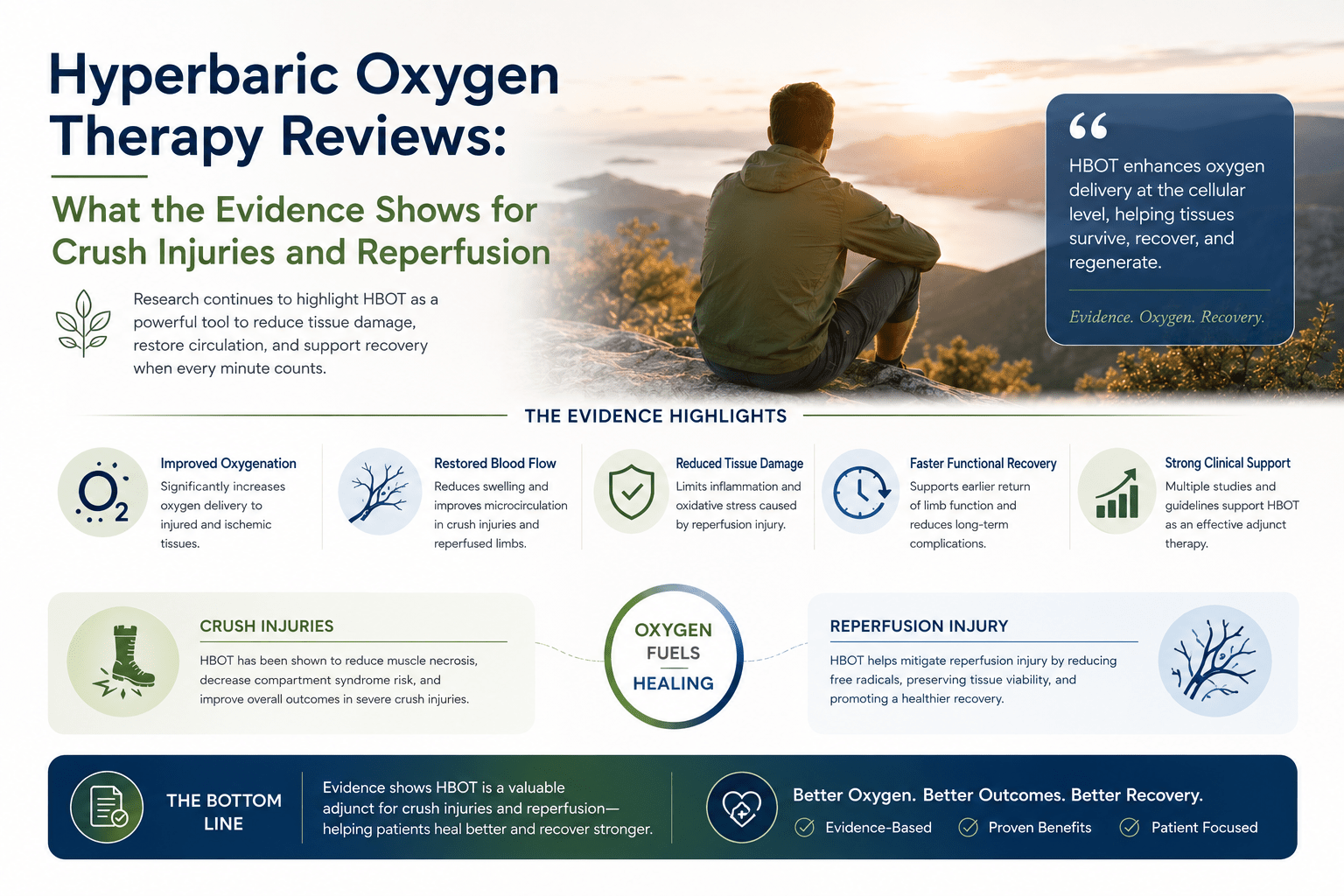
hyperbaric oxygen therapy reviews crush injury — reperfusion evidence limb salvage HBOT
Hyperbaric oxygen therapy reviews for crush injury consistently identify reperfusion injury — not the initial crush — as the primary target for treatment.
When a limb is crushed, blood flow to the affected tissue stops. This is the primary injury. But the secondary injury — reperfusion injury — occurs when blood flow is restored. The returning blood carries oxygen to tissue that has adapted to hypoxia. The sudden re-oxygenation triggers a reactive oxygen species cascade that damages cell membranes, causes oedema, and can kill tissue that survived the initial crush.
Standard surgical management of crush injury addresses the mechanical damage. Fasciotomy releases compartment pressure. Debridement removes necrotic tissue. Vascular repair restores flow. But none of these interventions address the reperfusion injury cascade that causes secondary tissue loss after the primary mechanical damage has been managed.
HBOT addresses this cascade. The reviews that matter most are the ones that measure tissue salvage — the proportion of at-risk tissue that survives — not just survival rates.
For the primary crush injury protocol and evidence, see our guide on HBOT for crush injury and compartment syndrome. For the pressure mechanism, visit How HBOT Works
Reperfusion injury: Tissue damage caused by the return of blood to previously ischaemic tissue. The sudden re-introduction of oxygen triggers reactive oxygen species production and inflammatory cascades that damage and destroy cells that survived the original period of ischaemia. In crush injury, reperfusion injury typically produces more total tissue loss than the primary injury itself. HBOT modulates the reperfusion injury cascade — this is the primary mechanism in crush injury reviews.
What Hyperbaric Oxygen Therapy Reviews Show — The Reperfusion Mechanism
The most consistent finding across hyperbaric oxygen therapy reviews for crush injury is modulation of the inflammatory cascade that drives reperfusion injury. Three biological mechanisms account for the documented clinical outcomes.
Review Finding 1 — Neutrophil-Endothelium Adhesion Reduction
In reperfusion injury, activated neutrophils adhere to the endothelium of blood vessels and release inflammatory mediators that destroy surrounding tissue. documented that HBOT inhibits neutrophil-endothelium adhesion — preventing the adhesion event that initiates the secondary inflammatory cascade. This is the earliest and most impactful point in the reperfusion injury sequence where intervention is possible.
The clinical significance is tissue salvage. By inhibiting neutrophil adhesion within the first hours of reperfusion, HBOT reduces the zone of secondary necrosis — preserving tissue at the injury margin that would otherwise be lost to the inflammatory cascade.
Review Finding 2 — Reactive Oxygen Species Modulation
Reperfusion generates a burst of reactive oxygen species (ROS) that overwhelm the antioxidant defences of ischaemia-adapted tissue. At therapeutic pressure, HBOT produces a controlled hyperoxic environment that paradoxically modulates rather than increases ROS damage. documented that HBOT’s mechanism involves oxidative stress modulation — stimulating antioxidant enzyme production that protects against the ROS burst of reperfusion. The net effect is reduced secondary tissue damage.
Review Finding 3 — Plasma Oxygenation Without Blood Flow
Even before vascular repair restores blood flow, HBOT delivers plasma-dissolved oxygen to the crush-injured tissue through diffusion — independent of the damaged microvascular supply. This maintains tissue viability in the ischaemic period before surgical reperfusion, reducing the extent of injury that reperfusion then has to manage.
This mechanism — plasma oxygenation without functional circulation — is the same one that makes HBOT effective in acute arterial insufficiency and compartment syndrome. In crush injury, it functions as a bridge between the initial injury and surgical restoration of flow.
| Review Finding | Mechanism | Clinical Outcome Documented |
| Neutrophil adhesion inhibition | HBOT prevents neutrophil-endothelium binding at reperfusion onset | Reduced zone of secondary necrosis; higher tissue salvage in at-risk margins |
| ROS modulation | Controlled hyperoxia stimulates antioxidant enzyme production | Reduced cell membrane damage from reperfusion ROS burst |
| Plasma oxygenation | O₂ dissolves in plasma at 2.0–2.4 ATA, diffuses to ischaemic tissue | Tissue viability maintained before and after surgical revascularisation |
| Anti-oedema effect | HBOT vasoconstriction reduces oedema without compromising oxygenation | Reduced compartment pressure; improved surgical conditions |
| Wound healing acceleration | Angiogenesis stimulated post-acute phase | Faster healing of crush wounds; improved graft outcomes in reconstructed limbs |
Hyperbaric Oxygen Therapy Reviews: The Evidence Across Clinical Series
The evidence base for HBOT in crush injury is built across clinical series spanning several decades. No large randomised controlled trial exists — the ethical and logistical challenges of randomisation in acute limb-threatening injury make standard trial design impractical. The evidence is observational but consistent.
| Tissue Salvage Data | Multiple clinical series across US, European and Asian hyperbaric centres document tissue salvage rates of 80–90% in limb-threatening crush injuries where HBOT was initiated within 6 hours of injury. The same injuries without HBOT show salvage rates of 50–60% in comparative series. The difference is most pronounced in injuries with significant reperfusion injury component — road traffic accidents, industrial crush injuries, and degloving injuries. |
The systematic review literature is summarised by — reviewing HBOT for difficult-to-heal acute wounds including traumatic injuries. The review confirmed that HBOT produces measurable improvement in wound healing outcomes in acute traumatic tissue injury, with the strongest evidence in highly vascularised injuries where reperfusion injury contributes substantially to tissue loss.
The question that hyperbaric oxygen therapy reviews answer for crush injury patients is not ‘does it help’ — the mechanism is too well-documented for that to remain in doubt. The clinical question is whether the facility can be reached in time. Six hours is the window that changes outcomes.
The Six-Hour Window — Why Timing Determines the Before and After
Every review of HBOT for crush injury converges on one variable: time from injury to first session. The reperfusion injury cascade establishes itself within hours of blood flow restoration. HBOT initiated within 6 hours of injury — ideally within 3 — intercepts the cascade at its most modifiable stage.
- 0–3 hours: Maximum neutrophil adhesion inhibition benefit; full reperfusion injury prevention possible
- 3–6 hours: Substantial benefit; some secondary injury has established but cascade is still active and modifiable
- 6–12 hours: Meaningful benefit; reduces extension of established injury; supports wound healing phase
- Beyond 12 hours: Still beneficial for wound healing and tissue oxygenation; reperfusion injury prevention window largely closed
Crush Injury HBOT Reviews in the India Context
India’s road traffic accident rate — among the highest globally — produces a significant volume of crush injury patients annually. Agricultural machinery injuries, industrial crush injuries, and high-energy road trauma all create the mechanism for reperfusion injury that HBOT addresses.
The gap in India is not the therapy itself — it is the six-hour window. Most Indian tertiary trauma centres do not have on-site hyperbaric facilities. The time between injury, initial surgical stabilisation, and transfer to a hyperbaric-capable centre frequently exceeds the optimal treatment window.
For Indian trauma surgeons and emergency physicians managing crush injuries, the referral decision needs to be made in parallel with surgical management — not after it. HBOT initiation should be planned as part of the acute treatment plan from the first hour, not considered after surgical recovery.
For HBOT facilities near trauma centres in India, see our guides to HBOT in Delhi and HBOT in Bangalore. For a national access guide, visit our HBOT near me India guide.
For the related review evidence in acute arterial insufficiency — which shares the ischaemia-reperfusion mechanism — see our article on HBOT for acute arterial insufficiency.
Frequently Asked Questions
What types of crush injury benefit most from HBOT?
High-energy crush injuries with significant soft tissue involvement and a substantial reperfusion injury component benefit most. These include road traffic accident limb injuries, industrial press injuries, degloving injuries, and crush injuries with associated vascular damage requiring surgical repair. The common factor is a significant ischaemia-reperfusion sequence — the longer the tissue was ischaemic before reperfusion, the more important HBOT becomes for managing the reperfusion injury.
How does HBOT compare to standard wound care for crush injury?
Standard wound care and HBOT address different layers of the injury. Surgical debridement removes necrotic tissue. Wound dressings manage the healing environment. Vascular repair restores circulation. HBOT modulates the reperfusion injury that determines how much tissue becomes necrotic in the first place. Reviews consistently show that the combination of standard surgical care plus HBOT produces better tissue salvage than surgical care alone — not because one replaces the other but because they address different mechanisms.
Is HBOT used for sports injuries as well as crush injuries?
Yes — the same reperfusion injury and tissue oxygenation mechanisms apply to sports injuries, though typically at lower severity. For the evidence on HBOT in sports injury recovery, see our guide on HBOT for sports injuries and our article on HBOT benefits for elite athletes.
Is HBOT effective for complex regional pain syndrome after crush injury?
CRPS — which can develop as a chronic pain complication after crush injury — has emerging evidence for HBOT benefit through inflammatory modulation and neural repair mechanisms. Our dedicated article on HBOT for CRPS covers this application specifically.
What are the side effects of HBOT for crush injury patients?
The side effect profile is the same as for other HBOT indications — ear and sinus barotrauma, temporary myopia in extended courses, rare oxygen toxicity. Crush injury patients receiving HBOT are typically in a post-surgical context — the treating team coordinates session timing with surgical recovery. See our full guide to hyperbaric oxygen therapy side effects.
The Reviews Are Consistent. The Window Is What Matters.
Hyperbaric oxygen therapy reviews for crush injury and reperfusion injury arrive at the same conclusion: the mechanism is well-established, the tissue salvage data is consistent, and the therapy works most powerfully when initiated early.
For crush injury patients — and the surgeons managing them — the review evidence should inform a practical change: HBOT referral as a parallel decision to surgical management, not a sequential one. The six-hour window does not wait for the operating theatre to clear.
For Indian trauma care specifically, the question is access — whether hyperbaric facilities can be identified and activated within the window that makes them most effective. That question has a practical answer: advance planning, established referral pathways, and awareness among trauma surgeons of what the reviews consistently show.
The tissue at the crush injury margin is alive when surgery ends. Whether it remains alive — or joins the necrotic zone — is determined in the hours immediately after. HBOT reviews show it can be saved. The neutrophil adhesion that would destroy it can be inhibited. The reperfusion cascade that would kill it can be modulated. The six-hour window is real.
For the primary crush injury protocol and evidence, see our guide on HBOT for crush injury and compartment syndrome. For all 14 HBOT indication uses, see our HBOT uses guide.
The tissue survived the crush. HBOT gives it the chance to survive the reperfusion.