

Why HBOT India Has a Pressure Problem
“India’s HBOT market is growing fast. Awareness is not growing at the same speed. That gap is where buyers get hurt.”
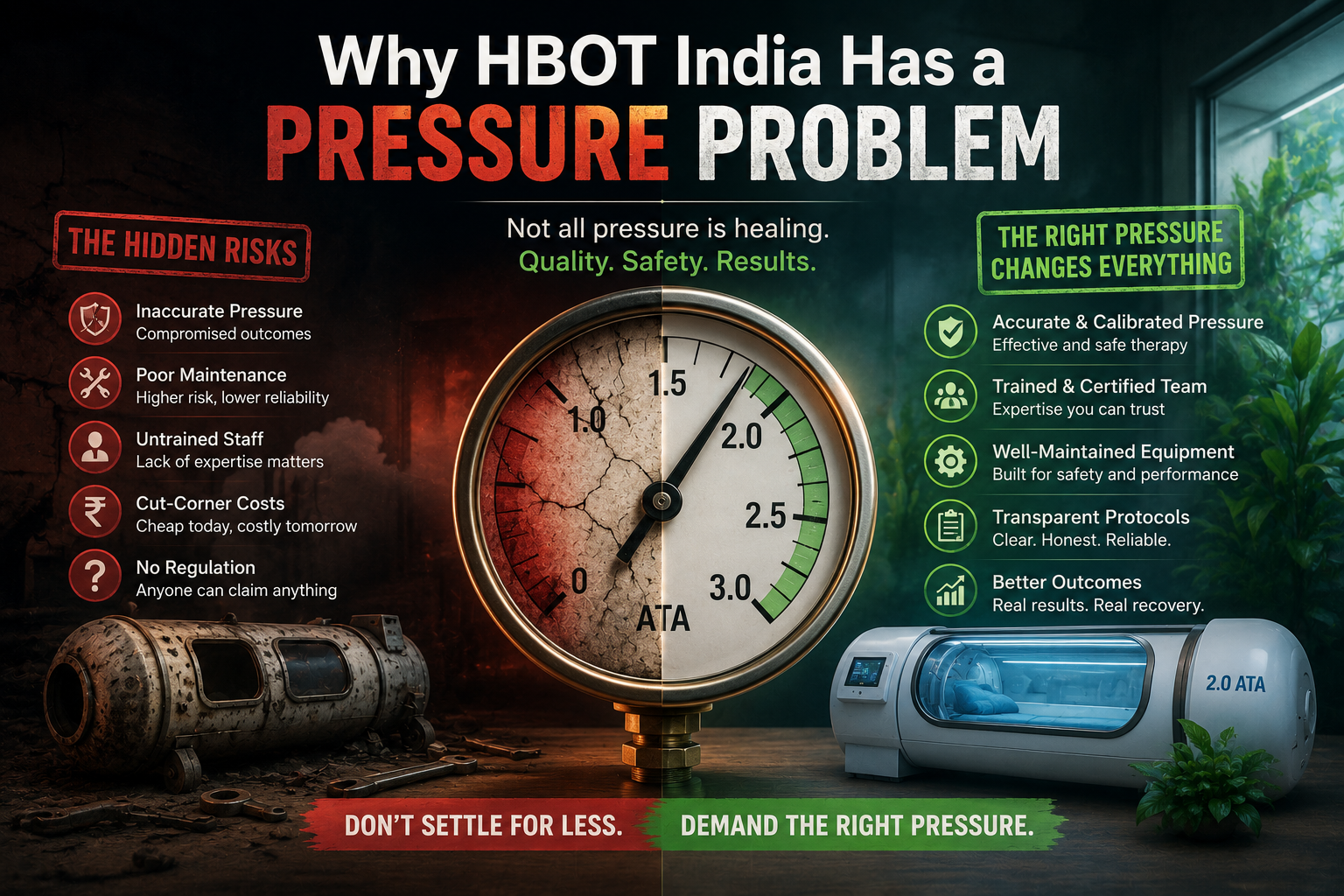 hbot india market — why India’s HBOT market has a pressure problem buyer guide 2026
The search results look the same. The websites use the same language. The prices vary by a factor of four. Nobody explains why.
If you have spent any time researching HBOT in India, you will have noticed something uncomfortable: facilities that charge ₹800 per session and facilities that charge ₹4,500 per session both describe what they offer using identical terminology. Both say hyperbaric. Both say oxygen therapy. Both reference healing, recovery, and wellness.
The buyer trying to make a rational decision has no framework to understand the gap. And without that framework, most buyers default to price — which is exactly the wrong signal in this market.
This is not a criticism of any facility or any category of provider. It is an honest account of how the Indian HBOT market reached a point where identical language describes fundamentally different products — and what you need to know to navigate it.
“When the same word describes two very different things, the word stops being useful. In India’s HBOT market right now, the word ‘hyperbaric’ has that problem.”
How the Indian HBOT Market Got to This Point
HBOT as a clinical therapy has been practiced in India for over two decades — primarily in hospital-based hyperbaric units attached to diving medicine, wound care, and surgical departments. These units use hard chambers, clinical-grade equipment, and physician oversight. They are regulated under medical device and hospital frameworks.
The wellness market entry is more recent and largely unregulated. As global interest in HBOT for longevity, athletic recovery, and cognitive health grew — driven by coverage of protocols used by high-performance athletes and longevity researchers — demand for accessible HBOT expanded rapidly in India’s metropolitan wellness market.
This demand was met not by the expansion of clinical HBOT facilities, but by the import and deployment of a different category of equipment entirely: low-pressure inflatable chambers, typically operating between 1.1 and 1.5 ATA, pressurised with ambient air or partial oxygen enrichment, marketed under the HBOT umbrella.
Fife CE et al. (Plastic and Reconstructive Surgery, 2016) — a landmark review of appropriate HBOT clinical standards — documented the equipment requirements for outcomes-producing HBOT in detail. Those requirements include a minimum pressure threshold, pure oxygen delivery, and certified pressure vessel construction. The low-pressure chambers entering India’s wellness market met none of these criteria for clinical protocols — but the word hyperbaric remained legally applicable because 1.3 ATA is, technically, above atmospheric pressure.
| The Regulatory Gap | India currently has no dedicated wellness HBOT regulatory framework. Medical-grade HBOT in hospital settings falls under CDSCO medical device regulation. Wellness centre HBOT chambers exist in a grey zone — they require general import clearance but no equipment-specific clinical certification for the therapy they are marketed as delivering. This is the structural gap that allows sub-clinical chambers to be marketed alongside clinical ones with no distinction visible to the buyer. |
Why Wellness Branding Accelerated the Problem
Clinical HBOT carries specific connotations — hospital settings, physician oversight, documented indications. These connotations limit its market appeal to buyers with active conditions.
Wellness branding removed those limitations. By framing HBOT as a recovery tool, a performance enhancer, a longevity investment, providers could reach athletes, executives, and health-conscious individuals who would never have considered a clinical therapy. This was a legitimate market development — clinical HBOT genuinely does have applications in all these areas at appropriate pressure.
But the wellness framing also created the cover under which low-pressure chambers entered the same space. A chamber operating at 1.3 ATA with ambient air is plausibly a wellness device. It is not clinical HBOT. But in a market where the distinction is invisible to buyers, both sell under the same description.
What “Hyperbaric” Actually Requires — and What It Doesn’t
This is the central information gap that most Indian HBOT buyers carry.
The word hyperbaric means above normal atmospheric pressure — that is 1.0 ATA at sea level. Any environment above 1.0 ATA is technically hyperbaric. A chamber pressurised to 1.1 ATA qualifies. So does a chamber at 2.0 ATA. The word does not specify how much above, or what oxygen is delivered, or whether the pressure is sustained.
| The Clinical Threshold | Thom SR (Plastic and Reconstructive Surgery, 2011) established the mechanism of clinical HBOT clearly: the therapeutic cascade — plasma oxygen dissolution, stem cell mobilisation, angiogenesis, anti-inflammatory response — activates meaningfully at pressures of 2.0 ATA and above when breathing 100% pure oxygen. The word hyperbaric does not guarantee this. Only the specific combination of pressure level and oxygen delivery does. |
This means a provider can legally describe their offering as hyperbaric oxygen therapy while operating at a pressure that does not activate the mechanisms documented in clinical research. They are not making a false claim. They are making a technically accurate but functionally misleading one.
Bhutani and Vishwanath (Indian Journal of Plastic Surgery, 2012) noted in their review of HBOT in India that the clinical application of hyperbaric oxygen requires specific pressure parameters to achieve its documented biological effects. Those parameters are equipment-dependent. The label alone tells you nothing about whether the equipment meets them.
The Three Categories of HBOT Provider Currently Operating in India
The Indian HBOT market in 2026 essentially has three distinct provider categories. They are not always easy to distinguish from the outside — which is why the questions in our
eight-point chamber checklist eight-point chamber checklist matter so much. Understanding these categories is the first step.
| Category | What They Operate | What They Deliver | Who They Serve |
| Hospital-Based Clinical Units | Hard chamber — 2.0 to 2.4 ATA — pure oxygen — trained clinical staff — full monitoring | Clinical HBOT matching peer-reviewed protocols. Documented outcomes for wound healing, neuroplasticity, emergency indications. | Post-surgical recovery, wound care, neurological conditions, emergency cases. Usually requires physician referral. |
| Dedicated Wellness Centres (Hard Chamber) | Hard chamber — 2.0 ATA — pure oxygen — trained operators — scheduled maintenance | Full therapeutic HBOT for wellness, longevity, sports recovery, and condition management. Outcomes match research protocols. | Longevity seekers, athletes, recovery-focused buyers, condition management without clinical setting requirement. |
| Low-Pressure Wellness Chambers | Soft or semi-rigid chamber — 1.1 to 1.5 ATA — ambient air or partial oxygen — variable oversight | Mild oxygenation and general wellness support. Outcomes do not match clinical HBOT research. Often marketed with clinical language. | General wellness, relaxation, mild recovery. Not appropriate for condition-specific protocols requiring 2.0 ATA. |
The critical point is that Categories 1 and 2 deliver clinical-grade HBOT. Category 3 delivers something real — but it is not the same thing, and the outcomes associated with clinical HBOT research do not apply to it.
Most of the price variation in the Indian market reflects the difference between these categories — not margin differences within the same category. A ₹900 session and a ₹3,500 session are not the same product at different prices. They are different products.
What the Price Range in India’s HBOT Market Is Actually Telling You
Session prices for HBOT in India in 2026 range from approximately ₹600 to ₹8,000. This is not a normal market price spread — it is a capability spread masquerading as a price spread.
| Session Type | Typical Price Range (INR) | What It Reflects | Appropriate For |
| Low-pressure soft chamber session | ₹600 – ₹1,200 | Minimal equipment cost, low overhead, ambient air | General wellness; NOT condition-specific HBOT |
| Mid-range hard chamber session | ₹1,500 – ₹2,500 | Hard chamber with moderate infrastructure | Verify pressure and O₂ delivery before booking |
| Full-specification hard chamber session | ₹2,500 – ₹5,000 | 2.0 ATA, pure O₂, trained staff, certified equipment | Condition management, longevity protocols, clinical outcomes |
| Hospital-based clinical HBOT | ₹3,000 – ₹8,000+ | Clinical oversight, physician involvement, full monitoring | Post-surgical, wound care, emergency indications |
The price floor for a legitimate 2.0 ATA session with pure oxygen delivery, trained staff, and certified equipment has a real cost structure behind it. Compressor-grade pressure systems, medical-grade oxygen supply, operator training, and chamber certification all carry cost. Sessions priced well below ₹1,500 in the commercial wellness market almost always reflect a compromise on one or more of these elements.
This is not a commercial argument. It is a cost-of-delivery observation. Understanding
what drives chamber cost what drives chamber cost makes the price signal legible.
Already visited a facility? If you have been to an HBOT centre in India and something in what they told you did not quite add up — we can help you read it. Tell us what you were told and we will give you a straight assessment of whether it holds up against the standard.
Why Awareness Is Growing Faster Than Quality Standards
India’s HBOT market is genuinely growing. Demand is expanding across Delhi NCR, Bangalore, Mumbai, Hyderabad, and Chennai. Media coverage of longevity protocols and athlete adoption is driving first-time searches at scale. This is real market development.
But awareness growth and quality standard growth are not moving at the same pace. As more buyers search for HBOT, more providers enter the market to meet demand — including providers whose equipment does not meet clinical specification. The demand signal does not distinguish between categories. The market response serves all categories simultaneously.
The result is a market where a buyer who has just read about HBOT’s longevity evidence — Efrati et al. (Aging, 2020) — and searches for a facility near them may end up in a Category 3 centre operating at 1.3 ATA with ambient air. The research they read was produced at 2.0 ATA with pure oxygen. The session they booked cannot replicate it. Nobody told them this was possible.
What Changes This
Three things change this market dynamic over time. Regulatory frameworks — which will eventually come as the market matures. Provider self-differentiation — as quality providers realise the commercial value of clearly distinguishing their offering. And buyer education — which is what this series exists to deliver.
An informed buyer changes the market incentive. When buyers ask the eight questions from Phase A before booking, and providers who cannot answer lose business to providers who can, the market corrects. Not overnight. But cumulatively, at scale.
Frequently Asked Questions
Is it illegal for a wellness centre to call their service HBOT if they operate at 1.3 ATA?
No — not under India’s current regulatory framework. The term hyperbaric is a physical descriptor, not a regulated clinical claim. A chamber operating at any pressure above atmospheric is technically hyperbaric. The absence of a regulatory requirement to specify pressure level and oxygen delivery system is precisely the structural gap that allows the current market ambiguity. This is expected to change as the market matures and regulatory attention increases.
How do I know which category a facility falls into before visiting?
The simplest path is to ask the eight questions from our HBOT chamber checklist for India before booking. Most Category 1 and 2 providers will answer all eight clearly. Most Category 3 providers will not be able to answer Questions 1, 2, and 3 with specificity — because their equipment does not support the answers those questions require.
Are low-pressure HBOT sessions worthless?
Not worthless — but limited in scope. Category 3 sessions deliver mild oxygenation and some recovery support. They are not appropriate for condition-specific protocols, longevity research applications, or any clinical indication. The problem is not that these sessions exist — it is that they are marketed using language that implies clinical equivalence with Categories 1 and 2.
Is HBOT in India more affordable than in Western markets?
Yes — significantly. A full-specification 2.0 ATA session in India at ₹2,500 to ₹4,000 is a fraction of the equivalent cost in the US or UK. This makes India potentially one of the most accessible markets globally for legitimate clinical HBOT. The challenge is finding Category 1 or 2 providers confidently — which is what this series is designed to equip you to do.
What will the Indian HBOT market look like in the next three to five years?
The trajectory is toward consolidation and differentiation. As awareness grows, buyers will become more sophisticated. Quality providers will have commercial incentive to differentiate clearly. Regulatory attention will increase as the therapy gains mainstream adoption. The likely outcome is a clearer market split between clinical and wellness categories — with more precise labelling requirements for each. The buyers best positioned in that transition are the ones who already know how to evaluate what they are being offered.
The Market Is Not the Problem. The Information Gap Is.
India’s HBOT market has real providers delivering genuine clinical outcomes. It also has providers whose equipment cannot deliver those outcomes at the pressure they operate at. Both exist. Both are growing.
The information gap between them is not permanent. It closes as buyers become more informed, as quality providers differentiate more clearly, and as the market develops the vocabulary to describe what it is actually selling.
You now have the vocabulary. You have the three-category framework. You have the price signal context. Combined with the Phase A framework — what medical grade means, why pressure determines outcomes, and the eight questions to ask — you are equipped to navigate this market as it currently stands.
For the pressure science that explains why category differences matter biologically, read our guide to why 1.3 ATA and 2.0 ATA produce different outcomes.
Evaluating a facility right now? If you have visited a centre, received a quote, or been shown a chamber and want a second opinion on whether what you were told reflects the standard — we are here. Tell us what you were told. We will give you a straight read.


Subscribe
One Comment
Comments are closed.
[…] For context on how India’s market reached its current price spread, see our analysis of why India’s HBOT market has a pressure problem. […]