
Hyperbaric Oxygen Therapy for Depression and Anxiety: What the Science Shows
hyperbaric oxygen therapy for depression and anxiety brain mental health India
Living with depression or anxiety is exhausting in a way that is hard to explain to people who have not been through it.
Medication helps many people. Therapy helps many people. But for a significant number, the improvement is partial — and the question of whether there is anything else becomes an important one.
Research on hyperbaric oxygen therapy for depression and anxiety is early but not absent. Several studies suggest that HBOT may support improvements in mood, anxiety, and psychological function — particularly when mental health symptoms are connected to neurological or physical conditions.
This article explains what the current research shows, how honest the picture is, and what people considering HBOT for mental health support should know before making any decisions.
| Important: HBOT is not a treatment for depression or anxiety. It is not a substitute for prescribed psychiatric medication, psychotherapy, or any other recommended mental health treatment. If you are experiencing a mental health crisis, please speak to a doctor, mental health professional, or call a crisis helpline immediately. This article is informational only. |
The Brain-Oxygen Connection: Why HBOT Has Relevance to Mental Health
Depression and anxiety have complex causes — genetic, psychological, social, and biological. The biological dimension is relevant here.
Research has identified several brain-level mechanisms that contribute to depression and anxiety: chronic neuroinflammation, disrupted neurotransmitter pathways, mitochondrial dysfunction in neural cells, and reduced blood flow to specific brain regions.
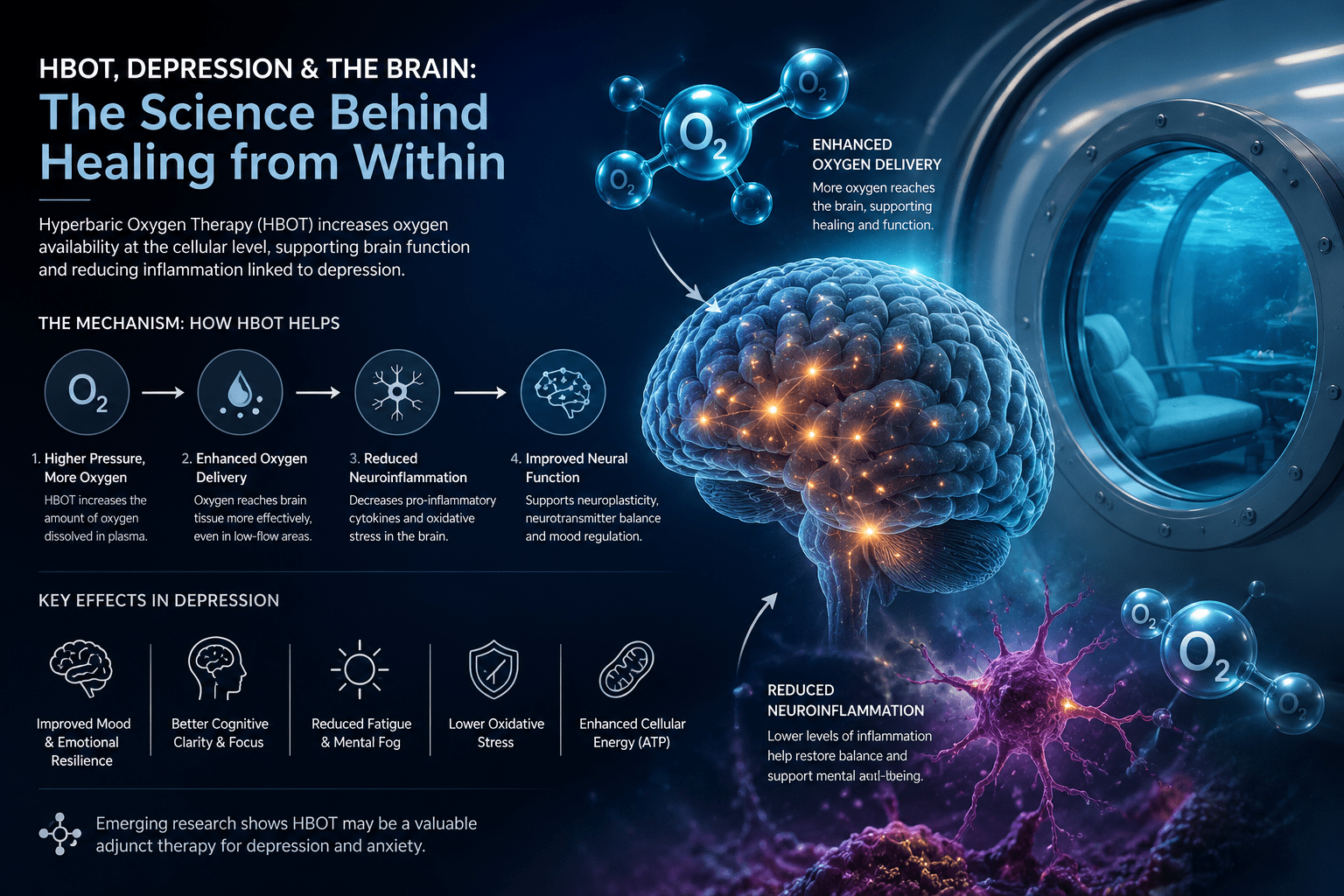
HBOT works by dissolving oxygen under pressure directly into blood plasma, allowing it to reach tissues with compromised circulation — including brain regions with reduced perfusion. This is the same mechanism that makes HBOT relevant in stroke and TBI recovery.
In mental health, the hypothesis is that HBOT may support recovery by reducing neuroinflammation, improving mitochondrial energy production in neural cells, and supporting neuroplasticity — the brain’s ability to rewire and repair itself.
For a plain-language explanation of how HBOT works, read our guide on what HBOT is and how it works. For the neuroplasticity mechanism specifically, see our article on how HBOT supports neuroplasticity.
How HBOT May Help With Depression and Anxiety — The Proposed Mechanisms
Several mechanisms connect HBOT to mental health outcomes:
- Reducing neuroinflammation — Chronic low-grade neuroinflammation is increasingly recognised as a contributing factor in depression. HBOT has demonstrated anti-inflammatory effects in neural tissue, inhibiting inflammatory cytokines linked to depressive symptoms.
- Supporting brain oxygenation — Brain imaging studies in patients with depression and PTSD have identified areas of reduced cerebral blood flow. HBOT may improve oxygenation in these hypoperfused areas. Vadas D et al (Front Integr Neurosci, 2017) showed that HBOT enhanced brain activity and cognitive performance in healthy subjects.
- Activating neuroprotective pathways — He H et al (Neuropsychiatr Dis Manage, 2019) found that HBOT activated the Akt/GSK3β/β-catenin pathway — a neuroprotective signalling route that reduces neuronal apoptosis (cell death). This pathway is relevant to both TBI recovery and emerging depression research.
- Reducing PTSD-linked anxiety — The strongest mental health evidence for HBOT comes from PTSD research, where anxiety is a core symptom. Multiple studies on TBI-associated PTSD have shown improvements in anxiety markers following HBOT protocols (Eve DJ et al, Neuropsychiatr Dis Manage, 2016; Harch PG et al, Med Gas Res, 2017).
hbot depression anxiety brain oxygen neuroinflammation mechanism research
Hyperbaric Oxygen Therapy for Depression and Anxiety — What the Research Shows
It is important to be clear about the evidence level here. There are no large randomised controlled trials specifically targeting primary depression or generalised anxiety disorder with HBOT. The evidence comes from related areas:
TBI and PTSD — Strongest evidence
The most consistent mental health evidence for HBOT comes from patients with traumatic brain injury (TBI) and PTSD — where depression and anxiety are common co-occurring symptoms.
Harch PG et al (Med Gas Res, 2017) conducted a case-control study of 71 TBI patients with persistent post-concussion syndrome and PTSD. Following 40 HBOT sessions, patients showed significant improvements in PTSD symptoms, depression scores, and quality of life measures. The improvements were sustained at follow-up.
Harch PG, Andrews SR, Fogarty EF, et al. Case control study: hyperbaric oxygen management of mild TBI persistent post-concussion syndrome and PTSD. Med Gas Res. 2017;7(3):156–174.
Eve DJ et al (Neuropsychiatr Dis Manage, 2016) reviewed the literature on HBOT for PTSD associated with TBI and found significant evidence supporting HBOT’s role in reducing anxiety and PTSD symptom burden.
Eve DJ, Steele MR, Sanberg PR, et al. Hyperbaric oxygen therapy as a potential treatment for PTSD associated with TBI. Neuropsychiatr Dis Manage. 2016;12:2689–2705.
Cognitive function and mood — supporting evidence
Vadas D et al (Front Integr Neurosci, 2017) showed that HBOT improved brain activity, multitasking performance, and mood in a controlled study. While not a depression trial per se, the mood improvement findings are relevant.
Vadas D, Kalichman L, Hadanny A, et al. Hyperbaric oxygen environment can enhance brain activity and multitasking performance. Front Integr Neurosci. 2017;11:25.
Honest gaps to acknowledge
There is currently no dedicated randomised controlled trial showing that HBOT treats primary depression or generalised anxiety disorder as a standalone condition. The evidence is predominantly in depression and anxiety as secondary symptoms of TBI and PTSD.
This does not mean HBOT has no role — but it does mean the evidence basis is not as strong as for conditions like diabetic wounds or radiation injury. If you are considering HBOT for mental health, go in with realistic expectations and always alongside, not instead of, prescribed care.
HBOT and PTSD — The Closest Evidence Link
PTSD sits at the intersection of mental health and neurological injury. Anxiety is one of its core symptoms. And the HBOT evidence for PTSD is more developed than for depression alone.
The Harch et al 2017 study enrolled veterans and civilian patients with TBI-associated PTSD. After 40 sessions at 1.5 ATA, patients showed:
- Significant reduction in PTSD checklist scores
- Improvement in depression rating scale scores
- Reduction in anxiety measures
- Improved sleep and quality of life
The neurological basis for these improvements — reduced neuroinflammation, improved brain perfusion, neuroprotective pathway activation — is the same mechanism that underlies HBOT’s role in TBI and stroke recovery.
For our full article on PTSD and trauma recovery with HBOT, see HBOT for PTSD and trauma recovery. And for the celebrity angle on HBOT and mental health, see our article on Justin Bieber and HBOT for mental health.
What a Mental Health HBOT Protocol Looks Like
There is no standardised HBOT protocol for depression or anxiety. Where mental health improvements have been observed, they have typically been secondary outcomes in neurological protocols. A general reference:
| Protocol Element | Typical Range | Notes |
| Pressure | 1.5–2.0 ATA | Harch 2017 used 1.5 ATA; many clinical setups use 2.0 |
| Session length | 60–90 minutes | 60 mins most common |
| Frequency | 4–5 days per week | Daily protocol in most research setups |
| Total sessions | 20–40 | Reassess at midpoint |
| Alongside | Prescribed treatment | HBOT is adjunctive — never a replacement |
Any clinic offering HBOT for mental health should be using a PVHO-certified hard chamber — a pressure vessel for human occupancy meeting ASME PVHO standards — operating at the appropriate clinical pressure. A soft portable chamber at 1.3 ATA is not appropriate for neurological or mental health protocols.
For safety information and what a certified clinic should look like, read our guide on is HBOT safe and our article on PVHO chamber safety in India.
What Patients in India Should Know Before Seeking HBOT for Mental Health
If you are considering HBOT for depression, anxiety, or PTSD, take these steps first:
- Do not replace prescribed treatment — HBOT should be discussed with your psychiatrist or psychologist as a complementary addition to your existing care — not an alternative to it.
- Be honest about your history — Tell the HBOT clinic about all medications, your mental health diagnosis, and any history of seizures or neurological events. These affect the protocol design.
- Set realistic expectations — The evidence for HBOT in PTSD and TBI-associated depression is genuinely positive. The evidence for HBOT in primary depression or GAD is much more limited. Know which category you are in.
- Ask for a written protocol — Any responsible clinic will document the number of sessions, pressure, frequency, and goals before you start.
- Seek out certified clinics — Mental health HBOT, where it is used, should happen at a PVHO-certified hard-chamber facility under medical supervision. Not a wellness spa with a portable unit.
To find certified clinics near you, see our guide on find a certified HBOT clinic near you. For cost guidance, see HBOT cost in India. And for our related article on brain function recovery, see HBOT and brain function recovery.
Frequently Asked Questions
Can hyperbaric oxygen therapy help depression?
Research suggests HBOT may help with depression symptoms when they are connected to neurological conditions like TBI or PTSD. The evidence for HBOT in primary depression as a standalone condition is limited. HBOT should always be used alongside, not instead of, prescribed psychiatric treatment.
Can HBOT help with anxiety?
The strongest evidence is for anxiety as part of PTSD following TBI, where multiple studies show improvements in anxiety scores after HBOT. For generalised anxiety disorder without an underlying neurological basis, the evidence is limited. Discuss with your doctor before starting.
How many HBOT sessions are needed for mental health support?
Most research protocols run 20 to 40 sessions at 1.5 to 2.0 ATA. The Harch et al 2017 PTSD study used 40 sessions. Mental health improvements often appear gradually across sessions rather than immediately after a first visit.
Is HBOT safe for someone with depression or anxiety?
HBOT is generally safe at certified clinics for people with depression or anxiety. Key precautions include: disclosure of all medications (particularly MAOI antidepressants), disclosure of any history of seizures, and ensuring the clinic uses a PVHO-certified chamber at 2.0 ATA under medical supervision.
Where can I access HBOT for mental health support in India?
Certified HBOT centres treating neurological and mental health conditions are available across Delhi NCR, Mumbai, Bangalore, Chennai, Hyderabad, and Noida. Use our resource on find a certified HBOT clinic near you to find the nearest certified centre.


Subscribe
One Comment
Comments are closed.
[…] the full evidence: HBOT for PTSD and depression | HBOT for depression and […]