HBOT vs Physiotherapy: Competing or Complementary for Recovery?
These are not really competitors. Physiotherapy restores movement, strength and function through targeted exercise and manual therapy; HBOT works one level deeper, supporting the tissue healing and oxygenation that recovery is built on. For most injuries the honest answer is “both” — HBOT does not replace rehabilitation.
Weighing up HBOT vs physiotherapy? This guide compares hyperbaric oxygen therapy with physiotherapy honestly — what each does, a side-by-side table, when each is the better choice, and whether they work together. For the therapy itself, see our hyperbaric oxygen therapy guide.
Tell us your condition and goal — we’ll give you an honest, doctor-led view of whether hyperbaric oxygen therapy fits, and say so plainly if it doesn’t.
📞 Call +91 98219 94283💬 WhatsApp usBook free consultation →📍 Get directionsHBOT vs Physiotherapy: side by side
| HBOT | Physiotherapy | |
|---|---|---|
| Works at the level of | Tissue & cells (oxygen, repair) | Muscles, joints, movement, function |
| Primary aim | Support the healing environment | Restore strength, mobility and function |
| How it is delivered | Rest & breathe in a pressurised chamber | Active exercise, manual therapy, retraining |
| Your role | Passive during the session | Active participation and effort |
| Best suited to | Slow-healing tissue, recovery support | Rebuilding function, mobility, strength |
| Evidence | Recognised for specific indications; adjunctive elsewhere | Strong, first-line for musculoskeletal & neuro rehab |
| Replaces the other? | No | No |
What is HBOT?
HBOT raises oxygen delivery to injured, poorly-perfused tissue and supports repair at the cellular level — helping create the conditions in which healing happens. See the recognised uses in our 14 indications guide.
How hyperbaric oxygen therapy works
Before comparing, it helps to know what HBOT actually does. Hyperbaric oxygen therapy means breathing near-100% oxygen inside a pressurised chamber, usually around 2.0 ATA. At that pressure the blood plasma carries far more dissolved oxygen than normal — enough to reach tissue that ordinary breathing cannot. Beyond delivering oxygen, a course of HBOT triggers the body’s own repair signalling: new blood-vessel growth (angiogenesis), reduced inflammation, mobilisation of the body’s own stem/progenitor cells and better mitochondrial energy. These are the documented mechanisms behind its recognised uses in wound healing and radiation injury, and the reason it is studied so widely. Crucially, HBOT is not a cure-all — it has a defined list of recognised indications, and everywhere else it is adjunctive support to be discussed with your doctor.
What is Physiotherapy?
Physiotherapy uses assessed, progressive exercise, manual therapy and movement retraining to restore range, strength, balance and function after injury, surgery or a neurological event.
When HBOT is the better choice
Choose HBOT as adjunctive support when tissue healing is slow or compromised, or for a recognised indication — helping the body reach a state where rehabilitation can progress. Explore the evidence in our research hub.
When physiotherapy is the better choice
Choose physiotherapy as the first-line, essential foundation for almost any musculoskeletal or neurological recovery — it is what actually rebuilds function.
How to choose between HBOT and physiotherapy
Rather than asking which is ‘better’ in the abstract, work through your own situation:
- What is the actual goal? Tissue healing and oxygenation point toward HBOT; physiotherapy suits its own, different aim (above).
- What does your treating doctor advise? Either option should fit alongside your existing care, not replace it.
- Is it a recognised use? HBOT has a defined list of recognised indications; outside them it is adjunctive — and the same honesty applies to physiotherapy.
- Invasiveness, time and cost. Weigh how invasive each is, the session commitment, and the total course cost.
- Could both help? They often target different things and can be complementary — see below.
Can you combine HBOT and physiotherapy?
Absolutely — this is the ideal pairing. HBOT supports the tissue; physiotherapy rebuilds the function on top of it. Sequence and intensity should be planned with your physiotherapist and doctor.
What HBOT involves in practice
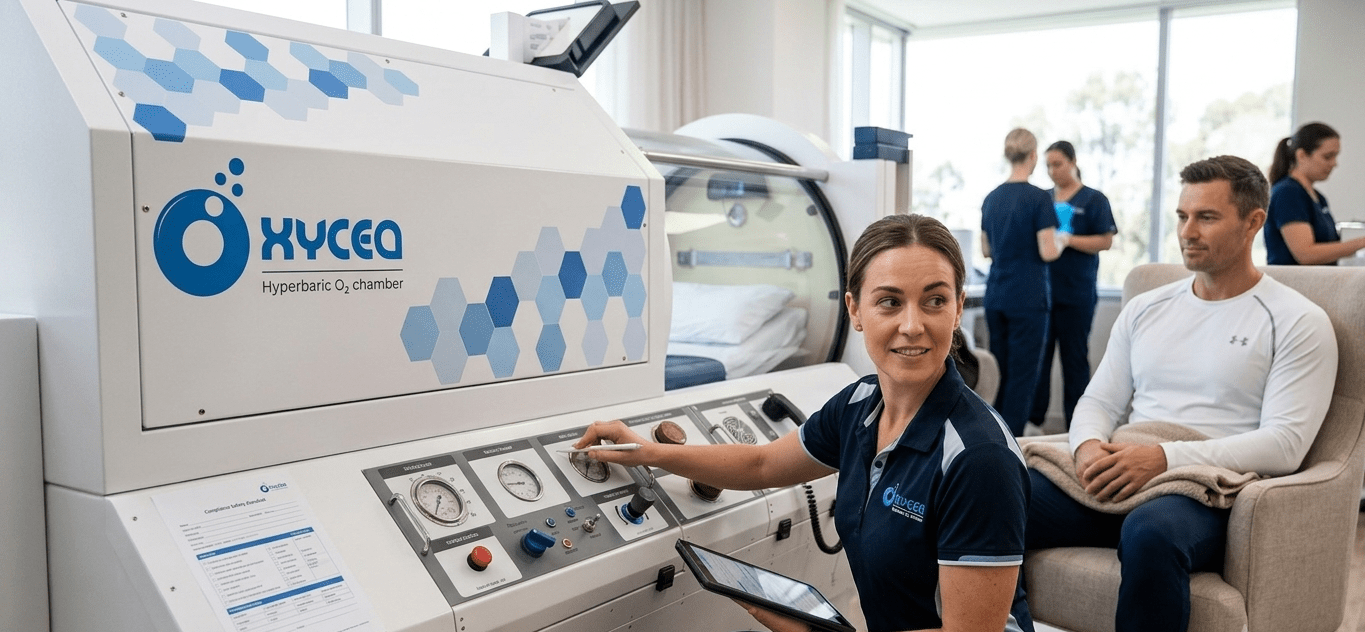
A genuine course of HBOT follows a clear pattern: a consultation and medical intake first; then sessions in which you wear cotton clothing, rest in the chamber while it gently pressurises (a mild ear-fullness like an aircraft descent), breathe oxygen at target pressure for 60–90 minutes, and decompress slowly — with no downtime afterwards. Most indications need a course of multiple sessions rather than a single visit, and a good clinic agrees a midpoint review to check for genuine benefit. Insist on a PVHO-certified hard chamber and a proper clinical intake; see our patient safety guide and how many sessions you need.
Red flags to watch for with either treatment
Both HBOT and physiotherapy are sometimes over-marketed in wellness settings, so the same caution applies whichever you consider:
- Guaranteed-cure language. No honest clinic promises a cure — for physiotherapy or for HBOT. Recovery and results vary between people.
- Pressure to buy a large package upfront before any assessment or a chance to see how you respond.
- Claims well beyond the evidence — especially for serious conditions. Ask what the actual research says, and check it against our research hub.
- No named clinician or proper intake. A real medical service reviews your history and tells you honestly if the treatment is not appropriate.
- For HBOT specifically: a soft, low-pressure chamber sold as equivalent to a PVHO-certified hard chamber — read our hard vs soft chamber guide.
The honest verdict
These are not really competitors. Physiotherapy restores movement, strength and function through targeted exercise and manual therapy; HBOT works one level deeper, supporting the tissue healing and oxygenation that recovery is built on. For most injuries the honest answer is “both” — HBOT does not replace rehabilitation. Whatever you choose, insist on medical-grade, PVHO-certified HBOT and be wary of any centre promising a guaranteed cure. HBOTLAB gives honest, doctor-led guidance across India and will tell you if HBOT isn’t right for you — find a centre via our HBOT near me hub.
Tell us your condition and goal — we’ll give you an honest, doctor-led view of whether hyperbaric oxygen therapy fits, and say so plainly if it doesn’t.
📞 Call +91 98219 94283💬 WhatsApp usBook free consultation →📍 Get directionsFrequently asked questions
Can HBOT replace physiotherapy?
No. Physiotherapy is what actually rebuilds strength, movement and function; HBOT only supports the underlying tissue healing. They work best together, not as substitutes.
Should I do HBOT before or after physiotherapy?
It varies with the injury and stage of recovery — your physiotherapist and doctor should plan the sequence. Often HBOT supports early tissue healing while physiotherapy progresses function alongside it.
Does HBOT help sports injury recovery more than physio?
No single tool “wins” — physiotherapy rebuilds function while HBOT can support the tissue-healing environment. For serious injuries they are best combined.
How much does HBOT cost compared with physiotherapy?
HBOT is priced per session or as a package, and most indications need a course, so compare the total course cost — not one session. Pricing depends on the chamber standard and protocol; see our HBOT cost in India guide, and confirm a centre uses a PVHO-certified hard chamber. Physiotherapy is priced differently, so compare on value and evidence, not headline rates.
Should I try HBOT or physiotherapy first?
It depends on your goal and your doctor’s advice — they are often not either/or. Start with an honest assessment of what you are trying to achieve; HBOTLAB will tell you plainly whether HBOT fits your situation or whether physiotherapy (or standard care) is the more relevant route.