
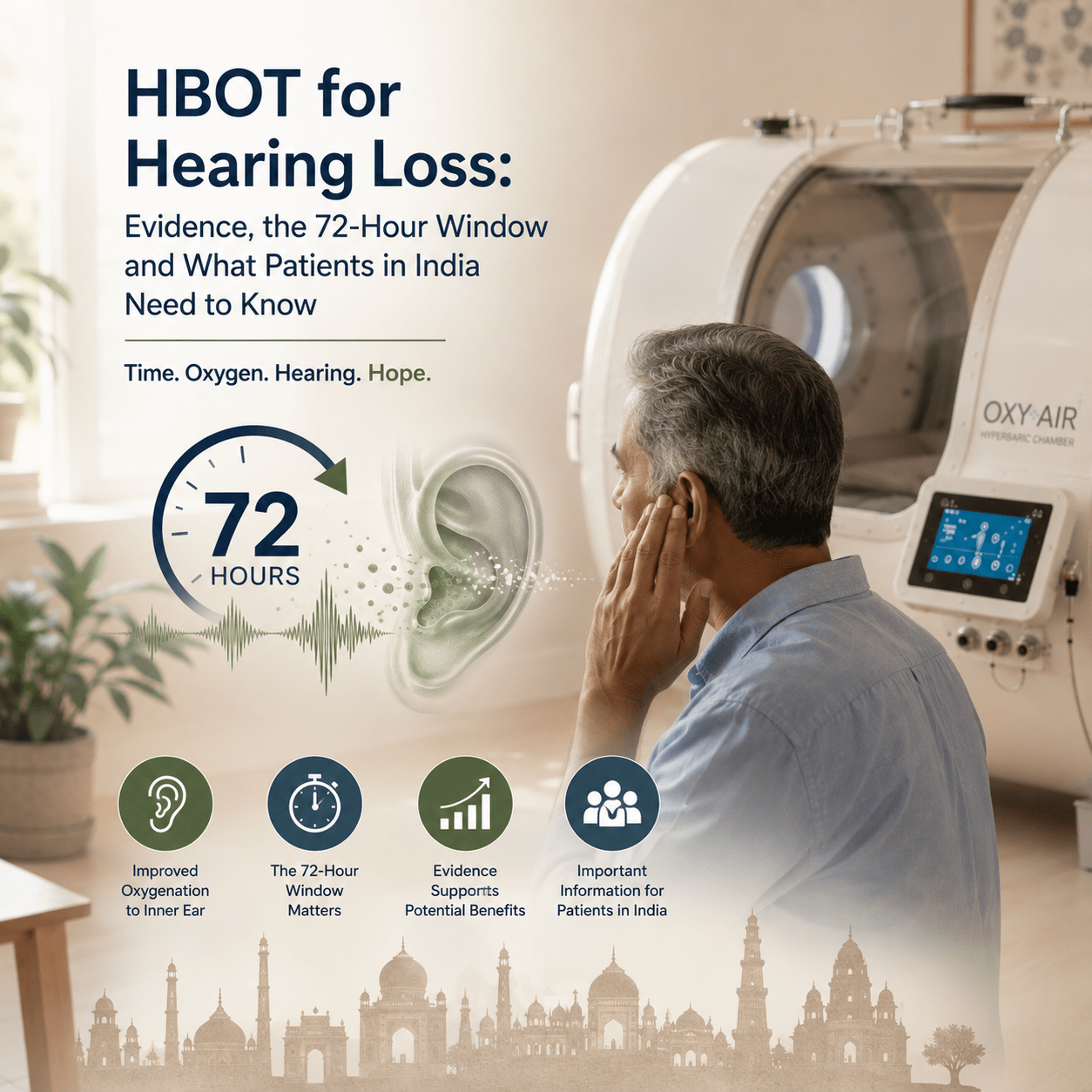
HBOT for Hearing Loss: Evidence, the 72-Hour Window and What Patients in India Need to Know
| ⚠ SUDDEN HEARING LOSS — SEEK TREATMENT IMMEDIATELY |
|---|
| Sudden sensorineural hearing loss (SSHL) is a medical emergency. If you or someone you know has experienced sudden loss of hearing in one or both ears — especially on waking — go to a hospital emergency department immediately. The treatment window is 72 hours. After 72 hours, the chance of recovery declines significantly. HBOT is most effective when started within this window alongside corticosteroid treatment. Do not wait to read more. Do not search for a clinic. Go to A&E now. |
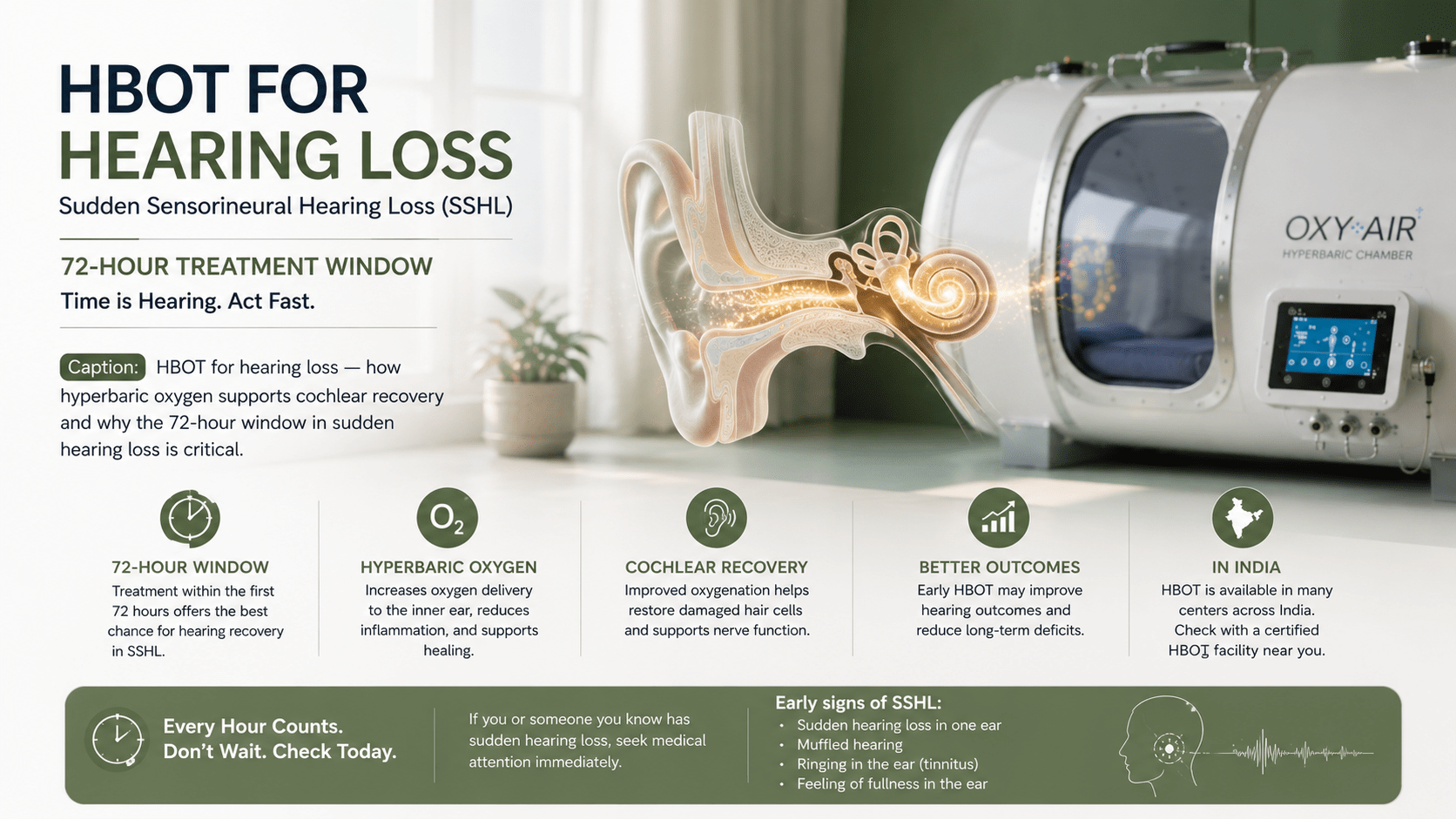 hbot for hearing loss sudden sensorineural SSHL 72-hour treatment window India Caption: HBOT for hearing loss — how hyperbaric oxygen supports cochlear recovery and why the 72-hour window in sudden hearing loss is critical.
Not all hearing loss is the same. The type determines both the urgency and whether HBOT for hearing loss has any role to play.
For sudden sensorineural hearing loss — the kind that happens with little or no warning, often on waking — HBOT combined with corticosteroids is an established adjunctive treatment that must begin within 72 hours to have meaningful effect. This is a genuine medical emergency.
For chronic tinnitus and age-related hearing loss, the evidence is more limited and the urgency is different. HBOT may provide some benefit — but the timeframe is not 72 hours.
This article explains what the science shows for each type, and what patients and families in India need to know.
Two Very Different Conditions — Same Search, Different Urgency
Sudden Sensorineural Hearing Loss (SSHL)
SSHL is defined as a loss of 30 dB or more across three frequencies, occurring within 72 hours. It typically affects one ear. It can happen during sleep — patients wake with one ear that simply does not work.
SSHL is classified as a medical emergency. The cochlear hair cells that process sound are among the most oxygen-sensitive cells in the human body. They have no blood-borne oxygen reserve. When blood flow to the cochlea is compromised — which appears to be the primary mechanism in SSHL — hair cells begin to die within hours.
HBOT has a well-established role in SSHL treatment internationally. By dissolving oxygen directly into blood plasma under pressure, HBOT can deliver oxygen to the cochlea even when localised circulation is compromised. The treatment is most effective when started within 72 hours of onset.
Chronic Tinnitus and Age-Related Hearing Loss
Tinnitus — ringing, buzzing, or hissing in the ears — has a more mixed evidence base for HBOT. Several small studies have shown improvements in noise-induced and idiopathic tinnitus when HBOT is applied in the acute phase (within weeks of onset). For chronic tinnitus lasting months or years, the evidence is less compelling.
Age-related hearing loss (presbycusis) is a progressive degenerative process. HBOT is not established as a treatment for this condition.
Why HBOT Works for Sudden Hearing Loss — The Mechanism
The cochlear hair cells responsible for hearing operate in an environment that is unusually dependent on localised oxygen delivery. Several features make HBOT specifically relevant to cochlear rescue:
- Plasma oxygen delivery — HBOT at 2.0–2.4 ATA increases dissolved plasma oxygen by 10 to 20 times. This allows oxygen to diffuse into cochlear tissue even when the local capillary supply is impaired (Thom SR, Plast Reconstr Surg, 2011).
- Perilymph oxygenation — The fluid that fills the cochlea — perilymph — has been shown to have significantly higher oxygen tension during HBOT. This directly benefits the hair cells that rely on it.
- Anti-oedema effect — HBOT reduces cochlear oedema by promoting vasoconstriction of healthy vessels while maintaining oxygen delivery through plasma dissolution (Gill AL, Bell CNA, QJM, 2004).
- Angiogenesis support — HBOT stimulates new blood vessel formation in hypoperfused tissue (Bhutani S, Indian J Plast Surg, 2012), which supports longer-term cochlear recovery after the acute SSHL phase.
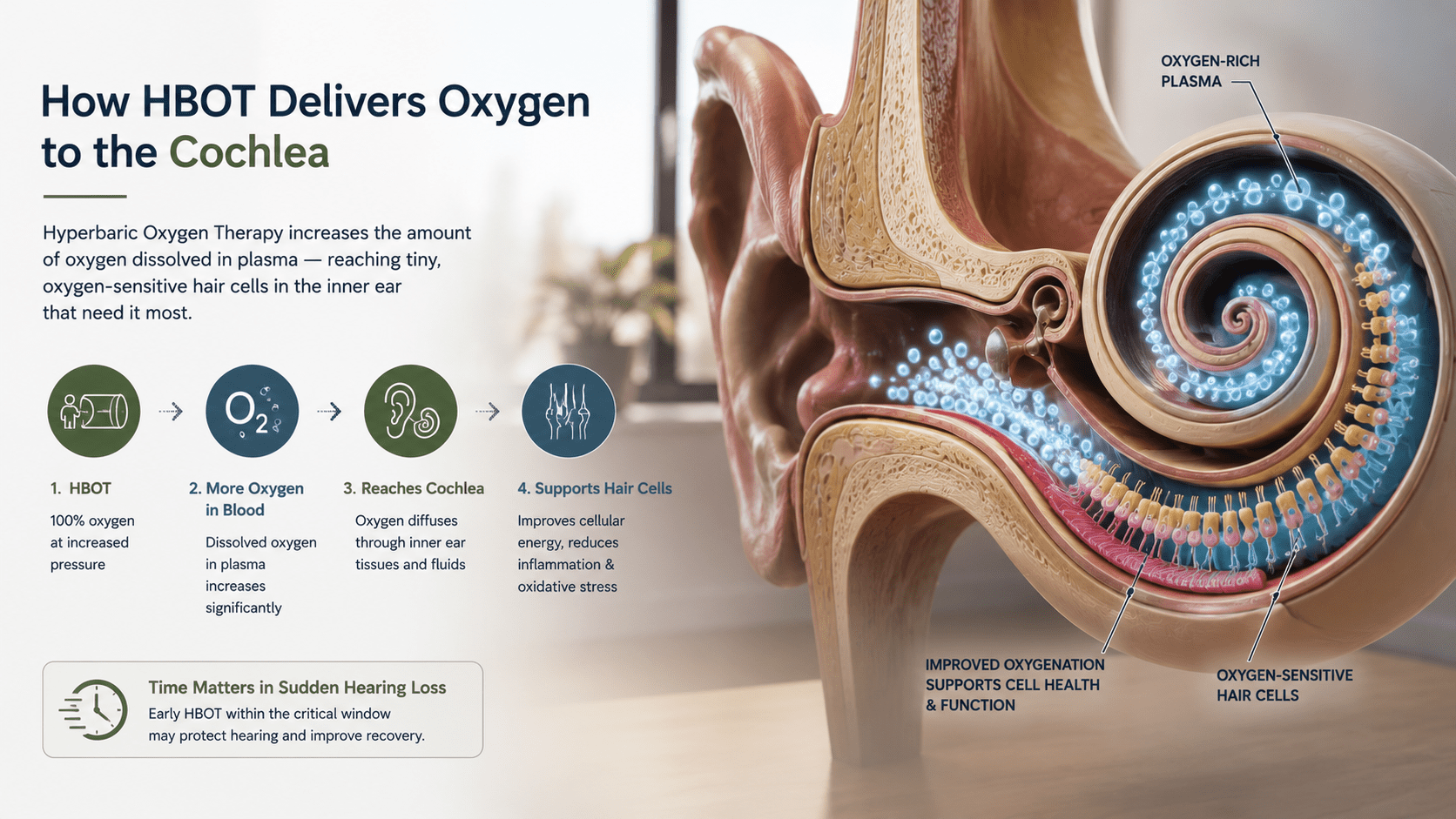 How HBOT delivers oxygen to the oxygen-sensitive cochlear hair cells — and why this mechanism matters for sudden sensorineural hearing loss.
For a plain explanation of how HBOT works across tissues, see our guide on what HBOT is and how it works. For the pressure question, see our article on does pressure level affect HBOT outcomes.
HBOT for Sudden Hearing Loss — What the Evidence Shows
SSHL is one of the more evidence-supported applications of HBOT outside the standard FDA-recognised indications. Multiple clinical studies across Germany, Israel, and the United States have demonstrated benefit when HBOT is started early.
A landmark study by Hadanny A et al (Clin Ophthalmol, 2016, published in a wider neurovascular context) confirmed that PVHO-certified hard-chamber HBOT can reverse ischaemia-related sensory loss when applied in the acute window. The mechanism — dissolved plasma oxygen bypassing occluded capillaries — applies directly to cochlear hair cell rescue.
German ENT guidelines and the UK NHS have both recognised HBOT as adjunctive treatment for SSHL that has not responded to steroid treatment alone, when initiated within the time window.
The time window in summary
| Time from SSHL onset | Typical recovery outcome | HBOT role |
|---|---|---|
| 0–24 hours | Highest recovery potential | Start HBOT + steroids immediately — most effective |
| 24–72 hours | Meaningful recovery still possible | Start HBOT + steroids — still within window |
| 72 hours – 2 weeks | Recovery chances decline | HBOT may still help — start as soon as possible |
| Beyond 2 weeks | Reduced but not zero | HBOT has limited but possible role — discuss with ENT specialist |
What Indian Patients with Sudden Hearing Loss Should Do
If you or someone you know has experienced sudden hearing loss in the past 72 hours:
- Go to a hospital emergency department immediately — not a clinic, not a GP appointment, not a search for an HBOT centre. A&E first.
- Ask for an ENT specialist on call — SSHL requires audiological assessment and immediate steroid therapy. The ENT will determine whether HBOT is appropriate alongside steroids.
- Request HBOT as adjunctive therapy — If the hospital has a PVHO-certified hyperbaric unit — a pressure vessel for human occupancy meeting ASME PVHO standards — HBOT alongside corticosteroids is the established treatment approach. If they do not, ask for a referral.
- Do not delay for cost or logistics — The 72-hour window does not pause. Every hour of delay reduces the chance of meaningful recovery.
For finding certified HBOT centres near you, see our guide on find a certified HBOT clinic near you. For session cost guidance, see HBOT session cost in India. For PVHO certification verification, see PVHO chamber safety in India.
HBOT for Tinnitus — What the Evidence Shows
For tinnitus that is recent in onset — particularly noise-induced tinnitus within weeks of the precipitating event — some studies have shown improvements with HBOT. A 2004 study (Yildiz S et al, J Int Med Res) on acute acoustic trauma found that HBOT combined with standard therapy produced better outcomes than standard therapy alone.
For chronic tinnitus (lasting more than three months), the evidence does not support HBOT as an effective standalone treatment. The British Tinnitus Association and most ENT guidelines do not recommend HBOT for established chronic tinnitus.
If you have tinnitus that began recently following noise exposure, discuss HBOT as an adjunctive option with your ENT specialist — the earlier the better.
Is HBOT Safe for Ear Conditions?
HBOT at certified PVHO-standard clinics is generally safe. However, ear-specific considerations apply:
- Middle ear barotrauma — The most common HBOT side effect is ear discomfort from pressure change. Patients must be able to equalise ear pressure (swallowing, yawning, or Valsalva manoeuvre). Those unable to equalise should not undergo HBOT.
- Existing ear conditions — Active middle ear infections, tympanic membrane perforations, and recent ear surgery are contraindications. The ENT specialist must assess before HBOT begins.
- Children with ear tube issues — Children with grommets should have ENT clearance before HBOT.
For a full overview of HBOT safety and side effects, see our guide on is HBOT safe and our complete HBOT side effects guide.
Frequently Asked Questions
Can HBOT restore sudden hearing loss?
HBOT combined with corticosteroids, started within 72 hours of sudden sensorineural hearing loss onset, gives the best chance of meaningful recovery. The earlier the treatment begins, the better the outcome. HBOT is not a guaranteed cure — but it is the best-evidenced adjunctive intervention currently available for SSHL.
How many HBOT sessions are needed for hearing loss?
For SSHL, standard protocols run 10 to 20 sessions, typically 5 per week, at 2.0–2.4 ATA for 90 minutes. The protocol is designed to deliver maximum cochlear oxygenation in the acute phase. Your ENT specialist and the HBOT centre will determine the appropriate number.
Is HBOT covered by insurance in India for hearing loss?
HBOT for sudden sensorineural hearing loss is not yet widely covered by Indian health insurance. Some cashless hospital plans may include HBOT when administered in a hospital setting for an approved indication. Check with your insurer specifically for the SSHL diagnosis code.
Can HBOT help tinnitus?
For recent-onset tinnitus following noise exposure, some studies show benefit. For chronic tinnitus lasting months or years, the evidence does not support HBOT as an effective treatment. Discuss timing and onset with your ENT specialist before deciding.
Where can I access HBOT for hearing loss in India?
For SSHL, the fastest route is through a hospital ENT department that has access to a PVHO-certified hyperbaric unit. For non-emergency hearing conditions, certified HBOT centres across Delhi NCR, Mumbai, Bangalore, Noida, and Chennai can be found through our guide at find a certified HBOT clinic near you.


Subscribe
One Comment
Comments are closed.
A very informative and important article on **HBOT for hearing loss**! 👂👏 I especially appreciate how clearly you explained sudden sensorineural hearing loss, the importance of seeking urgent medical care, the potential role of HBOT, and the differences between sudden hearing loss and chronic tinnitus. The practical guidance for patients in India is particularly useful. Thank you for sharing such valuable healthcare information and increasing awareness about timely treatment. Keep writing more informative blogs! 💙✨
Blood test Hyderabad