
HBOT for Depression and PTSD: What the Science Actually Shows
hbot depression ptsd brain recovery evidence India clinical research
| IF YOU ARE IN CRISIS — PLEASE REACH OUT NOW |
| You do not have to go through this alone. Trained counsellors are available right now — free and confidential. iCall (Tata Institute of Social Sciences): 9152987821 Vandrevala Foundation 24×7 Helpline: 1860-2662-345 NIMHANS (Bangalore): 080-46110007 This article is for information only. It is not a substitute for professional mental health care. |
Depression that does not fully lift with medication. Anxiety that stays even after years of therapy. PTSD that disrupts sleep, relationships, and every ordinary day.
For people living in that space, the question is not whether to try what is already being done — it is whether there is anything else worth exploring.
Research on HBOT for Depression and PTSD is not yet at the level of large definitive trials. But the evidence that exists — particularly for depression linked to PTSD and traumatic brain injury — is more substantive than most people realise. This article puts that evidence on the table honestly.
Why the Brain Matters in Depression and PTSD
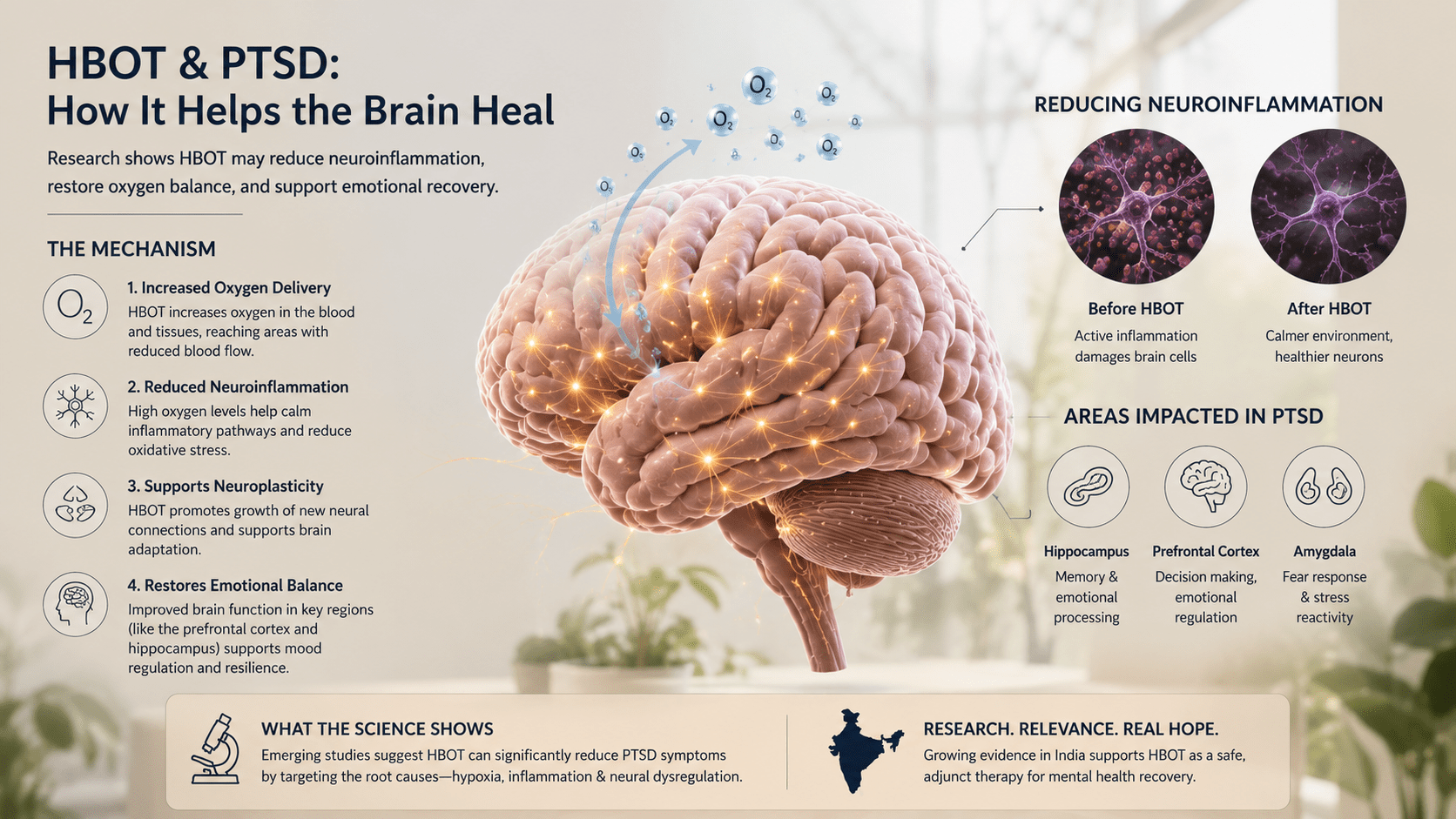
Depression and PTSD are not purely psychological. Both conditions involve measurable changes in brain structure and function — reduced activity in the prefrontal cortex, hyperactivity in the amygdala, chronic low-grade neuroinflammation, and impaired cerebral blood flow in specific regions.
These are physical changes in a physical organ. And that is why some researchers are investigating whether a therapy that directly improves brain oxygenation might help.
HBOT delivers oxygen dissolved under pressure directly into blood plasma — bypassing the haemoglobin-bound limit. This allows oxygen to reach brain tissue with reduced perfusion, potentially supporting the repair mechanisms that standard treatments cannot reach.
For the full explanation of how this works at a brain level, read our article on how HBOT supports neuroplasticity. For the broader picture on HBOT and cognitive recovery, see HBOT and cognitive brain recovery.
What ‘HBOT Depression’ Research Actually Shows — The Evidence
PTSD and TBI — the most developed evidence
The strongest evidence for HBOT in mental health comes from patients with PTSD secondary to traumatic brain injury. In this population, depression and anxiety are core symptoms — not side effects — which means improvements in PTSD directly measure depression outcomes.
Harch PG et al (Med Gas Res, 2017) enrolled 71 veterans and civilians with mild TBI and persistent PTSD. After 40 sessions at 1.5 ATA, patients showed statistically significant improvements across PTSD checklists, depression rating scales, anxiety measures, and quality of life scores. Effects were sustained at 6-month follow-up.
Harch PG, Andrews SR, Fogarty EF, et al. Case control study: hyperbaric oxygen management of mild TBI post-concussion syndrome and PTSD. Med Gas Res. 2017;7(3):156–174.
Boussi-Gross R et al (PLoS ONE, 2013) showed that HBOT improved post-concussion syndrome in patients with chronic mild TBI — a condition in which depression is near-universal. The study used 60 sessions at 1.5 ATA and demonstrated significant cognitive and symptomatic improvement.
Boussi-Gross R et al. Hyperbaric oxygen therapy can improve post-concussion syndrome years after mild traumatic brain injury. PLoS ONE. 2013;8(11):e79995.
Neuroprotective pathway activation
He H et al (Neuropsychiatr Dis Manage, 2019) identified that HBOT activates the Akt/GSK3β/β-catenin neuroprotective pathway, reducing neuronal apoptosis following TBI. This pathway is closely linked to neurobiological models of depression, where neuronal loss in hippocampal regions is a known contributor to depressive symptoms.
He H, Li X, He Y. Hyperbaric oxygen therapy attenuates neuronal apoptosis induced by traumatic brain injury via Akt/GSK3β/β-catenin pathway. Neuropsychiatr Dis Manage. 2019;15:369–374.
Brain perfusion and mood
Eve DJ et al (Neuropsychiatr Dis Manage, 2016) reviewed the broader evidence on HBOT for PTSD associated with TBI and concluded that the combination of improved cerebral blood flow, reduced neuroinflammation, and restored mitochondrial function in neural cells creates a plausible and supported mechanism for mood improvement.
Eve DJ, Steele MR, Sanberg PR, et al. Hyperbaric oxygen therapy as a potential treatment for PTSD associated with TBI. Neuropsychiatr Dis Manage. 2016;12:2689–2705.
 hbot ptsd brain neuroinflammation neuroprotection mechanism India
What HBOT Cannot Claim for Depression
Honesty matters here more than anywhere else.
There are currently no large randomised controlled trials showing that HBOT is an effective treatment for primary major depressive disorder or generalised anxiety disorder as standalone conditions without a TBI or neurological basis.
The evidence base is genuine — but it is concentrated in neurological populations. People with depression that is unconnected to TBI, brain injury, or PTSD should not expect the same level of evidence-backed benefit.
HBOT for depression should always be framed as an adjunctive, investigational option — used alongside, not instead of, established treatment. The Drugs and Magic Remedies Act 1954 in India reinforces this: no off-label therapy may be promoted as a cure or primary treatment.
For a clear-eyed look at what ‘only high-pressure HBOT’ debates mean, read our article on does only high-pressure HBOT work.
What a Depression or PTSD HBOT Protocol Looks Like in India
Where HBOT is used as adjunctive support for depression or PTSD in India, the protocol typically follows the neurological framework used in research:
| Element | Typical Specification | Clinical Basis |
| Pressure | 1.5–2.0 ATA | Harch 2017 / Boussi-Gross 2013 protocols |
| Session duration | 60 minutes | Standard across most PTSD/TBI trials |
| Frequency | 5 days/week | Daily during active protocol |
| Total sessions | 40 sessions | Harch 2017 used 40; Boussi-Gross used 60 |
| Oxygen | 100% O₂ via mask | Inside PVHO-certified hard chamber |
| Alongside | Prescribed care | Adjunctive only — never a replacement |
Any HBOT programme for mental health must use a PVHO-certified hard chamber — a pressure vessel for human occupancy meeting ASME PVHO standards — at 2.0 ATA. A soft portable chamber at 1.3 ATA does not deliver the oxygen levels this protocol requires and is not appropriate for neurological or psychiatric applications.
For PVHO certification explained, see our article on PVHO chamber safety in India. For safety in general, see is HBOT safe.
Before You Start — What to Discuss With Your Doctor
- Tell your psychiatrist or psychologist — HBOT should be discussed with your existing mental health team before you start. It should complement, not replace, your current care plan.
- Disclose all medications — Particularly MAOIs (monoamine oxidase inhibitors), lithium, and any anticonvulsants. These interact with pressurised oxygen environments in specific ways.
- Disclose any seizure history — Oxygen toxicity risk at elevated pressure is higher in people with a history of seizures. This is a contraindication at higher pressures.
- Set realistic expectations — Improvements in PTSD and depression with HBOT, where they occur, typically build gradually across 20–40 sessions. It is not a rapid intervention.
- Ask for a written protocol — Number of sessions, pressure setting, frequency, and goals should be documented before you start.
To find a certified HBOT centre near you, see our guide at find a certified HBOT clinic near you.
| IF YOU ARE IN CRISIS — PLEASE REACH OUT NOW |
| You do not have to go through this alone. Trained counsellors are available right now — free and confidential. iCall (Tata Institute of Social Sciences): 9152987821 Vandrevala Foundation 24×7 Helpline: 1860-2662-345 NIMHANS (Bangalore): 080-46110007 This article is for information only. It is not a substitute for professional mental health care. |
Frequently Asked Questions
Does HBOT work for depression?
Research shows HBOT can improve depression symptoms when they are associated with PTSD or traumatic brain injury. The evidence for HBOT treating primary depression as a standalone condition is limited. It should always be used alongside prescribed psychiatric treatment.
How many HBOT sessions are needed for depression or PTSD?
Research protocols typically run 40 sessions (Harch et al 2017) at 1.5–2.0 ATA, 5 days per week. Improvements often appear gradually — many patients report meaningful change after session 20.
Is HBOT safe for people with PTSD or depression?
At a certified PVHO-standard clinic, HBOT is generally safe for people with depression or PTSD. Disclose all medications — especially MAOIs — and any seizure history before starting. Speak to your mental health provider before beginning.
Can HBOT replace antidepressants?
No. HBOT is not approved as a treatment for depression and should never replace prescribed medication or therapy. It is an adjunctive option being explored in research — not a substitute for established care.
Where can I access HBOT for depression or PTSD in India?
Certified HBOT centres are available in Delhi NCR, Mumbai, Bangalore, Noida, Hyderabad, and Chennai. Use our guide on find a certified HBOT clinic near you to find the nearest certified centre and confirm they use a PVHO-certified hard chamber.



[…] the full evidence: HBOT for PTSD and depression | HBOT for depression and […]