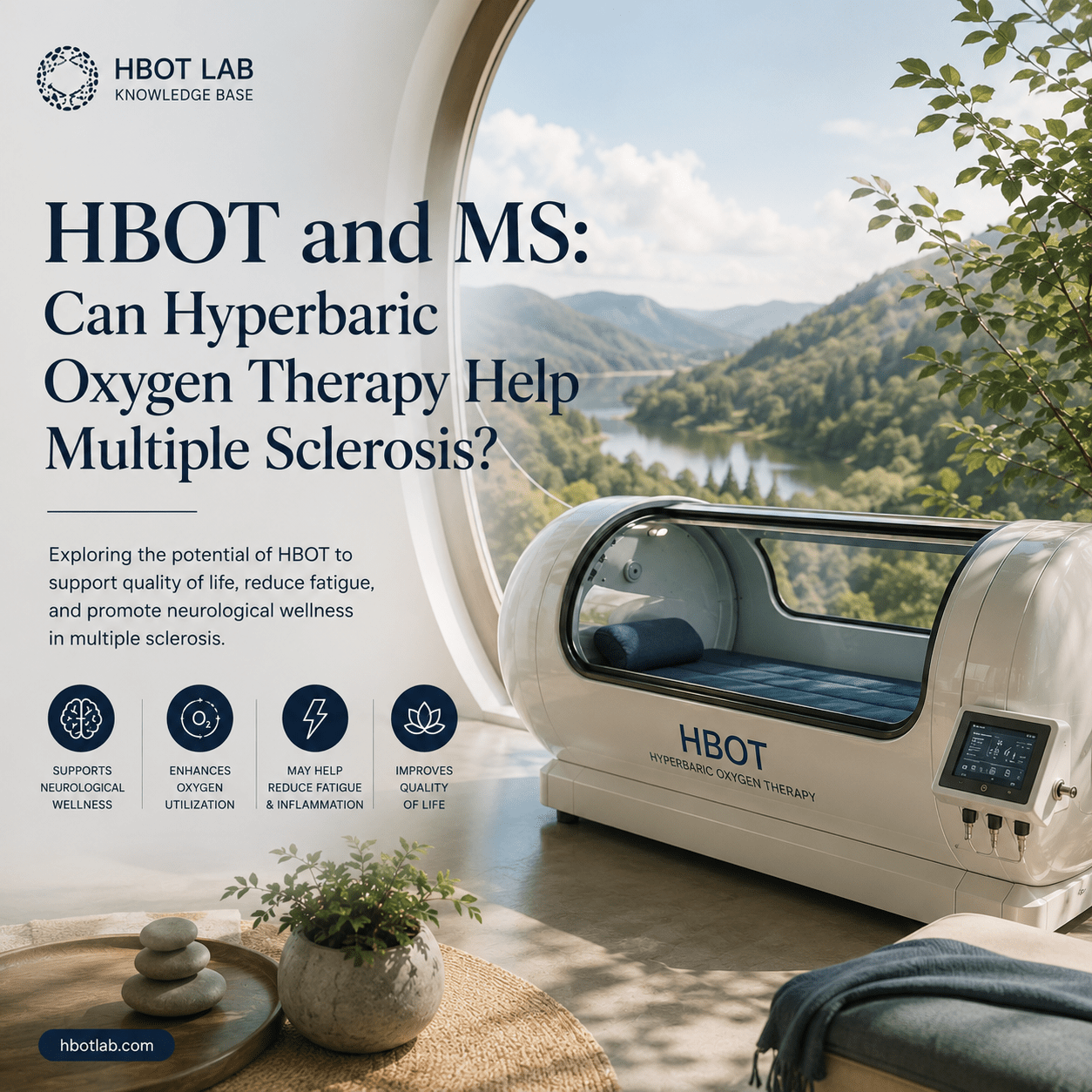
HBOT and MS: Can Hyperbaric Oxygen Therapy Help Multiple Sclerosis?
HBOT and MS: Can Hyperbaric Oxygen Therapy Help Multiple Sclerosis?
hbot and ms multiple sclerosis hyperbaric oxygen therapy India evidence
Multiple sclerosis is unpredictable in a way that makes every decision feel high-stakes.
Medications slow progression. Physiotherapy maintains function. But many people with MS — and their families — reach a point where they want to know: is there anything else that might help?
Research on HBOT and MS has been ongoing since the 1980s. The evidence is mixed — but it is not absent. Several studies have shown improvements in specific MS symptoms, particularly spasticity, bladder control, and fatigue, after HBOT treatment.
This article covers what the evidence actually shows, how honest the picture is, and what MS patients in India should know before pursuing HBOT as part of their care.
| Important: HBOT is not a treatment for multiple sclerosis. It is not a disease-modifying therapy and cannot replace any prescribed MS medication. If you are considering HBOT, always discuss it with your treating neurologist first. This article is informational — not a clinical recommendation. |
What Is Multiple Sclerosis and Why Is Oxygen Relevant?
MS is a chronic autoimmune condition where the immune system attacks the myelin sheath — the protective coating around nerve fibres in the brain and spinal cord. This disrupts nerve signal transmission and leads to a range of neurological symptoms.
The link to oxygen is indirect but real. MS lesions — areas of demyelination — create regions of the brain and spinal cord with reduced blood flow and oxygen supply. Tissue around active lesions shows hypoxia — oxygen deprivation — similar to the penumbra seen in stroke and TBI.
Brain perfusion imaging in MS patients has confirmed areas of significantly reduced blood flow adjacent to demyelinated plaques (Taghizadeh Asl M et al, BMC Neurol, 2016). This hypoxic tissue is not dead, but it is functioning below its potential.
For a plain explanation of how HBOT delivers oxygen to hypoxic tissue, read our guide on what HBOT is and how it works.
How HBOT May Help in MS — The Proposed Mechanisms
HBOT does not repair myelin. That is important to say clearly. But several mechanisms suggest it could support neurological function in MS:
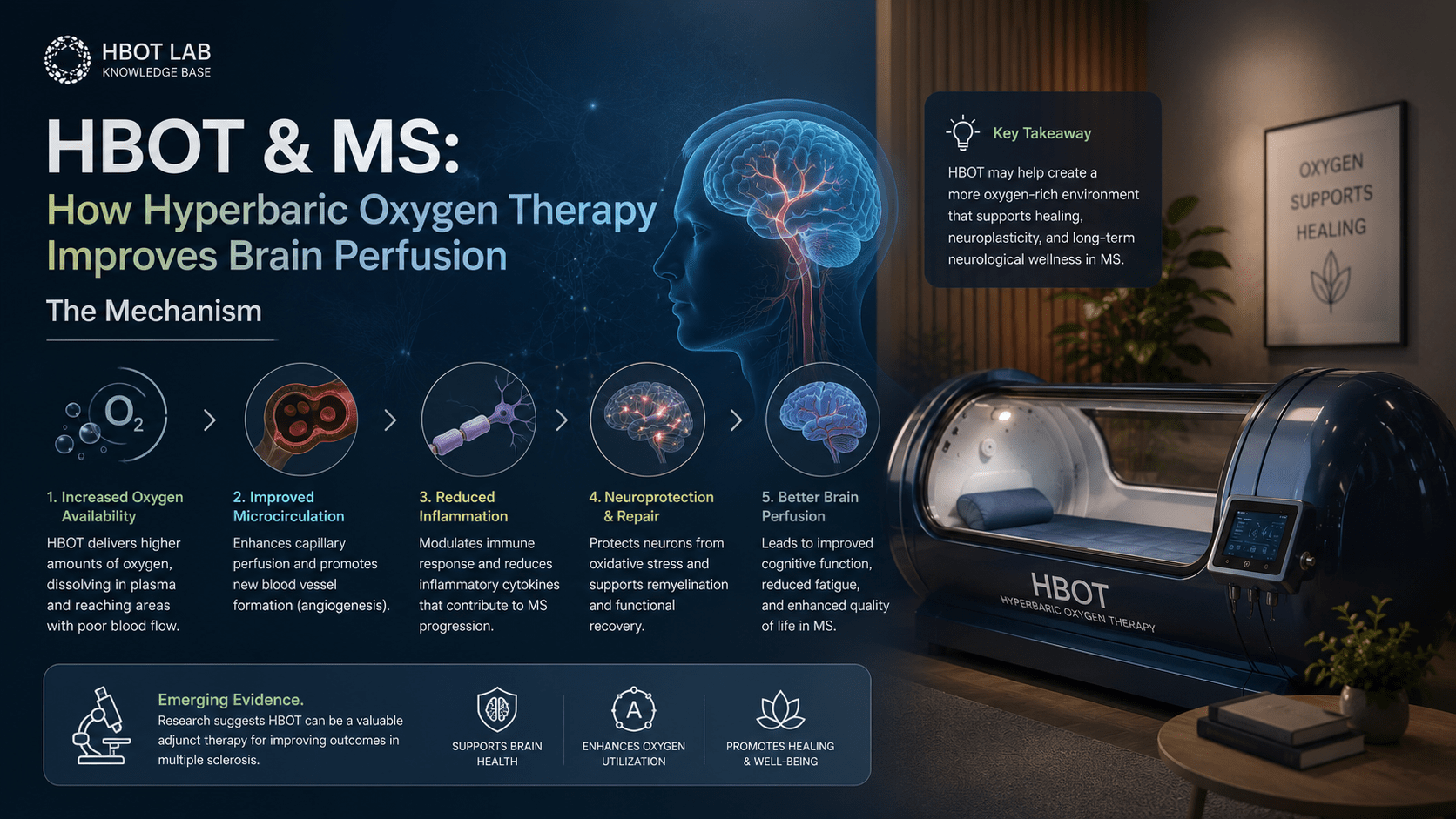
- Improving perfusion in hypoxic lesion areas — Hyperbaric oxygen dissolves into blood plasma and can reach tissue with poor circulation. This may restore some function in areas around active lesions where poor oxygenation is compounding the neurological deficit.
- Reducing neuroinflammation — HBOT has demonstrated anti-inflammatory effects in neural tissue, inhibiting inflammatory cytokines. Chronic neuroinflammation is a major driver of MS progression and symptom burden.
- Supporting mitochondrial function — Mitochondrial dysfunction is increasingly recognised as a factor in MS neurodegeneration. HBOT has been shown to support mitochondrial energy production in oxygen-deprived cells.
- Reducing oxidative stress — Paradoxically, controlled hyperoxia (high oxygen under pressure) can trigger antioxidant pathways that reduce overall oxidative damage — a known contributor to MS lesion expansion (Thom SR, J Appl Physiol, 2009).
For more on how HBOT supports the broader neurological repair process, read our article on how HBOT supports neuroplasticity.
HBOT and MS — What the Research Actually Shows
It is important to be honest here. The evidence for HBOT in MS is more limited than for stroke or TBI — and more contested. Here is a fair summary:
Early trials — some positive signals (1980s–1990s)
Several small trials in the 1980s reported improvements in MS symptoms — particularly bladder control, spasticity, and fatigue — following HBOT. However, these studies were often small, had methodological limitations, and were not consistently replicated.
A systematic review found that most early MS HBOT trials had insufficient patient numbers and inconsistent outcome measures to draw firm conclusions. The evidence at this level is suggestive but not definitive.
Brain perfusion imaging — stronger mechanistic evidence
A more recent and clinically significant study by Taghizadeh Asl M et al (BMC Neurol, 2016) used voxel-based brain perfusion analysis in secondary progressive MS patients. The study identified specific patterns of hypoperfusion — areas of the brain with measurably reduced blood flow — adjacent to MS lesions.
This provides a mechanistic rationale for why HBOT might help in MS: by improving oxygen delivery to hypoperfused areas, it may restore some function in tissue that is impaired not by demyelination alone, but also by oxygen deprivation.
Taghizadeh Asl M, Nemati R, Chabi N, et al. Brain perfusion imaging in secondary progressive MS patients: voxel-based analysis. BMC Neurol. 2016;16:79.
Pain and spasticity — some positive evidence
Kiralp MZ et al (J Int Med Res, 2004) conducted a study on HBOT for complex regional pain syndrome that also captured outcomes for other neurological pain conditions. Spasticity and neuropathic pain are among the MS symptoms where HBOT may have most practical value.
Kiralp MZ, Yildiz S, Vural D, et al. Effectiveness of hyperbaric oxygen therapy in the management of complex regional pain syndrome. J Int Med Res. 2004;32(3):258–262.
hbot ms multiple sclerosis brain perfusion oxygenation mechanism
Being Honest About the Evidence Gaps
The HBOT and MS evidence base has gaps that deserve honest acknowledgement:
- No large-scale RCT has confirmed disease modification — HBOT has not been shown to slow MS progression or reduce relapse frequency in a large randomised trial. Claims suggesting otherwise are not supported by current evidence.
- Symptom improvement ≠ disease modification — Improvements in fatigue, bladder control, or spasticity are meaningful quality-of-life gains — but they do not indicate that HBOT is slowing the underlying disease process.
- Patient response is variable — Some MS patients report significant symptom improvement after HBOT; others report none. Predicting individual response is currently not possible.
- MS type matters — The limited evidence that exists is mostly for secondary progressive MS and relapsing-remitting MS. Primary progressive MS has almost no dedicated HBOT trial data.
This does not mean HBOT is without value in MS. It means you should go in with realistic expectations, a clear protocol, and your neurologist’s input.
What an HBOT Protocol for MS Looks Like
There is no standardised MS protocol. Where HBOT has been used in MS research, the parameters have varied. A general reference:
| Protocol Element | Typical Range | Notes |
| Pressure | 1.75–2.0 ATA | Lower end often used in MS — neurological sensitivity |
| Session length | 60–90 minutes | 60 mins most common in MS trials |
| Frequency | 3–5 days per week | 5 days in some protocols; 3 days in maintenance |
| Total sessions | 20–40 | Initial course; maintenance may continue |
| Review point | After 20 sessions | Assess response before committing to full course |
At Indian pricing, a 20-session MS protocol would cost between ₹50,000 and ₹1,60,000 depending on the city. For full pricing, see our guide to HBOT cost in India.
What MS Patients in India Should Do Before Starting HBOT
If you are considering HBOT for MS in India, take these steps first:
- Speak to your neurologist — HBOT should be discussed as part of your existing MS management plan. Your neurologist should review any HBOT protocol before you start.
- Get an updated brain MRI — Active or enhancing lesions on MRI may change the HBOT approach. A certified clinic will want to review imaging before designing a protocol.
- Set realistic expectations — HBOT for MS is not a cure and is unlikely to reverse disability. The realistic goals are symptom management — fatigue, spasticity, bladder control — and general wellbeing.
- Request a mid-protocol review — After 10–15 sessions, a responsible clinic will reassess whether you are responding before committing you to a full course.
For safety information specific to MS and neurological conditions, read our guide on is HBOT safe. To find certified clinics near you, see our resource on find a certified HBOT clinic near you.
Also see our related articles on HBOT and stroke recovery and HBOT for traumatic brain injury which cover overlapping neurological HBOT applications.
Frequently Asked Questions
Can HBOT help multiple sclerosis?
The evidence is mixed but not absent. Some studies have shown improvements in MS symptoms — particularly spasticity, fatigue, and bladder control — after HBOT. HBOT has not been shown to slow MS progression or reduce relapses. It is not a disease-modifying treatment, but it may offer quality-of-life benefits for some patients.
Is HBOT safe for MS patients?
HBOT is generally considered safe for MS patients at certified clinics under medical supervision. The main precaution is that some MS patients are heat-sensitive (Uhthoff’s phenomenon) — the slight warming during a session may temporarily worsen symptoms for some individuals. This is temporary and resolves with cooling. Always discuss with your neurologist.
How many HBOT sessions would an MS patient need?
An initial course typically runs 20 to 40 sessions. There is no fixed protocol. Most clinics suggest reassessing after 20 sessions to evaluate response. Some patients undergo periodic maintenance protocols rather than a single fixed course.
Will HBOT cure or reverse MS?
No. There is no evidence that HBOT reverses MS or repairs myelin. The realistic goal is symptom management and quality-of-life improvement in specific domains — not disease reversal. Any provider claiming otherwise is overstating the evidence.
Where can MS patients access HBOT in India?
Certified HBOT centres with neurological experience are available in Delhi NCR, Mumbai, Bangalore, Chennai, Hyderabad, and Noida. Use our resource on find a certified HBOT clinic near you to find and contact the nearest centre.