Hyperbaric Oxygen Therapy and Traumatic Brain Injury: The Evidence
A traumatic brain injury changes everything — and recovery is rarely straightforward.
Standard rehabilitation helps. But for many TBI patients, there is a point where progress slows and the question becomes: what else is there?
Research into hyperbaric oxygen therapy and traumatic brain injury has grown considerably over the past decade. Several studies show that HBOT can improve cognitive function, memory, and neurological symptoms in TBI patients — including those injured months or years before treatment.
This guide walks through what the research actually shows, how a TBI protocol works, and what patients in India can expect if they pursue HBOT as part of their recovery.
| Important: HBOT is not a standalone treatment for TBI. It is used as an adjunctive therapy — alongside standard neurological care and rehabilitation. Nothing here should replace your treating doctor’s advice. Always discuss HBOT with your neurologist before starting. |
What Happens in the Brain After Traumatic Injury?
A traumatic brain injury — from a road accident, fall, blast, or sports impact — damages brain tissue in two stages.
The primary injury happens at the moment of impact. Brain tissue is torn, compressed, or haemorrhaged. This damage is largely irreversible.
The secondary injury follows over hours and days. Inflammation, oxygen deprivation, and cell death spread beyond the original site. This secondary cascade is where HBOT is thought to intervene most effectively.
Research shows that hypoxic (oxygen-deprived) tissue in the TBI penumbra — the zone around the primary injury — can survive for months or even years in a dormant state. These cells are not dead, but they are not functioning. Reoxygenating them is the core rationale for HBOT in TBI recovery.
For a plain explanation of how HBOT delivers oxygen to damaged tissue, read our guide on what HBOT is and how it works.
How HBOT Works in TBI Recovery
Three mechanisms make HBOT particularly relevant to TBI:
- Reducing secondary injury inflammation — HBOT inhibits inflammatory pathways including TLR4/NF-κB signalling, which drives secondary brain damage after injury. A study by Meng XE et al (Med Sci Monit, 2016) found that HBOT significantly reduced secondary injury markers in TBI models.
- Supporting neuroplasticity — Repeated HBOT sessions stimulate angiogenesis (new blood vessel growth) and neurogenesis (new nerve cell development) in damaged brain regions. Research by Tal et al (Front Hum Neurosci, 2017) directly visualised this using advanced brain imaging.
- Protecting against apoptosis — HBOT activates anti-apoptotic proteins that protect surviving brain cells from dying in the wake of the initial injury. He H et al (Neuropsychiatr Dis Manage, 2019) showed that the Akt/GSK3β/β-catenin pathway activated by HBOT significantly reduces neuronal cell death in TBI.
For a deeper look at the neuroplasticity mechanism, see our article on how HBOT supports neuroplasticity.
Hyperbaric Oxygen Therapy and Traumatic Brain Injury — Key Research
Here are the most important studies in this area:
Boussi-Gross et al — Post-Concussion Syndrome (PLoS ONE, 2013)
This landmark randomised controlled trial treated 56 patients with persistent post-concussion syndrome — symptoms lasting more than three months after mild TBI. Patients received 40 HBOT sessions at 1.5 ATA.
The HBOT group showed significant improvements in cognitive function, quality of life, and brain imaging markers compared to the control group. Crucially, patients were treated an average of 16 months after their original injury — showing that HBOT can produce recovery long after the acute phase.
Boussi-Gross R, Golan H, Fishlev G, et al. Hyperbaric oxygen therapy can improve post concussion syndrome years after mild traumatic brain injury — randomised prospective trial. PLoS ONE. 2013;8(11):e79995.
Tal et al — Angiogenesis and Nerve Regeneration (Front Hum Neurosci, 2017)
Using diffusion tensor imaging (DTI) and perfusion MRI, this study showed that HBOT produced measurable growth of new blood vessels and nerve fibres in the white matter of TBI patients. This was the first direct clinical evidence of structural brain repair following HBOT.
Tal S, Hadanny A, Sasson E, et al. Hyperbaric oxygen therapy can induce angiogenesis and regeneration of nerve fibres in traumatic brain injury patients. Front Hum Neurosci. 2017;11:508.
Hadanny et al — Chronic Neurocognitive Deficits (BMJ Open, 2018)
A retrospective analysis of 154 post-TBI patients treated with HBOT found significant improvements across cognitive domains — memory, attention, information processing, and executive function. Importantly, patients treated more than one year post-injury showed similar improvement to those treated earlier.
Hadanny A, Abbott S, Suzin G, et al. Effect of hyperbaric oxygen therapy on chronic neurocognitive deficits of post-traumatic brain injury patients: retrospective analysis. BMJ Open. 2018;8(9):e023387.
What Does a TBI Protocol Actually Look Like?
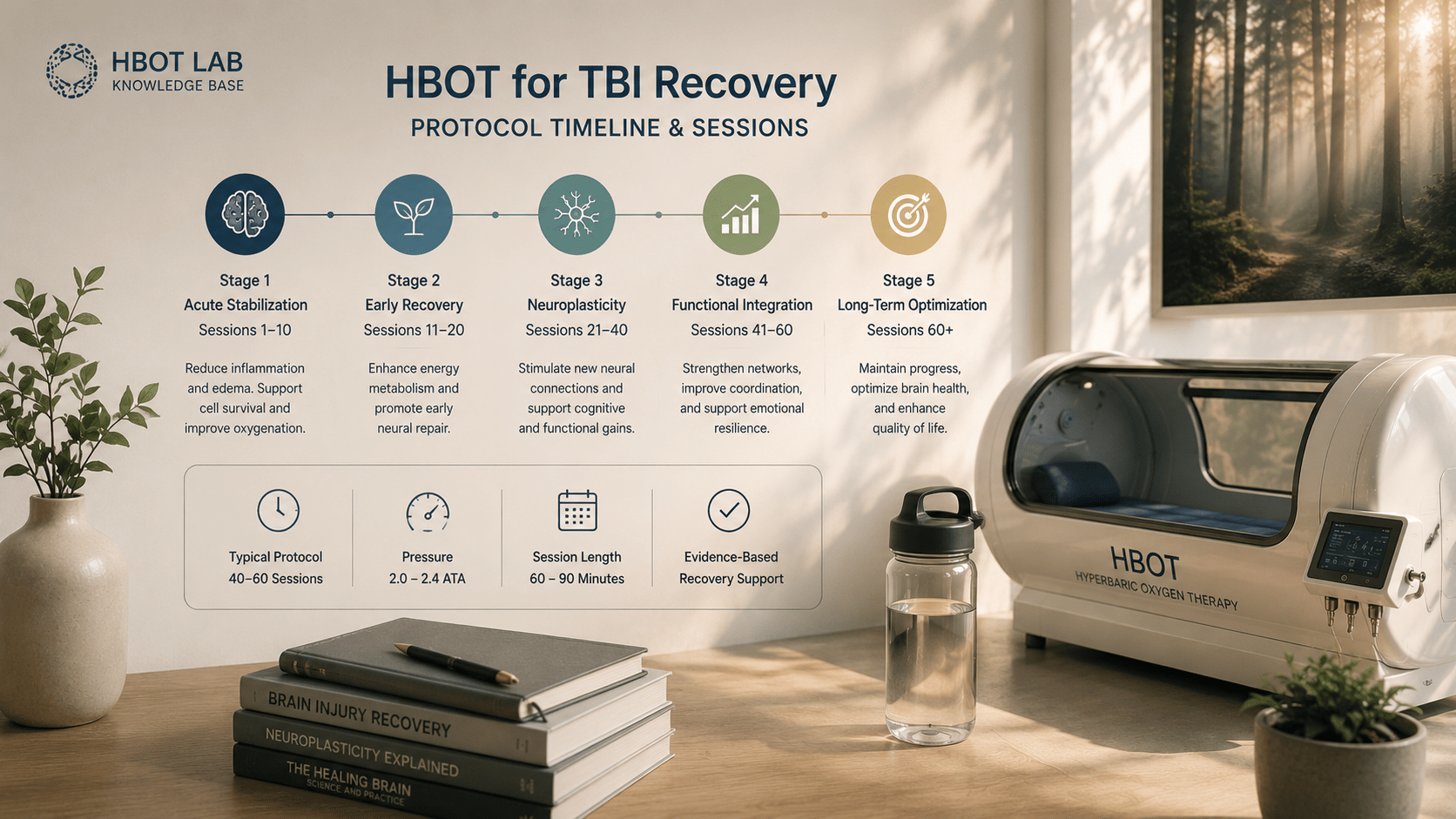
HBOT protocols for TBI vary by clinic and severity. Here is a general reference based on published trial data:
| Protocol Element | Typical Range | Notes |
| Pressure | 1.5–2.0 ATA | Boussi-Gross used 1.5; many clinical protocols use 2.0 |
| Session length | 60–90 minutes | 60 mins standard; 90 mins for more severe injury |
| Frequency | 5 days per week | Daily sessions Monday to Friday |
| Total sessions | 40–60 | Most trials used 40; severe TBI may warrant 60 |
| Patient timing | 3+ months post-injury | Studies show benefit even 1–3 years post-injury |
At Indian pricing, a 40-session TBI protocol would typically cost between ₹1,20,000 and ₹2,40,000 depending on the city. For a full cost breakdown, see our guide to HBOT cost in India.
TBI vs Concussion vs Post-Concussion Syndrome — How HBOT Applies
These terms are related but distinct — and HBOT evidence exists for all three:
- Severe TBI — Road accidents, serious falls, blast injuries. HBOT is used in the subacute and chronic phases to address residual neurological deficits. The Tal et al study showed structural brain repair even in this group.
- Mild TBI (concussion) — Sports injuries, minor vehicle accidents, falls. Recovery is usually expected within weeks — but in some patients, symptoms persist. HBOT is most studied in this group, with the Boussi-Gross trial being the most comprehensive evidence.
- Post-concussion syndrome — Persistent symptoms (headaches, cognitive fog, fatigue, mood changes) lasting more than three months after a concussion. This is where HBOT has the strongest evidence base for benefit.
See our article on HBOT and brain function recovery for more on cognitive recovery pathways. And for the closely related stroke recovery protocol, see our guide to HBOT and stroke recovery.
Is HBOT Safe for TBI Patients?
HBOT has a strong safety profile in TBI, with over 50 years of clinical use across neurological applications.
The most common side effects in TBI protocols are mild ear pressure during pressurisation (which resolves on depressurisation) and temporary vision changes that clear after treatment ends. Serious adverse events are rare.
A few specific precautions apply in TBI patients:
- Seizure history — Patients with a prior history of seizures require careful pre-treatment evaluation. HBOT oxygen toxicity-related seizures are rare but documented, and seizure risk should be assessed before starting.
- Raised intracranial pressure — HBOT is contraindicated in active raised ICP. A neurosurgical or neurological clearance is required before starting any protocol.
- Active infection or fever — HBOT should not be started if the patient has an active respiratory infection or fever.
Read our full guide on is HBOT safe and our article on HBOT side effects and what to expect before booking any sessions.
Frequently Asked Questions
Can hyperbaric oxygen therapy help traumatic brain injury?
Research suggests yes — particularly for post-concussion syndrome and chronic cognitive deficits following TBI. Multiple studies, including a randomised controlled trial by Boussi-Gross et al (PLoS ONE, 2013), showed significant improvements in cognitive function and quality of life after HBOT. It should always be used alongside, not instead of, standard neurological care.
How many HBOT sessions are needed for TBI?
Most TBI protocols run between 40 and 60 sessions, five days per week. The Boussi-Gross trial used 40 sessions at 1.5 ATA. More severe injury or more pronounced cognitive deficits may warrant a longer protocol. Always get a written session count from a doctor before committing to any package.
How long after TBI can HBOT still help?
Research shows meaningful benefit even years after the original injury. The Hadanny et al retrospective study (BMJ Open, 2018) showed equivalent improvement in patients treated more than one year post-injury compared to those treated earlier. The dormant penumbra tissue around a TBI site can remain viable for extended periods.
What is the difference between HBOT for TBI and for stroke?
Both conditions involve brain tissue hypoxia and a penumbra of dormant but viable cells. The mechanisms are similar. TBI protocols typically use slightly lower pressures (1.5 ATA in the Boussi-Gross trial vs 2.0 ATA in the Efrati stroke trial). See our guide on HBOT and stroke recovery for a comparison.
Where can TBI patients access HBOT in India?
Certified HBOT centres that treat TBI and post-concussion syndrome are available across Delhi NCR, Mumbai, Bangalore, Chennai, Hyderabad, and Noida. Use our resource on find a certified HBOT clinic near you to find the nearest certified centre.



Subscribe
2 Comments
Comments are closed.
[…] read our full article on HBOT and brain function recovery and our related article on HBOT for traumatic brain injury which covers overlapping neurological recovery […]
[…] see our related articles on HBOT and stroke recovery and HBOT for traumatic brain injury which cover overlapping neurological HBOT […]