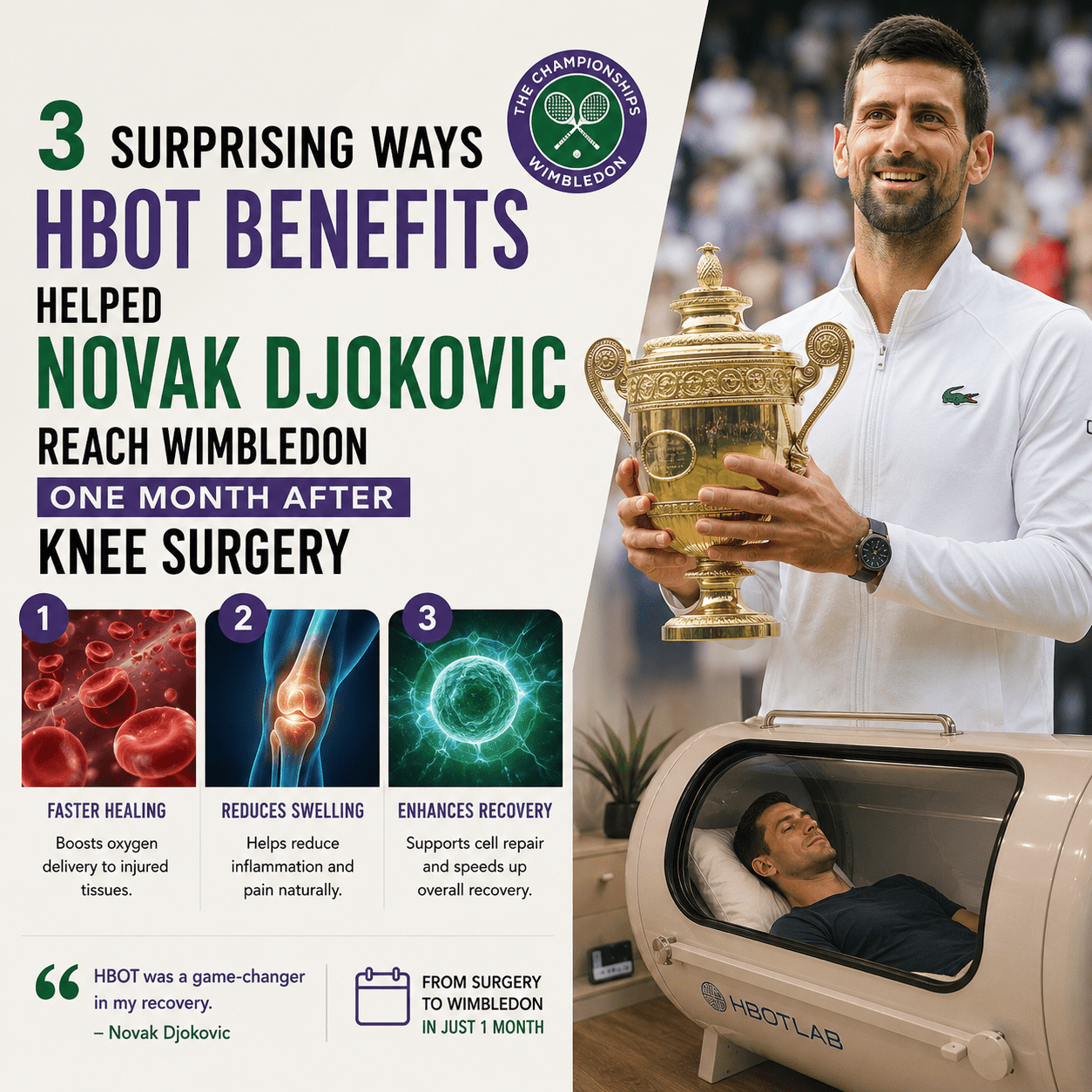
3 Surprising Ways hbot benefits Helped Novak Djokovic Reach Wimbledon One Month After Knee Surgery
A torn meniscus. Four weeks. The Wimbledon final. One recovery tool made the impossible timeline possible.
Everyone who has ever had a knee injury knows the feeling. The surgeon gives you a timeline. You do the maths. And the maths does not work.
In June 2024, Novak Djokovic tore his meniscus during the French Open. He underwent emergency surgery the following day. Standard medical recovery for a meniscus tear is four to six months. Wimbledon was four weeks away. By every conventional measure, his tournament was over before it began.
He reached the Wimbledon final. The HBOT benefits that made this possible are not widely reported — but they are well documented in peer-reviewed research. Here are the three ways hyperbaric oxygen therapy compressed Djokovic’s recovery timeline and what the science says about each one.
The Injury That Should Have Ended Djokovic’s 2024 Season
The timeline is stark. Djokovic tore his right medial meniscus during his French Open quarterfinal against Francisco Cerundolo on June 3, 2024. He completed the match on a damaged knee — a decision that drew as much admiration as concern — and then underwent surgery in Paris the following morning.
Medial meniscus repair is not a minor procedure. The meniscus is the cartilaginous disc that cushions and stabilises the knee joint. A tear disrupts load distribution, causes significant swelling and pain, and requires the regrowth of cartilaginous tissue — one of the slowest-healing tissue types in the body, precisely because it is poorly vascularised.
Djokovic was given no realistic expectation of competing at Wimbledon, which began on July 1 — less than four weeks post-surgery. He committed anyway, and built a recovery protocol around intensive daily physiotherapy, nutritional support, and hyperbaric oxygen therapy.
Understanding why HBOT was central to this protocol requires understanding how hyperbaric oxygen therapy works at the tissue level — specifically what happens to poorly-vascularised tissue when it is flooded with plasma-dissolved oxygen under pressure.
What Is HBOT — A Plain-Language Definition
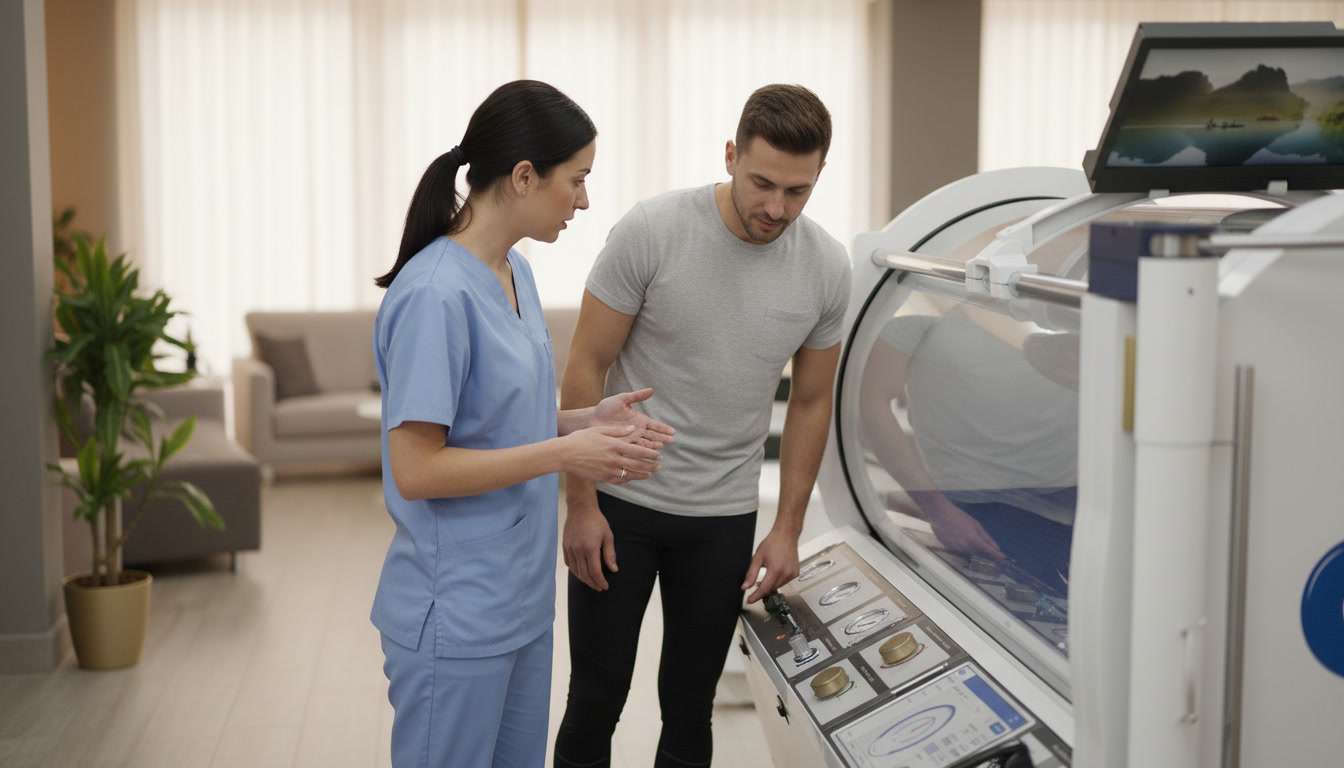
HBOT — hyperbaric oxygen therapy — is a treatment in which a person breathes pure oxygen inside a pressurised chamber, typically at 1.5 to 3.0 atmospheres absolute (ATA). Under this pressure, oxygen dissolves directly into blood plasma at concentrations far beyond what normal breathing achieves.
This plasma-dissolved oxygen can reach tissue that red blood cells cannot penetrate — including compressed, inflamed, or poorly vascularised areas like a recently repaired meniscus. The result is a localised and systemic increase in available oxygen that simultaneously drives multiple repair mechanisms.
For a complete breakdown of what happens inside the body during each session, read our guide on what is hyperbaric oxygen therapy. The three HBOT benefits below are specific to the mechanisms most relevant to joint and surgical recovery.
Surprising Way 1 — HBOT Activated Djokovic’s Body’s Own Repair Cells
Most people think of recovery as the body repairing itself with what it already has at the injury site. The reality is more sophisticated. The body’s most powerful repair resources — stem cells — are held in reserve in the bone marrow and only mobilised in response to specific biological signals.
HBOT is one of the most potent known triggers for this mobilisation. Every session of hyperbaric oxygen therapy causes the bone marrow to release stem cells into circulation. These stem cells travel through the bloodstream and migrate to sites of tissue damage, where they differentiate into the specific cell types needed for repair — including the chondrocyte-like cells involved in cartilage regeneration.
This mechanism was established by Thom SR et al. in foundational research published in the American Journal of Physiology in 2006. Their study demonstrated that hyperbaric oxygen exposure produces a significant, measurable increase in circulating stem cells — and that this effect is cumulative across sessions.
Thom SR, Bhopale VM, Velazquez OC, et al. Stem cell mobilization by hyperbaric oxygen. Am J Physiol Heart Circ Physiol. 2006;290(4):H1378–H1386. [View Study]
For Djokovic, this meant that every HBOT session was not just delivering oxygen to his knee — it was actively recruiting the body’s repair workforce and directing it to the surgical site.
The cumulative nature of this mechanism is why protocol consistency matters. Our HBOT results timeline explains how stem cell mobilisation builds across sessions — with measurable increases in circulating repair cells appearing after repeated daily exposure.
Surprising Way 2 — HBOT Grew New Blood Vessels Into Healing Tissue
Here is the biological problem with meniscus recovery that most sports coverage misses. Cartilage and meniscal tissue heal slowly not because the body lacks the will to repair them — but because they are poorly vascularised. Healing requires oxygen and nutrients delivered through blood vessels. Without blood vessels, repair is minimal.
HBOT directly addresses this. By repeatedly flooding tissue with high-concentration oxygen, it creates the biological conditions that trigger angiogenesis — the growth of new blood vessels. The primary signal molecule is VEGF: vascular endothelial growth factor. HBOT drives significant increases in VEGF production, which initiates the formation of new capillaries into previously avascular or hypovascular tissue.
Tal, Hadanny et al., writing in Frontiers in Human Neuroscience in 2017, documented HBOT’s capacity to induce angiogenesis and regeneration of nerve fibres in tissue with compromised vascular supply — demonstrating the mechanism across multiple tissue types, including those relevant to joint and surgical recovery.
Tal S, Hadanny A, Sasson E, et al. Hyperbaric oxygen therapy can induce angiogenesis and regeneration of nerve fibers in traumatic brain injury patients. Front Hum Neurosci. 2017;11:508. [View Study]
Fosen and Thom, in their 2014 review published in Antioxidants and Redox Signalling, confirmed that HBOT stimulates vasculogenic stem cells specifically — stem cells that form new blood vessels — and drives their differentiation at wound and injury sites.
Fosen KM, Thom SR. Hyperbaric oxygen, vasculogenic stem cells, and wound healing. Antioxid Redox Signal. 2014;21(11):1634–1647. [View Study]
For a meniscus that was surgically repaired but poorly supplied with blood, this angiogenic effect is transformative. HBOT was not just supporting Djokovic’s healing — it was building the vascular infrastructure that made healing possible at an accelerated rate.
Surprising Way 3 — HBOT Kept Djokovic’s Brain Sharp During Recovery
This is the benefit that surprises most people. Knee surgery recovery is primarily physical — or so the conventional thinking goes. But elite athletic performance is as much cognitive as it is physical. Pattern recognition on a tennis court, split-second decision making, spatial awareness, emotional regulation under match pressure — all of these are brain functions.
And the brain suffers during recovery. Enforced rest, disrupted sleep, reduced physical activity, post-surgical inflammation — all of these degrade cognitive function. Athletes returning from surgery frequently report mental sluggishness, reduced reaction times, and diminished focus in their first matches back.
HBOT counteracts this directly. By increasing oxygen availability to brain tissue, it supports neurological function during the recovery period. Boussi-Gross R et al., writing in PLoS ONE in 2013, demonstrated that HBOT produced measurable improvements in cognitive function — including memory, attention, and information processing — in patients with neurological challenges. The mechanism applies equally to cognitively healthy individuals under physiological stress.
Boussi-Gross R, Golan H, Fishlev G, et al. Hyperbaric oxygen therapy can improve post concussion syndrome years after mild traumatic brain injury — randomized prospective trial. PLoS ONE. 2013;8(11):e79995. [View Study]
Djokovic arrived at Wimbledon not just physically capable of competing — he was mentally sharp. His court movement, his tactical decisions, and his ability to manage pressure across five-set matches all require a brain operating at full capacity. HBOT supported that capacity throughout his four-week recovery.
This cognitive dimension of HBOT is increasingly documented in longevity research as well. Bryan Johnson’s 60-session protocol, covered in our article on the Bryan Johnson HBOT longevity protocol, produced measurable improvements in cognitive markers alongside the physical biomarker changes — confirming that HBOT’s brain benefits are real and measurable, not incidental.
Why One Month Was Possible — The Cumulative Effect of Daily HBOT
Each of these three mechanisms — stem cell mobilisation, angiogenesis, and cognitive preservation — operates cumulatively. Each session builds on the last. Stem cells mobilised in session one are still circulating when session five amplifies the signal. New blood vessels initiated in week one are maturing when week three adds further VEGF stimulus.
This is why frequency matters as much as duration. Djokovic’s protocol involved daily HBOT sessions across the four weeks between surgery and Wimbledon. That consistency — not just any HBOT, but intensive daily HBOT — is what produced the biological conditions for his return.
The biology of cumulative HBOT sessions is explained in detail in our guide on when HBOT benefits begin. The short version: the first week produces early anti-inflammatory effects. The second week initiates angiogenesis and stem cell activity. By weeks three and four, these processes are operating at full intensity — exactly the window Djokovic needed.
Djokovic is not alone among elite athletes using HBOT for accelerated recovery. For a broader view of how the world’s top performers use this therapy, read our article on the 9 HBOT benefits Cristiano Ronaldo trusts — a parallel case study in how systematic HBOT use extends athletic careers.
What Indian Athletes Can Learn From Djokovic’s Recovery
Djokovic’s recovery infrastructure — daily physiotherapy, specialist medical oversight, high-grade HBOT equipment — is not available to most people. But the biology he leveraged is not exclusive to him.
The three mechanisms that compressed his recovery timeline — stem cell mobilisation, angiogenesis, and cognitive preservation — operate in every human body. The meniscus repair that HBOT accelerated in Djokovic responds to the same biological signals in a recreational tennis player in Mumbai, a competitive footballer in Bengaluru, or a weekend runner in Delhi.
India’s own documented case is instructive. Rishabh Pant used HBOT as a central component of his recovery from the life-threatening injuries he sustained in his 2022 car accident. He returned to international cricket. The therapy is not reserved for European tennis stars with limitless recovery budgets.
The question for any Indian athlete or active person facing injury is not whether HBOT works — the peer-reviewed evidence and Djokovic’s own timeline answer that. The question is where you access a protocol serious enough to produce real results. For more on what a structured course looks like and what to expect, visit HBOTLAB — India’s first organised wellness HBOT franchise network.
Frequently Asked Questions
Did Djokovic really use HBOT after his knee surgery?
Yes. Djokovic’s use of hyperbaric oxygen therapy is documented across multiple credible sports media sources including Tennis.com, the Daily Mail, and Sportskeeda. He is also known to have brought a personal hyperbaric chamber to the 2019 US Open in a trailer, confirming that HBOT is a long-standing component of his recovery infrastructure — not a one-off intervention. His 2024 Wimbledon return after emergency meniscus surgery is the most compelling recent evidence of how he uses it in acute injury recovery.
How does HBOT help with knee and joint recovery?
HBOT helps knee and joint recovery through three primary mechanisms. First, it mobilises stem cells from bone marrow — cells that migrate to injury sites and differentiate into repair-specific tissue types. Second, it triggers angiogenesis — the growth of new blood vessels into poorly-vascularised cartilaginous tissue, which is the primary rate-limiting factor in joint recovery. Third, it delivers high-concentration oxygen directly into plasma, reaching tissue spaces that normal circulation cannot supply. All three mechanisms are documented in peer-reviewed research. For the foundational science, read our guide on how hyperbaric oxygen therapy works.
How many HBOT sessions did Djokovic use for his Wimbledon recovery?
The exact session count from Djokovic’s 2024 post-surgery protocol is not publicly disclosed. Based on the four-week window between surgery and Wimbledon and the daily session frequency reported by sources covering his recovery, an estimate of 20 to 28 sessions across the recovery period is consistent with what his timeline allowed. This aligns with the mid-phase range — sessions 10 to 20 — at which the most significant biological changes (angiogenesis initiation, peak stem cell activity) are documented in peer-reviewed HBOT research. For context on what different session counts produce, see our HBOT results timeline.