
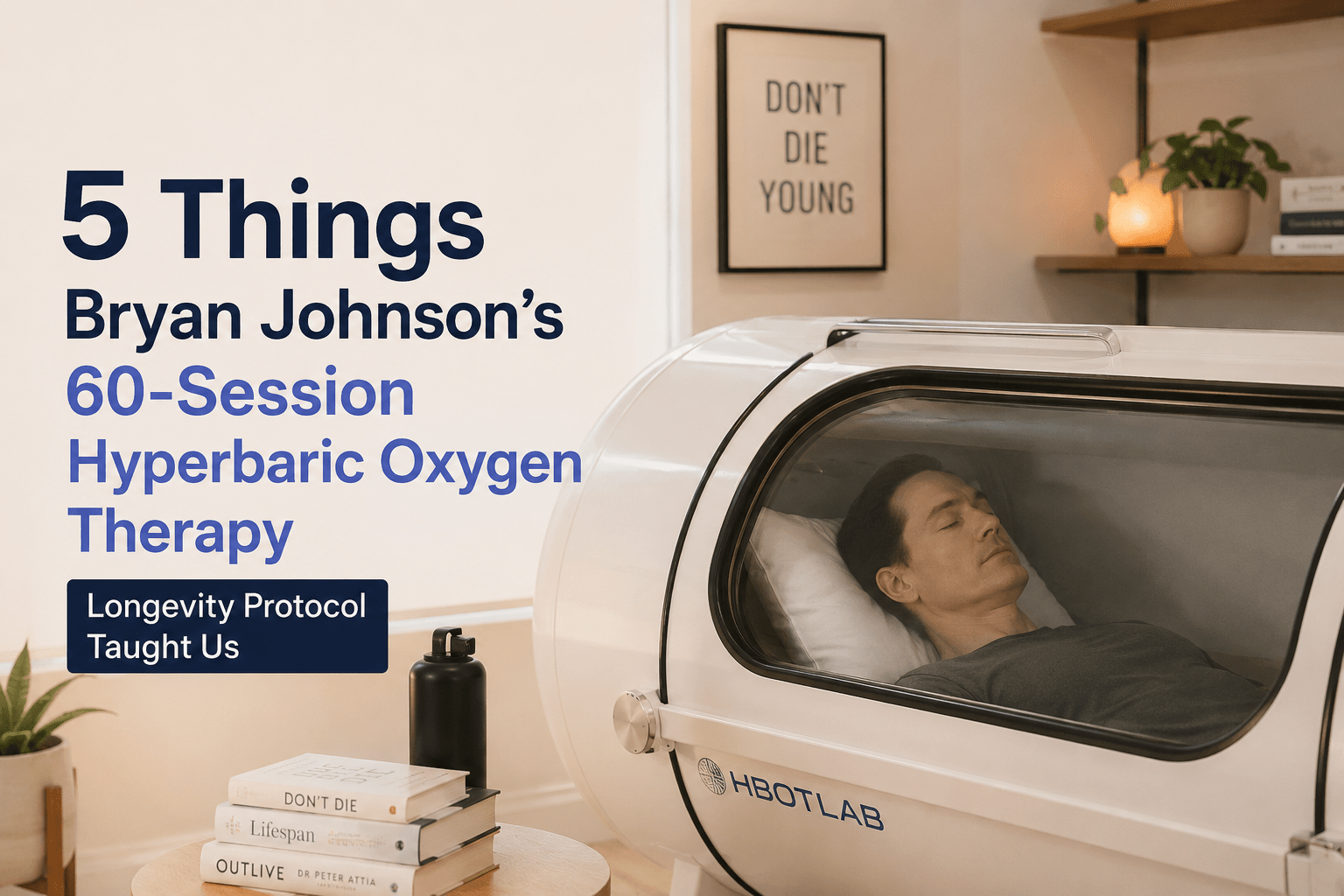
5 Things Bryan Johnson’s 60-Session hyperbaric oxygen therapy longevity Protocol Taught Us
Sixty sessions. One man. Data that turned the longevity world upside down.
You already know oxygen keeps you alive. What you probably don’t know is what happens when you breathe it under pressure — systematically, for 60 consecutive sessions — and then measure every biomarker your body produces.
Most people assume ageing is linear and inevitable. Inflammation rises. Blood vessels weaken. Cells slow down. And somewhere between forty and sixty, the body quietly stops repairing itself at the rate it once did. Most people accept that. Bryan Johnson did not.
Johnson completed a structured 60-session hyperbaric oxygen therapy longevity protocol in early 2025 — five sessions per week, 90 minutes each, at 2.0 ATA with 100% oxygen — and then published the biomarker results publicly. What those results showed is the most compelling real-world evidence for HBOT and longevity published in years.
Here are the five most important things that protocol taught us.
Who Is Bryan Johnson — And Why His HBOT Experiment Matters
Bryan Johnson is a technology entrepreneur who sold his company Braintree to PayPal for $800 million in 2013. Since 2021, he has been running Project Blueprint — a self-experiment in which he submits every measurable aspect of his biology to scientific testing and optimises each one with evidence-based interventions.
He is not chasing wellness trends. He is running a personal clinical trial. Every intervention he adopts is tracked against biomarkers, and every claim he makes is backed by lab data.
This matters because most celebrity HBOT endorsements are based on feel. Johnson’s are based on numbers. His 60-session protocol produced measurable changes across inflammation, vascular biology, mitochondrial function, and cellular ageing markers — all of which you can read more about in our guide on how hyperbaric oxygen therapy works.
Lesson 1 — Inflammation Can Be Driven to Undetectable Levels
After 60 sessions, Bryan Johnson’s high-sensitivity C-reactive protein (hsCRP) — the gold-standard blood marker for systemic inflammation — dropped to below detectable levels. His words: “wiped out all systematic inflammation in my body. Below detectable levels. This is wild.”
This is not just a wellness talking point. Chronic low-grade inflammation is now recognised as the underlying driver of virtually every age-related disease — cardiovascular disease, Alzheimer’s, type 2 diabetes, and several cancers. Bringing it to undetectable levels is a meaningful clinical outcome.
The science behind this is well established. HBOT modulates the NF-κB inflammatory signalling pathway and reduces the production of pro-inflammatory cytokines including TNF-α and IL-6. Research published in the journal Medical Science Monitor demonstrated that hyperbaric oxygen therapy inhibited the TLR4/NF-κB inflammatory cascade — the same pathway that drives chronic systemic inflammation.
Meng XE, Zhang Y, Li N, et al. Hyperbaric oxygen alleviates secondary brain injury after trauma through inhibition of TLR4/NF-κB signaling pathway. Med Sci Monit. 2016;22:284–288.
For a detailed breakdown of how these anti-inflammatory changes develop across sessions, see our HBOT results timeline.
Lesson 2 — Your Blood Vessels Can Grow New Branches
Johnson reported a 300% increase in VEGF — vascular endothelial growth factor — after his 60-session protocol. VEGF is the primary signal that triggers angiogenesis: the formation of new blood vessels.
This is not a cosmetic outcome. Your blood vessels are your body’s delivery system. Oxygen, nutrients, immune cells, hormones — all of it travels through your vascular network. As you age, microvascular density declines. Tissues that were once well-supplied start running at a deficit. Organs work harder for diminishing returns.
HBOT reverses this. By flooding tissues with oxygen under pressure, it creates the biological conditions that signal the body to grow new capillaries. This mechanism has been documented extensively in peer-reviewed research. Milovanova et al., writing in the Journal of Applied Physiology in 2009, demonstrated that hyperbaric oxygen stimulates vasculogenic stem cell growth and differentiation — the cellular foundation of new vessel formation.
Milovanova TN, Bhopale VM, Sorokina EM, et al. Hyperbaric oxygen stimulates vasculogenic stem cell growth and differentiation in vivo. J Appl Physiol. 2009;106(2):711–728.
This is also why HBOT has such a strong evidence base for wound healing. New blood vessel growth is how oxygen-starved tissue gets rescued. You can read more about the foundational science at what is hyperbaric oxygen therapy.
Lesson 3 — Mitochondria Respond Powerfully to Oxygen Pressure
Every cell in your body runs on ATP — the energy molecule produced inside mitochondria. Ageing mitochondria produce less ATP, generate more free radical waste, and eventually trigger cellular senescence: the biological state in which a cell stops dividing but refuses to die, leaking inflammatory signals into surrounding tissue.
Hyperbaric oxygen therapy acts directly on mitochondrial function. Research by Palzur et al., published in Brain Research in 2008, demonstrated that HBOT preserves mitochondrial membrane properties — the structural integrity that determines how efficiently a mitochondrion converts oxygen into energy.
Palzur E, Zaaroor M, Vlodavsky E, et al. Neuroprotective effect of hyperbaric oxygen therapy in brain injury is mediated by preservation of mitochondrial membrane properties. Brain Res. 2008;1221:126–133.
When mitochondria function better, cells produce more energy, create less oxidative waste, and age more slowly. This is not a theoretical pathway — it is the mechanism that underlies every energy and recovery benefit HBOT users report.
Johnson’s inflammation results are likely downstream of this mitochondrial effect. A mitochondria that functions cleanly produces less inflammatory waste. This is also the biological basis for the fatigue reduction and energy improvement that users report early in their protocol. For more on what to expect as sessions accumulate, read our guide on when HBOT benefits begin.
Lesson 4 — The Brain Gets More Than You Expect
The longevity conversation often focuses on the body. But the brain ages too — and it ages in ways that are harder to see and harder to reverse.
Johnson reported telomerase activity consistent with the biological age of a 12-year-old after his 60 sessions. Telomerase is the enzyme that rebuilds telomeres — the protective caps on chromosomes that shorten with each cell division. Longer telomeres are one of the most reliable markers of biological youth.
The cognitive benefits of HBOT are also well-documented independently of Johnson’s self-experiment. Research by Vadas et al., published in Frontiers in Integrative Neuroscience in 2017, demonstrated that a hyperbaric oxygen environment enhances brain activity and multitasking performance — measurable improvements in cognitive function in healthy adults.
Vadas D, Kalichman L, Hadanny A, et al. Hyperbaric oxygen environment can enhance brain activity and multitasking performance. Front Integr Neurosci. 2017;11:25.
For people approaching or past forty, this is one of the most compelling aspects of hyperbaric oxygen therapy longevity research. The brain is not exempt from the biological ageing process. But it is responsive to oxygen.
Lesson 5 — Consistency Is the Real Protocol
Sixty sessions sounds like a lot. Five per week for twelve weeks. But this is the number that produced the results Johnson reported. Not ten sessions. Not twenty. Sixty.
This is the lesson most people miss when they read about HBOT and longevity. The biology requires repetition. Each session builds on the last. Stem cells mobilised in one session are amplified in the next. Angiogenesis initiated in week two becomes mature vasculature by week eight. Mitochondrial adaptation is cumulative.
Thom SR’s foundational research on stem cell mobilisation by HBOT, published in the American Journal of Physiology in 2006, showed that the mechanism requires sustained oxygen pressure signals over time — not a single bolus. The HBOT results timeline follows a predictable pattern: subtle improvements in the first week, measurable changes by week four, and deeper systemic changes beyond session twenty.
Thom SR, Bhopale VM, Velazquez OC, et al. Stem cell mobilization by hyperbaric oxygen. Am J Physiol Heart Circ Physiol. 2006;290(4):H1378–H1386.
The practical implication for anyone in India considering a hyperbaric oxygen therapy longevity protocol is straightforward: commit to a structured course, not a single session. The results Johnson achieved were the product of a disciplined twelve-week commitment.
What This Means for You — Hyperbaric Oxygen Therapy Longevity in India
Bryan Johnson spent approximately $100,000 on his HBOT equipment alone. He had access to medical-grade hard-shell chambers, daily monitoring, and a full team of clinicians tracking his biomarkers in real time.
Most people do not have that. But the biology is the same.
The mechanisms Johnson’s protocol activated — reduced inflammation, new blood vessel growth, mitochondrial repair, cognitive enhancement, and telomere preservation — are not exclusive to his protocol. They are the mechanisms that hyperbaric oxygen therapy activates in any well-run clinical setting. What matters is the quality of the session: the pressure level, the oxygen concentration, and the consistency of attendance.
India’s wellness market is now large enough and sophisticated enough to support access to serious HBOT protocols. The question is no longer whether the science supports it. Johnson’s data, and the peer-reviewed research it reflects, answers that question clearly. The question now is where you access it and how seriously you take the protocol.
If you are new to this therapy, start with understanding the science. Our guide on how hyperbaric oxygen therapy works explains the mechanism in plain language. Then understand the timeline. The HBOT results timeline will tell you what to expect at each stage of a structured course.
Frequently Asked Questions
What did Bryan Johnson’s HBOT protocol involve?
Johnson completed 60 sessions over approximately 12 weeks, using a hard-shell chamber at 2.0 ATA with 100% oxygen, five sessions per week, each lasting 90 minutes. He tracked biomarkers before and after, including hsCRP (inflammation), VEGF (vascular growth), and telomere-related markers.
Can hyperbaric oxygen therapy really slow ageing?
The evidence suggests it can influence several of the biological mechanisms associated with ageing — including chronic inflammation, vascular density, mitochondrial function, and telomere length. Johnson’s self-experiment produced measurable improvements across all four. Peer-reviewed research supports each of these mechanisms independently. However, hyperbaric oxygen therapy is a supportive intervention, not a guaranteed age-reversal treatment. Results vary based on protocol, pressure levels, and individual biology.
How many HBOT sessions do you need to see longevity benefits?
Johnson’s results came from 60 sessions. Most peer-reviewed protocols showing meaningful longevity-related outcomes use between 40 and 60 sessions. Shorter protocols of 10 to 20 sessions may produce early benefits — reduced inflammation, improved energy, better sleep — but the deeper structural changes (angiogenesis, telomere effects, mitochondrial adaptation) appear to require sustained exposure. See our guide on when HBOT benefits begin for a full breakdown by session count.



3 Comments
Comments are closed.

[…] For the full breakdown of what his protocol involved and what each biomarker result means, read our dedicated article on the Bryan Johnson HBOT longevity protocol. […]
[…] research as well. Bryan Johnson’s 60-session protocol, covered in our article on the Bryan Johnson HBOT longevity protocol, produced measurable improvements in cognitive markers alongside the physical biomarker changes — […]
[…] Johnson’s 60-session longevity protocol, which we documented in detail in our article on the Bryan Johnson HBOT longevity protocol, also produced significant sleep quality improvements as a secondary outcome — confirming that […]