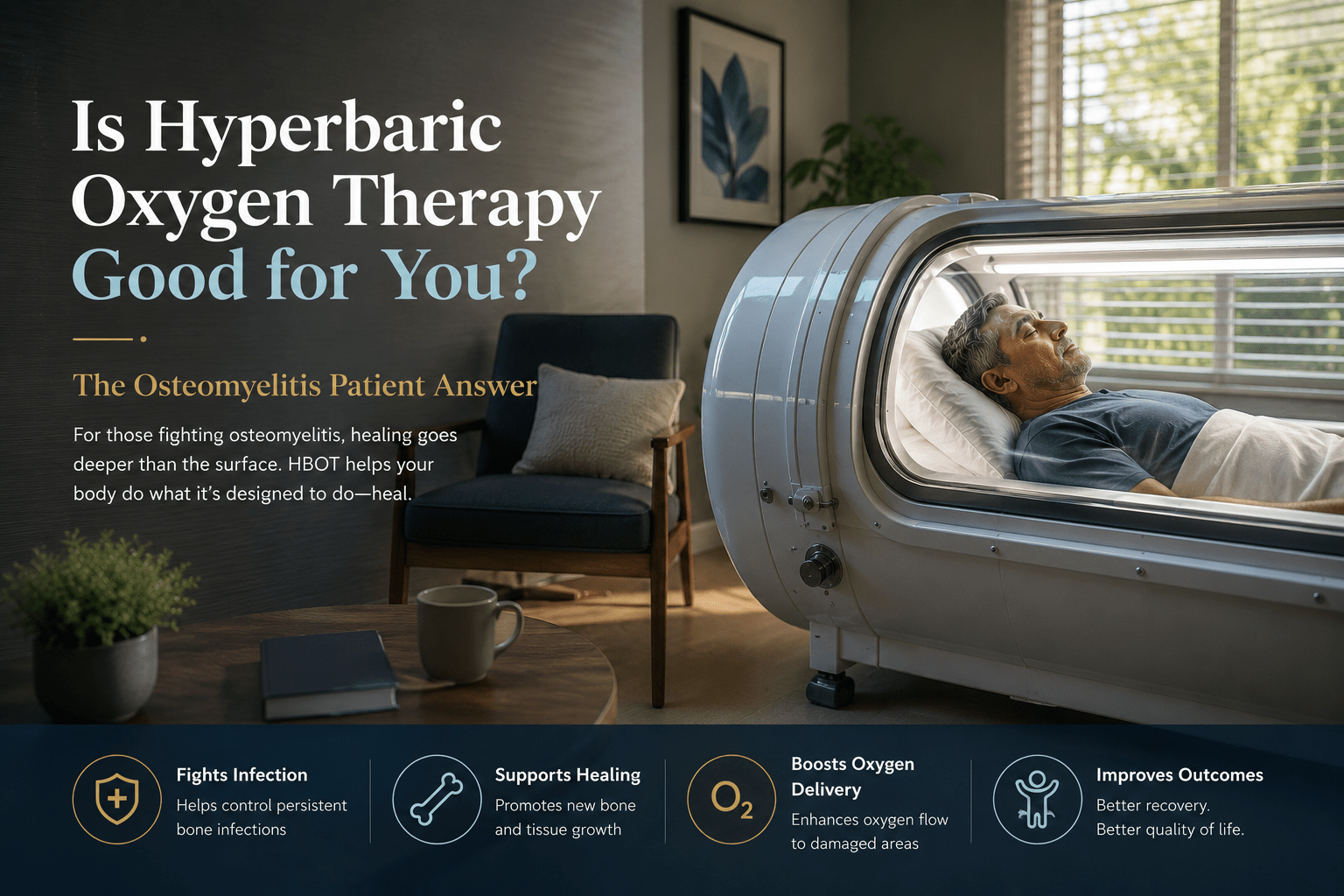
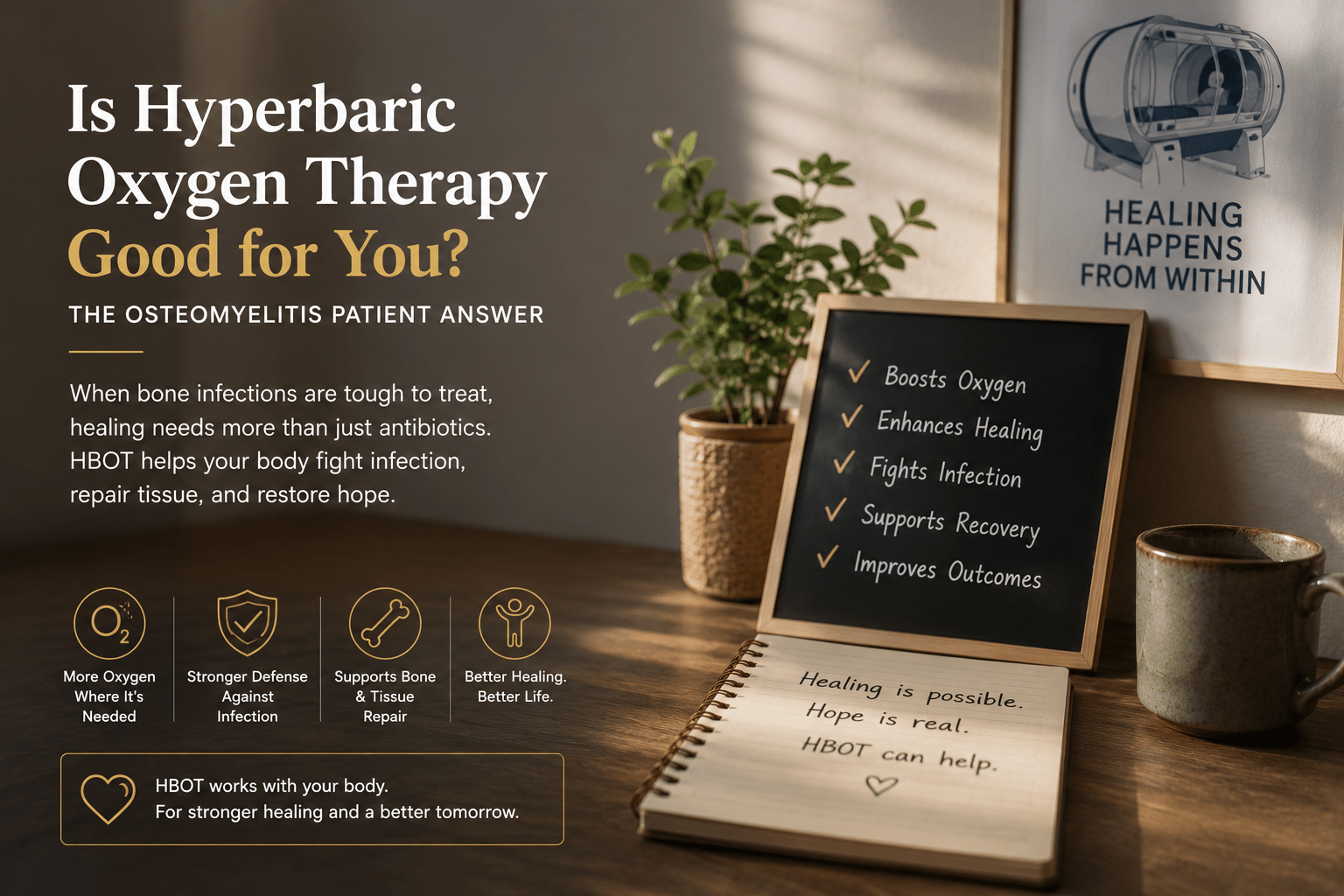
Is Hyperbaric Oxygen Therapy Good for You? The Osteomyelitis Patient Answer
Chronic bone infection that has resisted antibiotics and survived multiple surgeries is not untreatable. It is oxygen-deprived. And that is a problem HBOT is specifically built to solve.

is hyperbaric oxygen therapy good for you — osteomyelitis bone infection patient guide HBOT antibiotic
Is hyperbaric oxygen therapy good for you if you have osteomyelitis? The answer depends on which type of osteomyelitis and where you are in its course.
For chronic refractory osteomyelitis — bone infection that has failed to resolve with multiple courses of antibiotics and surgical debridement — the answer is yes. HBOT addresses the biological reason antibiotics stop working in chronic bone infection: the hypoxic, hypovascular tissue environment that prevents them from reaching therapeutic concentrations at the infection site.
For acute osteomyelitis presenting for the first time and treated promptly with appropriate antibiotics and surgery, HBOT adds less — because the environment has not yet become the problem. For diabetic osteomyelitis with associated peripheral vascular disease, HBOT is among the most evidence-supported adjunctive treatments available.
This article answers the ‘is HBOT good for you’ question with the specificity that actually helps: which osteomyelitis patients benefit most, why the therapy works, and what the evidence shows about outcomes.
For the primary osteomyelitis protocol and clinical evidence, see our guide on HBOT for refractory osteomyelitis. For the foundational mechanism, visit How HBOT Works.
Refractory osteomyelitis: Chronic bone infection that has failed to respond to at least two courses of appropriate antibiotic therapy and at least one surgical debridement. The failure mechanism is almost always environmental rather than pharmacological — the bone tissue is hypovascular and hypoxic, preventing antibiotics from reaching therapeutic concentrations at the infection site. HBOT addresses this environment directly.
Why Antibiotics Stop Working in Chronic Bone Infection
Most people with chronic osteomyelitis have been told that their bacteria are ‘resistant’ to antibiotics. In most cases, this is not accurate. The bacteria are often not genuinely resistant — they are surviving in an environment where the antibiotic cannot reach them at effective concentrations.
The Oxygen Threshold Problem
Aminoglycoside antibiotics — among the most effective agents against Staphylococcal osteomyelitis — require aerobic conditions for transport across bacterial cell membranes. Their killing mechanism depends on tissue oxygen tension above 30 mmHg. In chronically infected bone, tissue oxygen tension is typically well below this threshold.
The antibiotic is present in the blood. It reaches the bone. But in the hypoxic bone tissue, the mechanism that makes it bactericidal cannot function. The bacteria survive not because they have evolved resistance but because the environment has made the antibiotic inert.
The Biofilm Problem
Staphylococcus aureus — the most common osteomyelitis pathogen — forms biofilms on bone surfaces and surgical implants. Biofilms are structured bacterial communities encased in a polysaccharide matrix that dramatically reduces antibiotic penetration. documented that biofilm-embedded bacteria are 100 to 1,000 times more resistant to antibiotics than planktonic (free-floating) bacteria — not due to genetic resistance but to the physical barrier the biofilm creates.
HBOT disrupts biofilms through reactive oxygen species generated at therapeutic pressure — breaking down the matrix that protects the bacteria and restoring antibiotic access to the organisms within it.
The Vascularity Problem
Chronic bone infection progressively destroys the bone’s blood supply through inflammation, necrosis, and the formation of sequestra — islands of avascular dead bone that harbour bacteria beyond the reach of both immune cells and antibiotics. Even with adequate systemic antibiotic dosing, the drug cannot reach these protected zones through damaged vessels.
HBOT stimulates angiogenesis in the hypovascular bone — growing new capillaries that rebuild the blood supply and restore antibiotic delivery to the areas that were previously inaccessible.
| Failure Mechanism | Why Antibiotics Fail | How HBOT Addresses It |
| Tissue hypoxia | Aminoglycosides require O₂ >30 mmHg for bactericidal mechanism | HBOT raises bone tissue O₂ to 200+ mmHg — restores full antibiotic efficacy |
| Bacterial biofilm | Polysaccharide matrix reduces antibiotic penetration 100-1,000x | ROS from HBOT disrupts biofilm matrix; exposes bacteria to antibiotics |
| Hypovascular bone | Poor blood supply prevents antibiotic delivery to sequestrum | Angiogenesis from HBOT rebuilds vasculature; restores delivery |
| Impaired immune function | Leukocyte killing requires O₂ >30 mmHg — absent in hypoxic bone | HBOT restores tissue O₂ — leukocytes regain full bactericidal function |
Is Hyperbaric Oxygen Therapy Good for Diabetic Osteomyelitis Specifically?
Diabetic osteomyelitis is a distinct and highly prevalent clinical presentation — and the patient group for whom HBOT is most definitively beneficial.
Diabetic patients have the worst baseline conditions for osteomyelitis: peripheral vascular disease that has already compromised bone vascularity before infection, hyperglycaemia that impairs immune function, and neuropathy that allows ulcers — the entry point for most diabetic osteomyelitis — to develop without warning. Every mechanism that makes HBOT useful for refractory osteomyelitis is amplified in the diabetic context.
The diabetic osteomyelitis evidence builds on the foundational diabetic wound healing data. documented that HBOT improves microvascular perfusion and reduces amputation rates in diabetic patients with foot complications — and osteomyelitis is the complication most strongly associated with major amputation. The bone infection evidence and the wound healing evidence point to the same conclusion: HBOT is good for diabetic patients with lower-extremity bone infection.
For the related diabetic wound healing evidence, see our guides on HBOT for diabetic foot wounds and hyperbaric therapy for diabetic neuropathy.
is hyperbaric oxygen therapy good for you — diabetic osteomyelitis antibiotic potentiation HBOT mechanism
The Evidence: Is Hyperbaric Oxygen Therapy Good for Osteomyelitis Outcomes?
| Surgical Failure Rate | Davis JC et al. documented a 50% reduction in surgical failure rate in patients with chronic refractory osteomyelitis who received HBOT alongside surgery and antibiotics, compared to surgery and antibiotics alone. The mechanism — HBOT restoring antibiotic efficacy and leukocyte function in hypoxic bone — is consistent with this outcome. The therapy does not replace surgery; it changes the biological environment that determines whether surgery succeeds. |
The systematic evidence is reviewed by — documenting HBOT outcomes in compromised host osteomyelitis. The review confirmed that HBOT produces measurable improvement in infection resolution, reduced reoperation rates, and improved bone healing outcomes in patients where standard management had failed.
The evidence base spans more than four decades. The mechanism is well-understood. The FDA and UHMS recognition has been in place since 1977. For refractory osteomyelitis, HBOT is not an emerging or experimental treatment — it is the established adjunct for the situation where standard management has reached its limit.
Who Should and Should Not Use HBOT for Bone Infections
HBOT Is Good For
- Chronic refractory osteomyelitis — failed 2+ antibiotic courses and at least one surgical debridement
- Diabetic osteomyelitis with peripheral vascular disease — the patient group with the most pronounced benefit
- Post-surgical osteomyelitis — infection following orthopaedic implant placement, where biofilm on the implant is the mechanism
- Chronic osteomyelitis with sequestrum — avascular dead bone requiring both surgical removal and angiogenesis to close the resulting cavity
- Osteomyelitis in irradiated bone — where the baseline vascularity is already compromised by radiation
HBOT Is Less Indicated For
- Acute osteomyelitis, first presentation — the hypovascular, biofilm environment has not yet established; standard antibiotics work effectively at this stage
- Osteomyelitis with adequate blood supply and no treatment failure history — the mechanism that makes HBOT useful is not yet the limiting factor
- Patients who cannot commit to 30–40 sessions — incomplete courses produce incomplete results; the angiogenesis benefit requires the full course
What Indian Osteomyelitis Patients Should Know
India’s osteomyelitis burden is substantial — driven by high rates of diabetes, open fractures from road traffic accidents, post-surgical infections, and delayed presentation to tertiary care. Chronic refractory osteomyelitis requiring prolonged antibiotic courses and repeated surgery is a significant clinical volume in Indian orthopaedic and infectious disease practices.
Awareness of HBOT as an adjunctive treatment among Indian orthopaedic surgeons and infectious disease specialists is growing but remains limited. Most Indian orthopaedic centres do not have on-site hyperbaric facilities and do not have established referral pathways for osteomyelitis patients.
The practical question for Indian patients is not whether HBOT is good for osteomyelitis — the evidence answers that. It is whether the referral pathway can be activated and the treatment course completed.
For HBOT facility locations in India, see our guides to HBOT in Delhi and HBOT in Bangalore. For a national access guide, see our HBOT near me India guide. For insurance guidance, see our HBOT insurance India guide.
Frequently Asked Questions
How many HBOT sessions does osteomyelitis require?
The standard course for refractory osteomyelitis is 30 to 40 sessions — once daily, five days per week, over 6 to 8 weeks. This is one of the longer HBOT courses among the recognised indications, reflecting the need to establish lasting angiogenesis in the hypovascular bone rather than just temporarily raising tissue oxygen. Patients who complete fewer than 20 sessions rarely achieve the angiogenesis benefit. Assessment at session 20 guides whether extension to 40 is warranted.
Does HBOT for osteomyelitis replace antibiotics?
No — HBOT makes antibiotics work, not replaces them. The therapy restores the tissue oxygen concentration that enables aminoglycosides and other antibiotics to achieve their full bactericidal mechanism. Antibiotics must continue throughout and after the HBOT course. The combination of HBOT plus appropriate antibiotic therapy produces outcomes that neither achieves alone. Antibiotic selection and duration should be managed by an infectious disease specialist in parallel with HBOT.
Can HBOT help if bone has already been removed (sequestrectomy)?
Yes — and this is one of its most important uses in osteomyelitis. After surgical removal of sequestrum (dead bone), the resulting cavity has impaired blood supply and poor healing capacity. HBOT supports healing of the post-sequestrectomy cavity by stimulating angiogenesis in the surrounding bone — growing new vessels that enable the cavity to fill with healthy bone-forming tissue rather than fibrous scar.
Is HBOT good for osteomyelitis if I have an implant?
Yes — biofilm on orthopaedic implants is one of the most challenging osteomyelitis scenarios, and HBOT’s biofilm disruption mechanism is directly applicable. Whether the implant is retained or will be removed is a surgical decision — HBOT supports infection control in both scenarios. If the implant is retained, HBOT’s ongoing biofilm disruption effect throughout the treatment course is particularly valuable.
What are the side effects of HBOT for osteomyelitis?
The side effect profile is the same as for other HBOT indications. For a complete guide, see our article on hyperbaric oxygen therapy side effects. Diabetic patients require blood glucose monitoring before each session — see our diabetic HBOT safety guidance.
The Antibiotic That Was Not Failing — It Was Waiting
The most important reframe in chronic osteomyelitis management is this: in most cases, the antibiotics were not failing because the bacteria were resistant. They were failing because the tissue environment made them inert.
Restoring that environment — raising tissue oxygen from below threshold to therapeutic levels — is what makes the antibiotics work, the immune system function, and the bone heal. It is not magic. It is oxygen delivery to tissue that could not receive it through its damaged blood supply.
Is hyperbaric oxygen therapy good for you if you have refractory osteomyelitis? The evidence says yes. The mechanism explains why. And for diabetic patients specifically — where every layer of the failure mechanism is amplified — it is one of the most important adjunctive treatments available.
Chronic osteomyelitis that has resisted antibiotics and surgery is not a hopeless diagnosis. In most cases, the bacteria are surviving in a hypoxic sanctuary — a tissue environment where antibiotics cannot function and the immune system cannot kill effectively. HBOT changes that environment. The 50% reduction in surgical failure rate when HBOT is added to standard management is the evidence that quantifies what changing that environment actually achieves.
For the complete osteomyelitis protocol and evidence, see our primary guide on HBOT for refractory osteomyelitis. For all 14 HBOT indication uses, see our HBOT uses guide.
The infection is not antibiotic-resistant. The environment was oxygen-deprived. HBOT fixes the environment.