
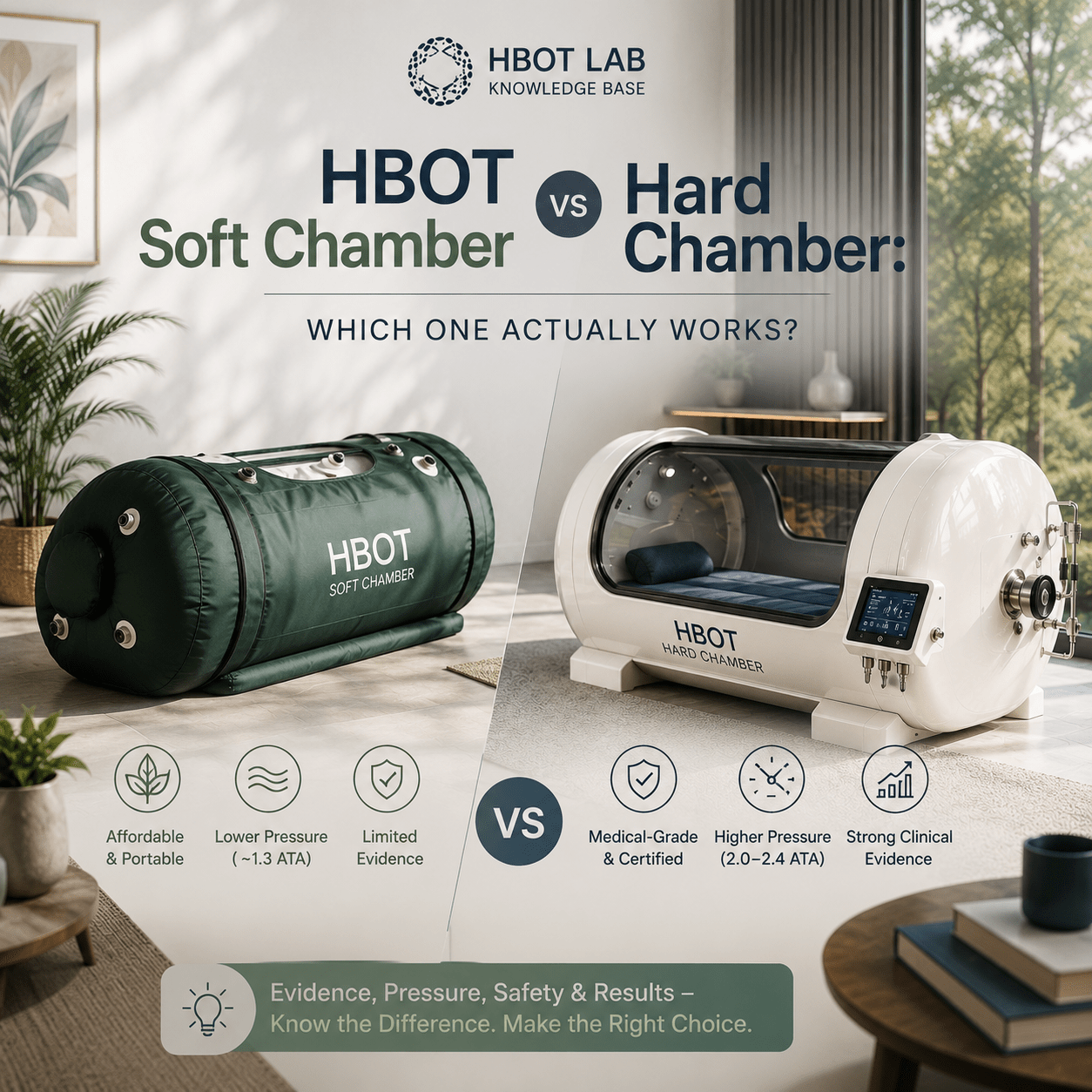
HBOT Soft Chamber vs Hard Chamber: Which One Actually Works?
HBOT Soft Chamber vs Hard Chamber: Which One Actually Works?
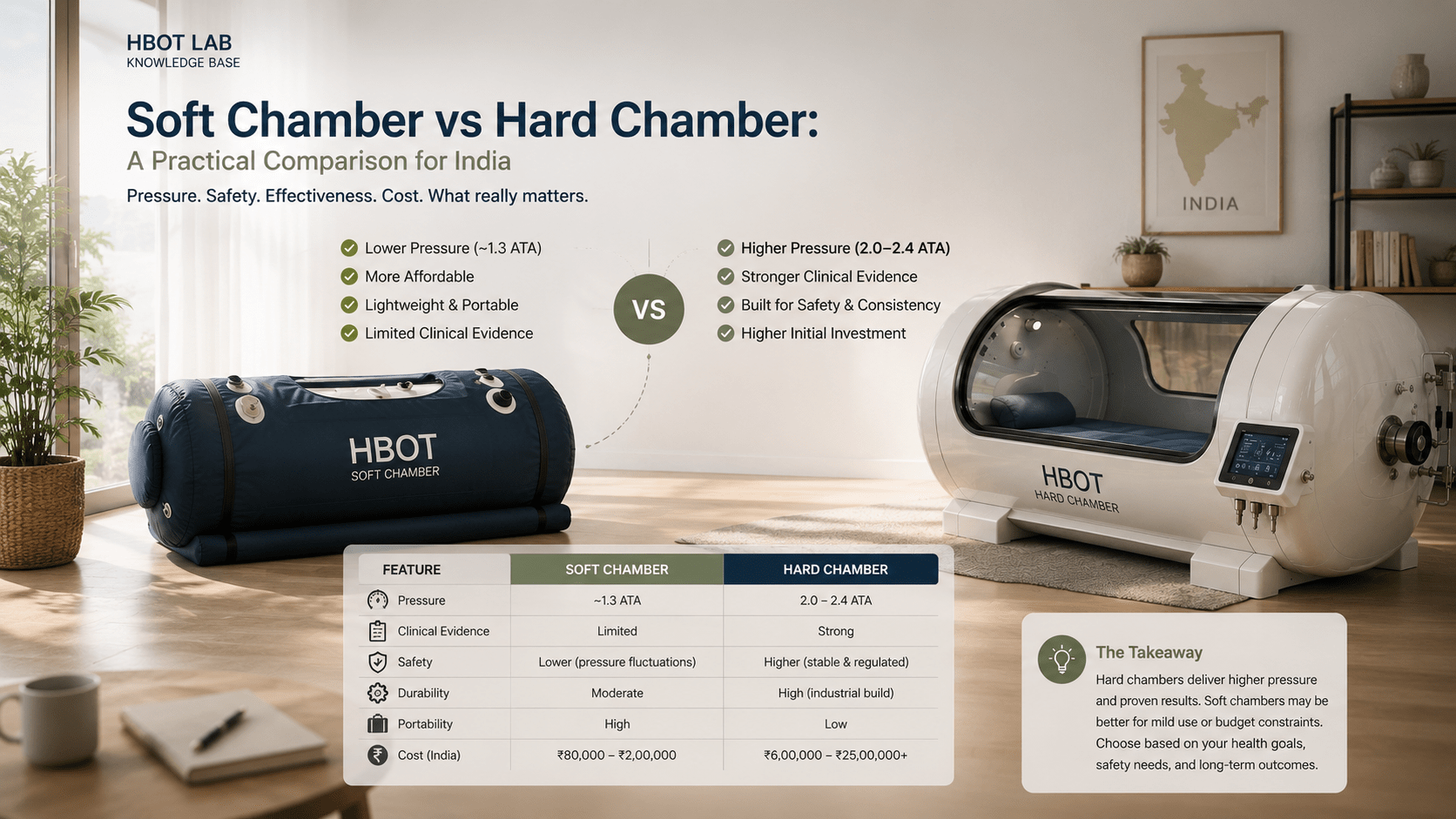
The HBOT soft chamber market in India has grown rapidly. Walk into almost any wellness centre and you may find a soft portable chamber alongside — or sometimes instead of — a proper clinical setup.
That growth has created real confusion. Patients researching HBOT find wildly different price points and wildly different claims. The ₹800 session at a gym and the ₹5,000 session at a certified clinic are both called HBOT — but they are not the same thing.
hbot soft chamber vs hard chamber comparison pressure clinical India
This guide explains the actual difference between a soft chamber and a hard chamber, what that difference means for your results, and why the choice of chamber type is the most important decision you will make before booking your first session.
| PVHO DEFINITION
A hard-shell HBOT chamber is classified as a pressure vessel for human occupancy — or PVHO. This means it is engineered to contain and safely manage pressures significantly above atmospheric level while a person is inside. PVHO standards are set by the American Society of Mechanical Engineers (ASME) under the PVHO-1 Safety Standard. Any chamber used on humans for clinical HBOT in India should meet this standard. A soft chamber is not classified as a PVHO. It is a fabric enclosure that can reach limited pressurisation — but cannot meet the engineering requirements that PVHO standards demand. |
The Single Most Important Difference: Pressure
Everything else — size, comfort, price, branding — is secondary. The pressure a chamber reaches determines whether clinical HBOT can actually happen inside it.
Clinical HBOT protocols — the ones used in peer-reviewed research on diabetic wounds, stroke recovery, TBI, and other conditions — operate at 2.0 ATA (atmospheres absolute) or above. At 2.0 ATA, oxygen dissolves directly into blood plasma. This is the mechanism that drives clinical outcomes.
An HBOT soft chamber typically operates at 1.3 ATA. At this pressure, the increase in dissolved plasma oxygen is minimal. The therapeutic mechanism that makes hard-chamber HBOT work does not activate fully at 1.3 ATA.
For a detailed explanation of how pressure translates into clinical oxygen delivery, read our article on how HBOT pressure works. And for a plain explanation of what HBOT does at the right pressure, see our guide on what HBOT is and how it works.
What Is a Soft Chamber and What Can It Do?
A soft chamber is a fabric-encased, inflatable pressure vessel. It is portable, lightweight, and significantly cheaper than a hard-shell unit. Sessions in soft chambers are often marketed at ₹800 to ₹1,500 — a fraction of a certified hard-chamber session.
Soft chambers can produce some benefits — particularly for mild relaxation, mild oxygenation, and convenience. They are popular in home use settings and sports recovery setups where the goal is general wellness rather than clinical treatment.
However, they cannot:
- Reach the 2.0 ATA threshold required for clinical HBOT
- Meet PVHO standards — they are not pressure vessels for human occupancy under the ASME classification
- Deliver the dissolved plasma oxygen levels that research studies have used in their clinical protocols
- Be used for FDA-recognised HBOT indications such as diabetic wounds, decompression sickness, or radiation injury
If you are considering a soft chamber for home use, read our detailed guide on choosing a hyperbaric chamber for home use which covers what to look for and what to avoid.
HBOT Soft Chamber vs Hard Chamber — Complete Comparison
Here is the full side-by-side breakdown:
| Factor | Soft Chamber | Hard Chamber (PVHO) |
| Maximum pressure | 1.3–1.5 ATA | 2.0–3.0 ATA |
| PVHO classification | No — not a PVHO | Yes — meets ASME PVHO-1 standard |
| Clinical HBOT possible? | No | Yes |
| FDA indications treatable | No | Yes — all 14 recognised indications |
| Research-backed protocols | Very limited | Yes — all major trials used hard chambers |
| Typical cost per session | ₹800–₹1,500 | ₹2,500–₹8,000 |
| Safety certification | None required | ASME PVHO standards mandatory |
| Suitable for serious conditions | No | Yes |
| Portable / home use | Yes | No — fixed clinical installation |
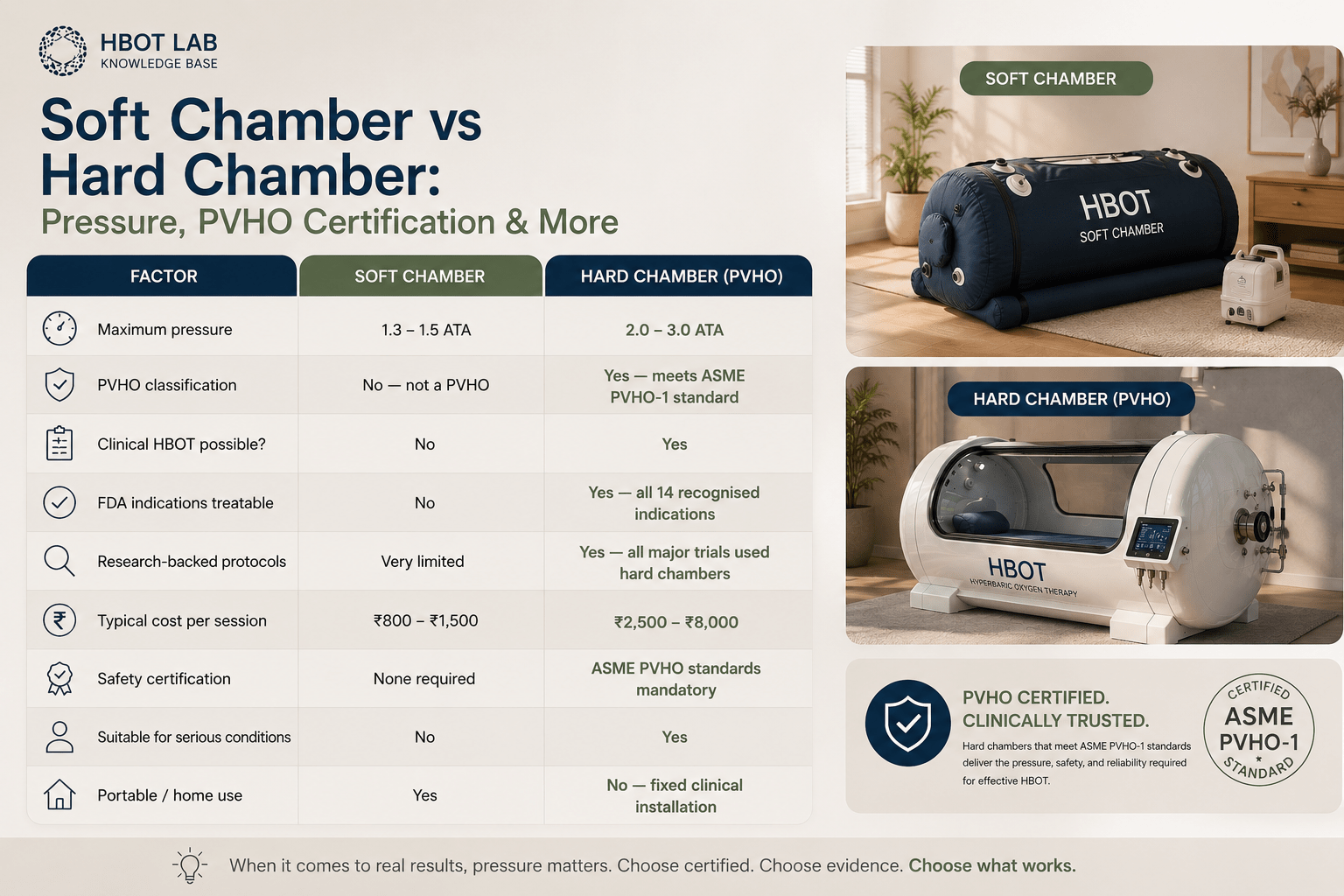
hbot soft chamber hard chamber pressure difference PVHO certification comparison
Why the Price Difference Is Not What It Appears to Be
At first glance, a ₹1,000 soft chamber session looks like a much better deal than a ₹4,000 hard chamber session. Over 40 sessions, that is the difference between ₹40,000 and ₹1,60,000.
But the comparison only makes sense if both sessions produce equivalent outcomes. They do not.
A soft chamber session at 1.3 ATA cannot activate the mechanisms — dissolved plasma oxygen, angiogenesis stimulation, anti-inflammatory signalling — that the clinical research is built on. If you complete 40 sessions at 1.3 ATA and see no improvement in your diabetic wound or post-stroke recovery, the real cost is not the ₹40,000 you spent. It is the time you lost and the outcome you missed.
Every certified HBOT clinic in India using a genuine PVHO-classified hard chamber has to recover the cost of a chamber that meets ASME PVHO standards. That engineering standard exists because a pressurised vessel with a human inside it requires a level of safety that a fabric inflatable cannot provide. The higher price reflects that reality.
Read our full breakdown on why cheap HBOT chambers cost more for a detailed cost analysis. And for what to look for when verifying any Indian clinic’s chamber, see our chamber checklist for Indian buyers.
When a Soft Chamber Might Be Appropriate
Being balanced matters here. There are scenarios where a soft chamber is a reasonable choice:
- General wellness and mild oxygenation — If your goal is relaxation, mild recovery support, or general wellness without a specific clinical protocol, a soft chamber at home may serve that purpose.
- Paediatric use in non-clinical settings — Some families with children on autism or developmental support protocols use mild hyperbaric sessions at home between clinical treatments. This is a supplementary, not primary, use.
- Athletes recovering from minor injuries — For muscle soreness, minor strains, and general recovery acceleration, soft chambers can provide some benefit — though hard chambers produce more consistent results.
What a soft chamber should never be used for: any condition where HBOT is prescribed clinically — diabetic wounds, radiation injury, osteomyelitis, stroke recovery, TBI, or any of the 14 FDA-recognised HBOT indications.
How to Verify Whether an Indian Clinic Is Using a PVHO-Certified Chamber
When you visit or call any HBOT clinic in India, ask these questions specifically:
- Is your chamber certified as a pressure vessel for human occupancy under ASME PVHO-1? The answer should be yes, and they should be able to produce the certification document on request.
- What pressure does your chamber reach during a session? The answer should be 2.0 ATA or above. If they say 1.3 ATA or ‘mild hyperbaric’, it is a soft chamber regardless of what else they call it.
- Is the chamber inspected and recertified on schedule? PVHO standards require ongoing inspection and recertification. A responsible clinic will have current documentation.
For a full guide to HBOT PVHO certification and what it means for patients, read our dedicated article on PVHO chamber safety in India. For everything that makes a chamber medical-grade, see our guide on what makes a chamber medical-grade.
Frequently Asked Questions
What is the difference between an HBOT soft chamber and a hard chamber?
A hard chamber is a PVHO — a pressure vessel for human occupancy — that can reach 2.0 ATA or above. A soft chamber is a fabric enclosure that reaches 1.3 ATA maximum. Clinical HBOT requires 2.0 ATA. Soft chambers cannot meet PVHO standards and cannot deliver clinical-grade HBOT.
Is a soft HBOT chamber effective?
A soft chamber can provide mild oxygenation and general wellness benefits at 1.3 ATA. It cannot produce the clinical outcomes that research associates with HBOT — which requires 2.0 ATA minimum. For any medically prescribed condition, a soft chamber is not a substitute for a certified hard chamber.
Why is hard chamber HBOT more expensive than soft chamber?
Hard chambers must meet ASME PVHO standards — the engineering and safety code for pressure vessels used on humans. The procurement, installation, maintenance, inspection, and staffing costs of a PVHO-certified chamber are substantially higher than a portable soft unit. That cost difference is real, not arbitrary.
Can I use a soft chamber at home for medical conditions?
No. For any clinically diagnosed condition where HBOT is the treatment — diabetic wounds, radiation injury, neurological recovery, osteomyelitis — a soft chamber at 1.3 ATA is not appropriate. These conditions require a certified hard-chamber PVHO setup under medical supervision.
How do I know if a clinic in India has a hard chamber?
Ask for the ASME PVHO-1 certification document for their chamber and confirm it operates at 2.0 ATA or above. Any clinic unable to produce this documentation is not running a certified clinical-grade setup. See our chamber checklist for Indian buyers for a full verification checklist.



Subscribe
14 Comments
Comments are closed.
[…] a detailed side-by-side comparison of the two types, read our article on the hard vs soft chamber comparison. For the full PVHO safety picture, see our guide on PVHO chamber safety in […]
[…] directly into blood plasma — activates fully. At 1.3 ATA, it does not. See our article on the hard vs soft chamber comparison for a detailed pressure […]
[…] Pricing depends on your city, chamber type (hard vs soft), pressure and whether you buy a package. A genuine course runs multiple sessions, so both per-session and package price matter. See our up-to-date HBOT cost in India guide, or the city links above for local figures. If a price looks unusually cheap, check the chamber standard before booking — see hard vs soft chamber. […]
[…] Cost depends on the chamber type (hard vs soft), pressure, session length and whether you buy a package — and a genuine course involves multiple sessions, so both per-session and package pricing matter. For current, city-wise figures see our HBOT cost in India guide. If a quoted price looks unusually low, check the chamber standard first — a mild soft chamber at ~1.3 ATA is not the same treatment as a PVHO-certified hard chamber. See hard vs soft chamber. […]
[…] HBOT cost in India · hard vs soft chamber […]
[…] HBOT cost in India · hard vs soft chamber […]
[…] HBOT cost in India · hard vs soft chamber […]
[…] HBOT cost in India · hard vs soft chamber […]
[…] Hard chambers — rigid, medical-grade vessels that reach the higher pressures (around 2.0 ATA and above) at which most clinical effects are documented. See hard chamber vs soft chamber. […]
[…] chamber at ~1.3 ATA is a different treatment from a PVHO-certified hard chamber at ~2.0 ATA. Our hard vs soft chamber guide explains why that gap […]
[…] chamber at ~1.3 ATA is a different treatment from a PVHO-certified hard chamber at ~2.0 ATA. Our hard vs soft chamber guide explains why that gap […]
[…] chamber at ~1.3 ATA is a different treatment from a PVHO-certified hard chamber at ~2.0 ATA. Our hard vs soft chamber guide explains why that gap […]
[…] chamber at ~1.3 ATA is a different treatment from a PVHO-certified hard chamber at ~2.0 ATA. Our hard vs soft chamber guide explains why that gap […]
[…] chamber at ~1.3 ATA is a different treatment from a PVHO-certified hard chamber at ~2.0 ATA. Our hard vs soft chamber guide explains why that gap […]