HBOT Meaning: What Hyperbaric Oxygen Therapy Means for Arterial Insufficiency Patients
HBOT meaning, reduced to its essentials: a chamber. Pure oxygen. Pressure above normal atmosphere. And inside the body — oxygen dissolving into blood plasma at concentrations that reach tissue even when the arteries supplying it have failed. That is what HBOT means. That is why it matters for arterial insufficiency.
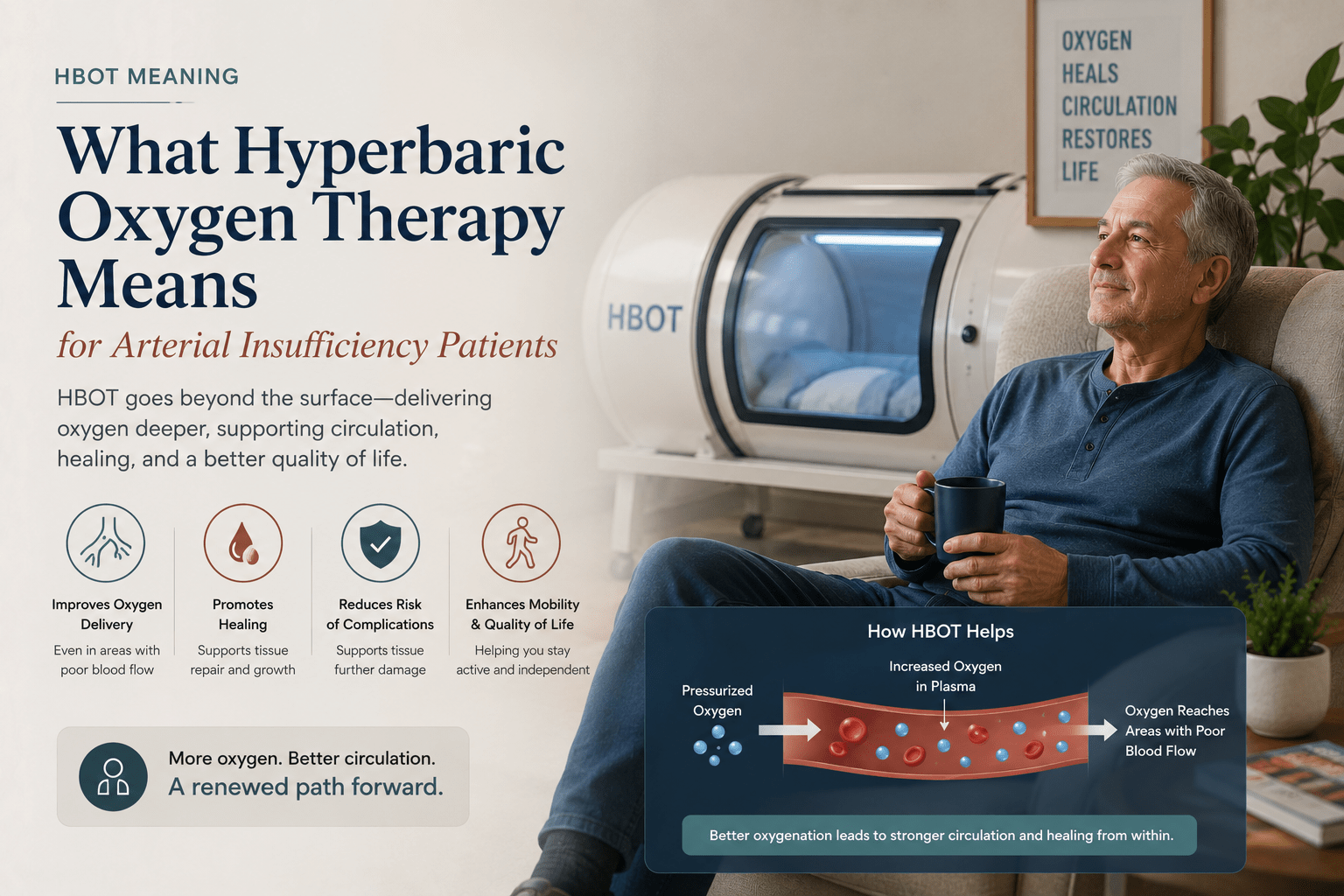
hbot meaning — arterial insufficiency plasma oxygenation hyperbaric oxygen therapy mechanism explained
HBOT meaning begins with a physical fact: oxygen dissolves in plasma under pressure.
At normal atmospheric pressure — 1.0 ATA — plasma carries a negligible amount of dissolved oxygen. The vast majority of oxygen transport in the body depends on haemoglobin. When arteries supplying a limb or organ are blocked, occluded, or insufficient, haemoglobin cannot reach the tissue that needs oxygen. The tissue becomes ischaemic. Cell death follows.
The therapy changes the equation. At 2.0 to 2.4 ATA breathing pure oxygen, the plasma oxygen concentration rises to 20 times its normal level. This plasma-dissolved oxygen diffuses through tissue by simple physics — independent of the blocked arteries, independent of the haemoglobin that cannot reach the ischaemic zone. The tissue receives oxygen through a pathway the arterial disease cannot obstruct.
That is the meaning most relevant to arterial insufficiency patients: a delivery system for oxygen that bypasses the arteries.
For the primary arterial insufficiency protocol and evidence, see our guide on HBOT for acute arterial insufficiency. For the complete mechanism explanation, visit How HBOT Works.
HBOT meaning (full form): Hyperbaric Oxygen Therapy. A treatment in which a patient breathes 100% pure oxygen inside a pressurised chamber at 1.5 to 3.0 times normal atmospheric pressure (ATA). The increased pressure causes oxygen to dissolve directly into blood plasma — reaching tissue through diffusion regardless of haemoglobin function or arterial blood supply. Used for 14 FDA-recognised conditions, including acute arterial insufficiency.
HBOT Meaning in Medical Context — Breaking Down the Term
Hyperbaric
‘Hyperbaric’ means above normal atmospheric pressure. Normal atmospheric pressure at sea level is 1.0 ATA (atmosphere absolute). Hyperbaric environments start above this level. Clinical HBOT is delivered at 1.5 to 3.0 ATA depending on the indication. For acute arterial insufficiency, the standard pressure is 2.0 to 2.4 ATA — enough to achieve the plasma oxygen concentrations that deliver meaningful tissue oxygenation without blood vessel function.
For the detailed pressure science, see our guide on hyperbaric oxygen therapy pressure explained.
Oxygen
The oxygen breathed during HBOT is 100% pure — not the 21% oxygen in room air, not the 40 to 60% delivered by a standard face mask, but 100% medical-grade oxygen. At 2.0 ATA, 100% oxygen produces plasma oxygen partial pressures of approximately 1,400 to 1,600 mmHg — compared to roughly 100 mmHg in normal arterial blood. This concentration gradient is what drives the diffusion of oxygen into hypoxic tissue.
Therapy
The therapeutic effect of HBOT is not the oxygen alone and not the pressure alone — it is their combination. The pressure dissolves the oxygen into plasma. The plasma concentration gradient drives diffusion into tissue. The diffusion reaches tissue that haemoglobin-dependent transport cannot reach. The result — for arterial insufficiency patients — is oxygenation of ischaemic tissue through a pathway completely independent of the blocked arterial supply.
| Term Component | What It Means | Why It Matters for Arterial Insufficiency |
| Hyperbaric | Above normal atmospheric pressure (>1.0 ATA) | Pressure drives O₂ into plasma at concentrations 20× normal — the physical mechanism |
| Oxygen (100%) | Pure medical-grade oxygen, not room air | Maximises plasma dissolution; room air at 2.0 ATA achieves only a fraction of the effect |
| Therapy | Treatment with measurable, repeatable biological outcomes | Repeated sessions build cumulative angiogenesis — vessels that survive after treatment ends |
| Full form: HBO2 | Hyperbaric Oxygen (subscript 2 = O₂ molecule) | Clinical abbreviation; equivalent to HBOT for all practical purposes |
HBOT Meaning in Practice — What Happens in the Chamber
The meaning becomes concrete inside the chamber. Understanding what physically happens during a session clarifies why it produces the clinical outcomes documented for arterial insufficiency.
Compression Phase — 10 to 15 Minutes
The chamber pressurises from 1.0 ATA to the treatment pressure — typically 2.0 to 2.4 ATA for arterial insufficiency. During this phase, the patient equilibrates ear pressure through swallowing or jaw movements. The oxygen breathing begins. As pressure rises, the partial pressure of the 100% oxygen the patient is breathing increases proportionally — driving oxygen into plasma at increasing concentrations.
Treatment Phase — 60 to 90 Minutes
At treatment pressure, the patient breathes 100% oxygen continuously. Plasma oxygen concentrations reach their therapeutic maximum. Oxygen diffuses from plasma into all adjacent tissue — including the ischaemic zones that cannot be reached by arterial blood. For arterial insufficiency, this diffusion is the primary therapeutic mechanism: the tissue that has been deprived of oxygen through insufficient arterial supply is receiving it through a different route.
Air breaks — periods of breathing room air at treatment pressure — are included every 20 to 25 minutes to prevent oxygen toxicity. The breaks do not reduce the therapeutic benefit because plasma oxygen remains elevated during the brief interval. The treatment protocol is highly standardised and has been refined across decades of clinical use. documented the mechanisms by which therapeutic pressure and oxygen concentration produce the biological cascade effects that extend the benefit beyond the session itself.
Decompression Phase — 10 to 15 Minutes
The chamber depressurises gradually to 1.0 ATA. The elevated plasma oxygen concentration reduces as pressure falls, but tissue oxygen levels remain above pre-treatment baseline for 4 to 6 hours post-session. This inter-session elevation sustains the therapeutic benefit between sessions and contributes to the cumulative angiogenesis that builds across the treatment course.
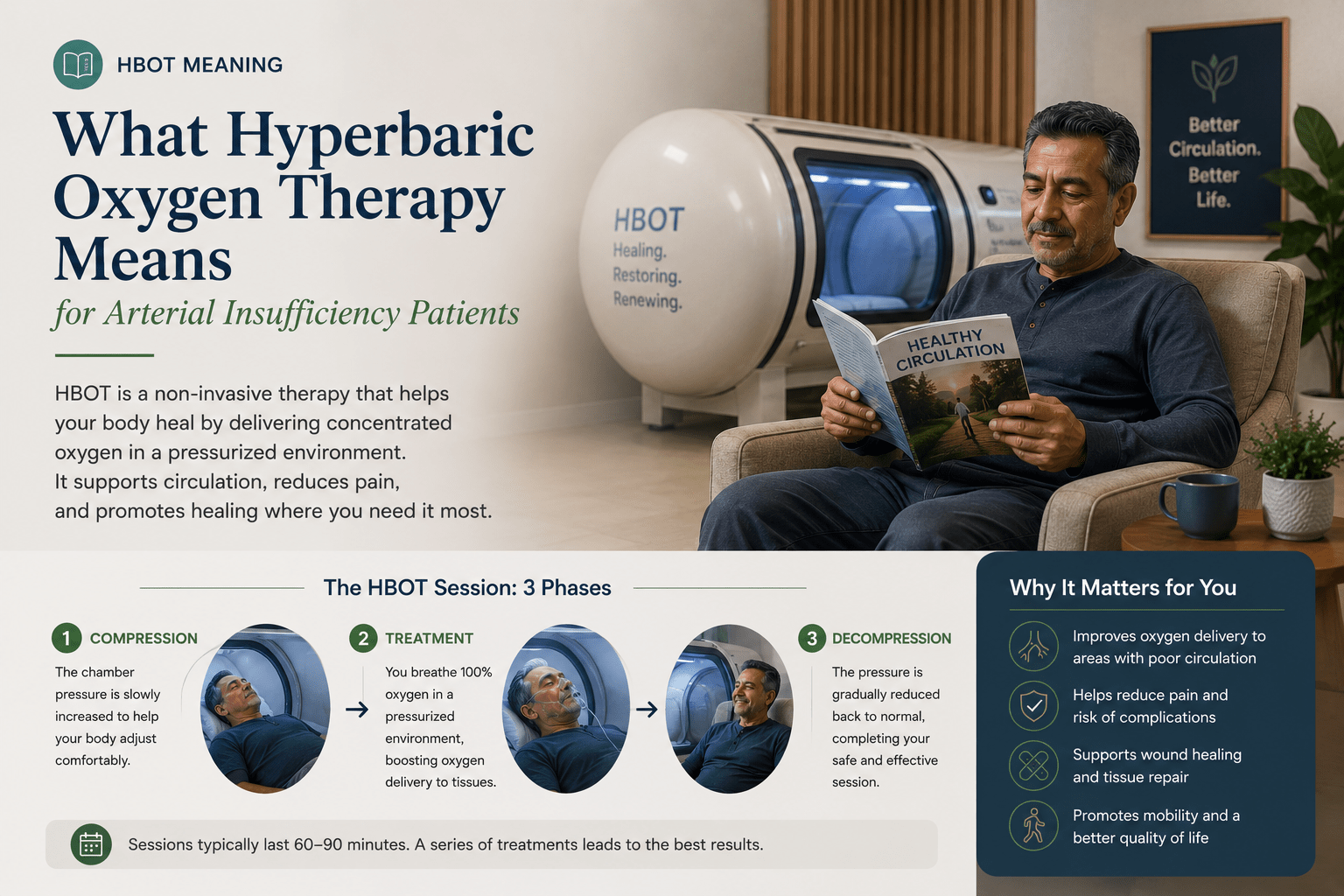
hbot meaning — chamber session phases compression treatment decompression arterial insufficiency
HBOT Meaning for the Five Conditions It Most Closely Resembles
HBOT meaning is sharpest when the therapy is contrasted with conditions that share the arterial insufficiency mechanism — showing what makes HBOT specifically different from each alternative.
| The core HBOT meaning for vascular patients | HBOT does not repair arteries. It does not remove plaques. It does not restore flow through blocked vessels. What it does is provide oxygen to tissue that those blocked vessels can no longer supply — using plasma dissolution and diffusion rather than haemoglobin transport. This distinction is the entire clinical rationale for HBOT in arterial insufficiency. |
HBOT vs Supplemental Oxygen (Face Mask)
Standard supplemental oxygen at 100% concentration via face mask operates at 1.0 ATA — normal atmospheric pressure. At this pressure, plasma can only dissolve approximately 0.03 mL of oxygen per 100 mL of plasma. At 2.4 ATA, this rises to 5.6 mL per 100 mL — enough to sustain tissue viability independent of haemoglobin. A face mask at 1.0 ATA, even at 100% oxygen, cannot achieve plasma oxygenation anywhere close to HBOT levels.
HBOT vs Revascularisation Surgery
Revascularisation — angioplasty, bypass, or stenting — restores blood flow through the diseased vessel. HBOT does not repair the vessel. The two interventions are complementary rather than competitive: revascularisation addresses the anatomical cause, HBOT addresses the immediate tissue oxygen deficit that threatens viability before or after the procedure. HBOT is most valuable when revascularisation is not immediately possible or when tissue viability during the waiting period is at risk.
HBOT vs Vasodilators
Vasodilator medications increase blood flow through existing vessels. In arterial insufficiency with fixed obstructions, the vessel cannot dilate beyond the obstruction. Vasodilators may increase flow proximal to the obstruction without significantly increasing distal tissue oxygenation. HBOT bypasses the obstruction entirely through plasma diffusion — delivering oxygen distal to the block regardless of vessel patency.
HBOT Meaning in the India Context — Why Arterial Insufficiency Patients Need to Know It
India’s cardiovascular disease burden — the world’s largest — means a substantial population of arterial insufficiency patients who may not be aware that HBOT is a recognised treatment option. Peripheral arterial disease, critical limb ischaemia, and acute thrombotic events all create the tissue oxygen deficit that HBOT meaning addresses.
The practical gap in India is not the therapy’s existence — it is awareness. Most vascular surgeons and cardiologists in India are familiar with HBOT for wound healing but not specifically for acute arterial insufficiency as a standalone indication. Understanding the HBOT meaning and mechanism — plasma oxygenation independent of arterial supply — is the clinical argument that justifies referral.
For HBOT facility locations in India, see our guides to HBOT in Delhi and HBOT in Bangalore. For a complete national access guide, see our HBOT near me India guide.
Frequently Asked Questions
What is the full form of HBOT?
HBOT stands for Hyperbaric Oxygen Therapy. It is also written as HBO2 (Hyperbaric Oxygen) in clinical literature. The full form describes the three elements of the treatment: a hyperbaric (above normal atmospheric pressure) environment, pure oxygen breathing, and a therapeutic protocol with documented clinical outcomes. ‘Hyperbaric’ is derived from the Greek hyper (above) and baros (weight or pressure).
What does HBOT mean for patients who are not divers or military?
HBOT meaning is relevant to a wide civilian patient population — not just divers with decompression sickness. The 14 formally recognised indications include chronic conditions affecting millions of patients globally: diabetic wound healing, radiation injury in cancer survivors, refractory bone infection, and vascular conditions including arterial insufficiency. The therapy’s civilian applications far outnumber its emergency dive medicine origins.
Is HBOT the same as oxygen therapy?
No — HBOT and standard oxygen therapy are fundamentally different in their mechanism of action. Standard oxygen therapy delivers higher oxygen concentrations through breathing at normal pressure. HBOT delivers 100% oxygen at elevated pressure — producing plasma oxygen concentrations 20 times higher than standard therapy can achieve. The plasma oxygenation that makes HBOT clinically useful for ischaemic tissue is not achievable with standard oxygen therapy regardless of the concentration delivered.
What does HBOT feel like from the patient’s perspective?
Patients describe the experience as similar to descending in an aeroplane — a feeling of pressure in the ears during the compression phase that resolves with swallowing. The treatment phase is uneventful — patients breathe normally inside the chamber, often sleeping or watching a screen. The most common side effects are ear and sinus discomfort during compression. For a complete patient guide, see our article on hyperbaric oxygen therapy side effects.
Where can I access HBOT for arterial insufficiency in India?
HBOT facilities offering treatment for arterial insufficiency are available in Delhi NCR, Mumbai, Bangalore, Hyderabad, and Chennai. For the nearest facility, see our HBOT near me India guide. For insurance coverage guidance, see our HBOT insurance India guide.
HBOT Meaning: Simple, Specific, and Built for Arterial Failure
HBOT meaning resolves to one sentence for arterial insufficiency patients: it delivers oxygen to tissue that your blocked arteries can no longer supply — using pressure to dissolve oxygen into plasma and diffusion to carry it where haemoglobin cannot go.
This is not a metaphor or a simplification. It is the exact biological mechanism. The pressure is the tool. The plasma is the carrier. The diffusion is the delivery. And the outcome — tissue that survives the ischaemia that would otherwise kill it — is what the therapy means clinically.
For Indian patients with arterial insufficiency, peripheral arterial disease, or critical limb ischaemia: the HBOT meaning is practical, documented, and accessible. The therapy is available. The mechanism is understood. The question is whether the referral to a hyperbaric centre can be made before the tissue oxygen deficit produces irreversible damage.
For vascular patients, the meaning that matters most: plasma oxygenation independent of arterial supply. In acute arterial insufficiency, this means tissue that would die during the window between symptom onset and revascularisation can receive oxygen through a route the blocked artery cannot obstruct. The therapy does not repair the artery. It keeps the tissue alive until the artery can be repaired — or until angiogenesis builds the new vessels that can eventually replace it.
For the primary arterial insufficiency protocol and clinical evidence, see our guide on HBOT for acute arterial insufficiency. For the complete 14-indication HBOT overview, see our HBOT uses guide.
Oxygen under pressure. Plasma delivery. Tissue that survives. That is what HBOT means.