
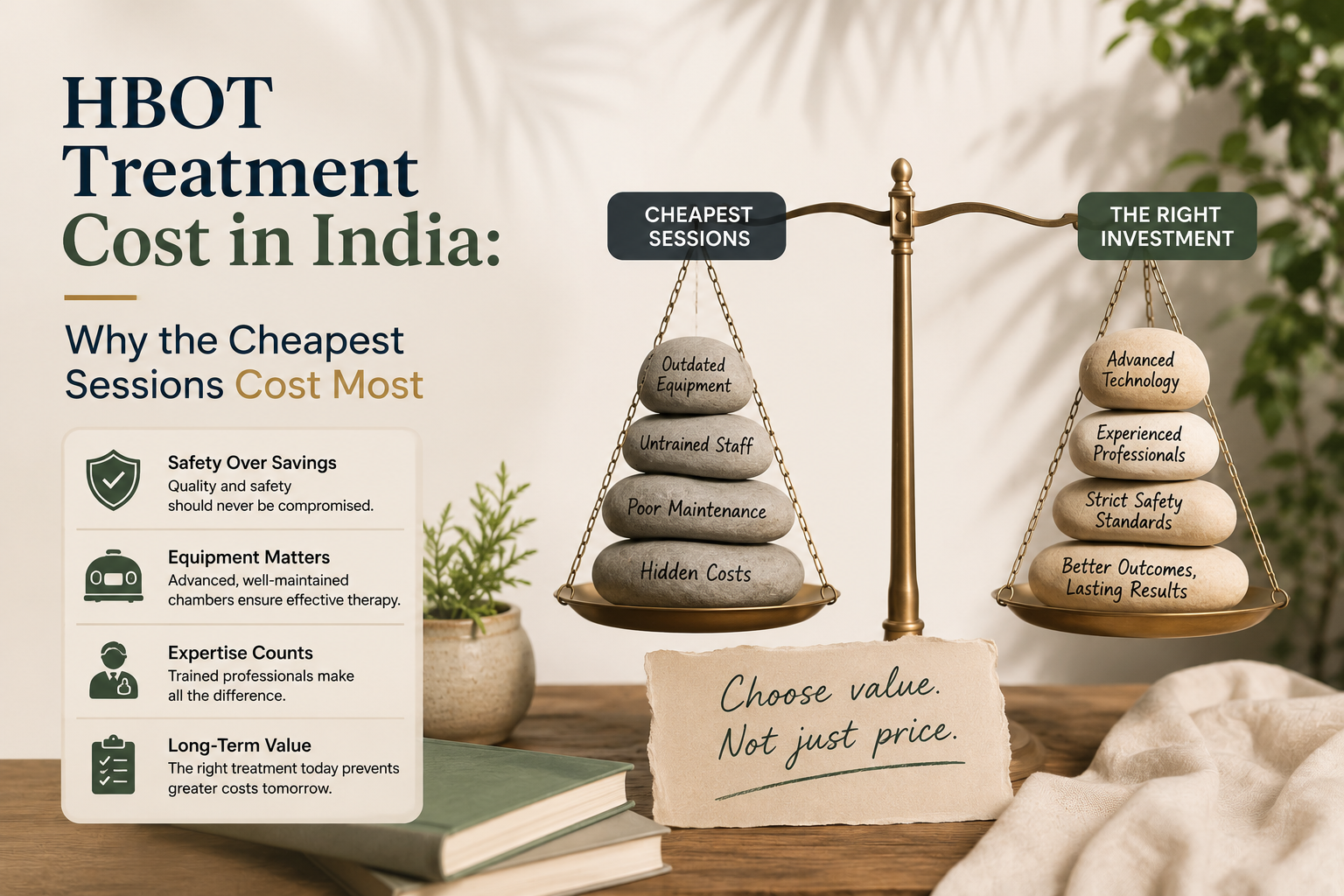
HBOT Treatment Cost in India: Why the Cheapest Sessions Cost Most
“Cheap HBOT is not a bargain. It is a different product with a similar name. Understanding the difference is the only way to make a rational buying decision.”
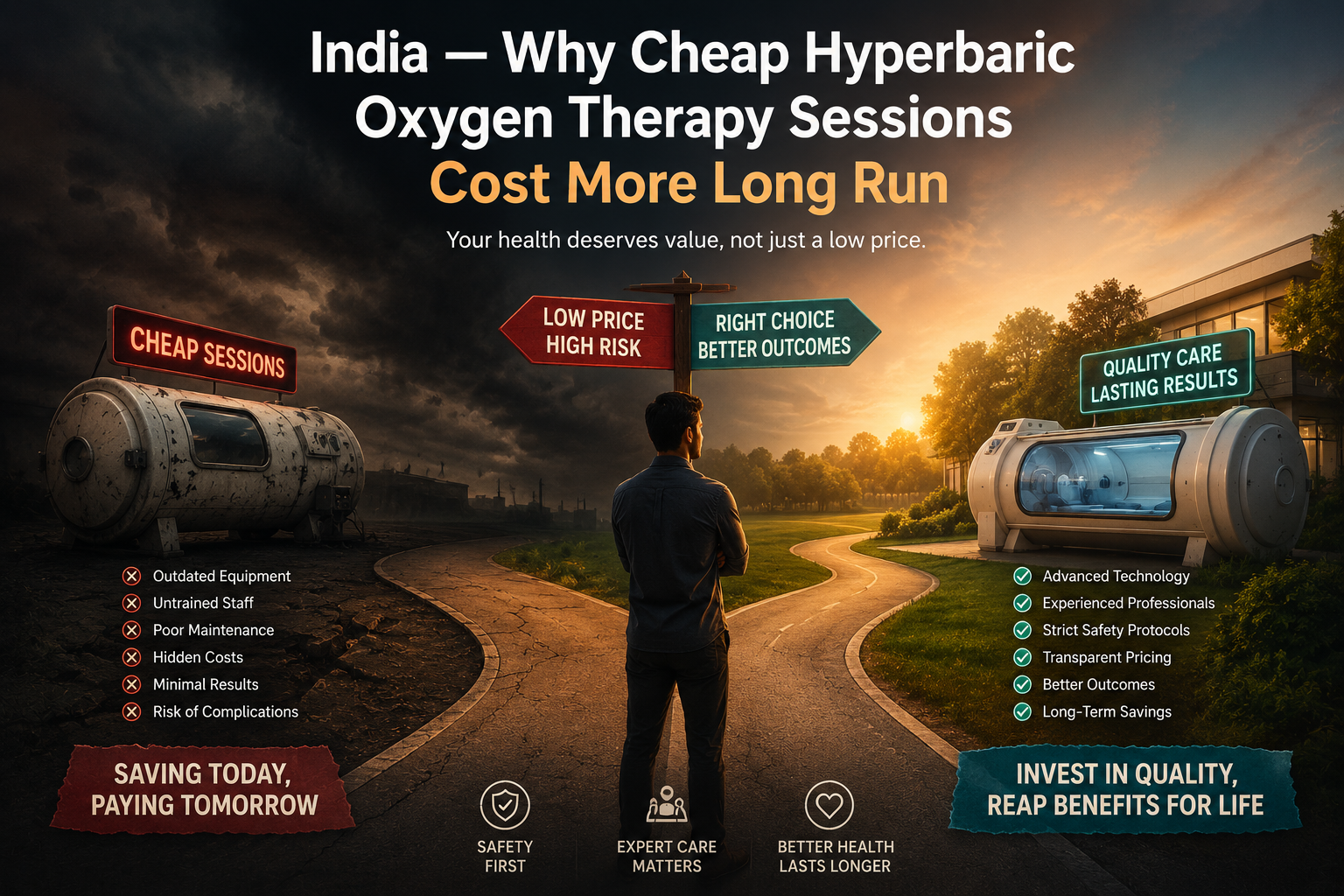 hbot treatment cost india — why cheap hyperbaric oxygen therapy sessions cost more long run
“HBOT treatment cost in India ranges from ₹900 to ₹5,000 per session. The range is not a pricing spread. It is a capability spread.”
The smart decision starts with understanding that you are not comparing the same product at two price points. You are comparing two different products — one of which may not be capable of delivering the biological outcomes you are paying for.
This is not a commercial argument in favour of premium pricing. It is a cost-of-delivery analysis. Every element that makes HBOT work at clinical levels has a real cost attached to it. When a session price is dramatically below that cost floor, something has been removed. This post tells you exactly what.
“The research that documented HBOT’s outcomes was conducted at specific pressures with specific equipment. If your session cannot replicate those conditions, the research does not apply to it — regardless of what the marketing says.”
The Five Cost Drivers Behind a Legitimate HBOT Session
A full-specification HBOT session at 2.0 ATA with pure oxygen delivery, trained staff, and certified equipment has five structural cost components. Removing or compromising any one of them reduces both the cost and the capability of the session.
| Cost Driver | What It Funds | What Happens Without It |
| High-specification compressor | Reaches 2.0 ATA and holds it without pressure loss for a full 90-minute session | Chamber peaks at rated pressure then bleeds down — effective pressure during session is lower than stated; buyer receives less therapeutic oxygen exposure than paid for |
| Certified pressure vessel shell | Structural integrity under sustained pressure; safety valve system; material specification for hyperbaric environments | Uncertified shells carry risk of seal degradation and structural stress over time; no independent verification that the chamber can sustain rated pressure safely |
| Medical-grade pure oxygen supply | 100% O₂ delivery via concentrator or cylinder supply rated for hyperbaric use, plus mask or hood delivery system | Ambient air pressurisation delivers 21% oxygen — not the plasma dissolution mechanism that clinical HBOT research describes; the core mechanism is absent |
| Trained operator and monitoring | Session oversight by trained staff; active pressure and O₂ monitoring; ability to respond to equipment anomaly or patient distress | Unmonitored sessions cannot respond to equipment failure or patient discomfort; no safety response capability during the session |
| Scheduled calibration and service | Regular pressure calibration, seal inspection, oxygen system servicing to maintain rated performance over time | Chamber drifts from rated specification without visible signs; buyer pays for 2.0 ATA sessions on equipment that may be delivering 1.6 ATA after six months of uncalibrated use |
These five elements are not luxury additions to a basic service. They are the components that make the basic service work. Fife CE et al. (Plastic and Reconstructive Surgery, 2016) established these parameters as prerequisites for outcomes-producing HBOT. A session missing any of them is a different service.
What HBOT Treatment Cost Is Actually Telling You in India
The Cost Floor for a 2.0 ATA Session in India
Building from the five cost drivers above, a genuine full-specification HBOT session in India has a real cost floor that most qualified operators estimate between ₹2,000 and ₹3,000 per session at current input costs — covering equipment amortisation, oxygen supply, operator time, facility overhead, and maintenance allocation.
Sessions priced at ₹900 or ₹1,200 cannot cover this cost structure. Something has been removed. The most common removals are the oxygen delivery system (ambient air instead of pure O₂), the pressure specification (operating at 1.3 ATA instead of 2.0 ATA), or active session monitoring. Each removal reduces cost — and removes a component that the clinical mechanism depends on.
The Oxygen Supply Cost Nobody Talks About
Medical-grade pure oxygen for HBOT is not free. A 90-minute session at 2.0 ATA breathing 100% oxygen requires a consistent oxygen supply — either from a medical-grade concentrator producing high-purity O₂ or from cylinder supply. Either system carries cost: equipment purchase or rental, maintenance, and per-session consumption.
Facilities using ambient air pressurisation eliminate this cost entirely. They also eliminate the primary mechanism of clinical HBOT — plasma oxygen dissolution at therapeutic partial pressures. As our guide to
why pressure determines HBOT outcomes why pressure determines HBOT outcomes explains, the therapeutic cascade requires 100% oxygen at 2.0 ATA. Ambient air at any pressure cannot replicate it.
The Calibration Cost That Compounds Over Time
Bhutani and Vishwanath (Indian Journal of Plastic Surgery, 2012) noted in their review of clinical HBOT in India that equipment maintenance and calibration are essential for consistent therapeutic outcomes. A chamber that is not regularly calibrated degrades in performance without any visible external sign.
A buyer who pays ₹3,000 per session at a well-maintained facility is consistently receiving 2.0 ATA. A buyer at an uncalibrated facility paying ₹2,500 may be receiving 1.7 ATA by their tenth session with no way of knowing. The price difference has inverted — the cheaper sessions are now less effective per rupee spent.
The True Cost Comparison: What You Actually Spend Per Outcome
Most buyers in India calculate HBOT cost as session price multiplied by session count. This is the wrong calculation. The right calculation is outcome achieved per rupee spent — which requires knowing whether the sessions were capable of producing the outcome in the first place.
| Scenario | Total Spend (20 sessions) | What the Buyer Actually Received |
| Low-pressure sessions at ₹900 each | ₹18,000 | 20 sessions at 1.3 ATA with ambient air. General wellness benefit. Outcome research for condition-specific HBOT protocols does not apply. Protocol incomplete. |
| Full-specification sessions at ₹3,500 each | ₹70,000 | 20 sessions at 2.0 ATA with pure oxygen, trained staff, certified chamber. Protocol matches peer-reviewed evidence. Cumulative biological cascade activated. |
| Mixed approach: 5 low-pressure then 15 full-spec | ₹56,000 (₹4,500 + ₹52,500) | 5 sessions that did not contribute to the protocol, followed by 15 sessions that did. Research protocols require consecutive sessions. Partial completion may reduce cumulative effect. |
Health Quality Ontario (2017) — a systematic review of HBOT for diabetic foot ulcers — found that HBOT cost-effectiveness depended entirely on sessions meeting clinical pressure and oxygen delivery specifications. Sessions that did not meet specification did not produce the cost-effective outcome, regardless of their individual session price. The cheapest sessions produced the worst cost-effectiveness ratio because they did not work.
This principle applies across every application of HBOT. Twenty sessions at 1.3 ATA with ambient air for a longevity protocol is not a budget version of the Efrati protocol. It is a different intervention that the research has not validated for that purpose.
Received a quote you want help evaluating? If you have been quoted a session price and want to understand what capability it is likely to reflect — tell us what you were quoted and what the facility told you about their equipment. We will give you a straight read.
What Fair Pricing Actually Looks Like in India’s Major Cities
Session pricing for full-specification HBOT in India’s major markets in 2026 reflects local cost structures — real estate, oxygen supply logistics, operator labour costs, and equipment amortisation all vary by city.
Delhi NCR
Full-specification hard chamber sessions in Delhi NCR typically range from ₹2,500 to ₹4,500 per session at qualified facilities. The higher end reflects central locations with premium facility costs. The lower end reflects operational efficiency without capability compromise. Sessions below ₹1,500 in the Delhi market warrant the eight-question checklist before booking.
Bangalore
Bangalore’s wellness market has seen significant HBOT growth. Full-specification sessions range from ₹2,200 to ₹4,000. The city has several qualified operators alongside a growing number of low-pressure wellness chamber deployments. The checklist applies here equally.
Mumbai
Mumbai’s higher real estate costs push session prices upward. Qualified hard chamber sessions in Mumbai typically range from ₹3,000 to ₹5,500. Sessions priced below ₹2,000 in central Mumbai locations warrant investigation of equipment specification.
Hyderabad and Chennai
Both markets have growing HBOT presence. Qualified sessions typically range from ₹2,000 to ₹3,500. Lower operational costs than Mumbai allow competitive pricing without capability compromise at qualified facilities.
| The Price Signal Principle | Price is not a guarantee of quality — an expensive session at an unqualified facility delivers no more than a cheap one. But a dramatically low price for HBOT in India’s current market almost always signals a capability compromise somewhere in the five cost drivers above. Use price as a first filter, then verify with the eight questions from Phase A. |
How to Use Price as an Evaluation Tool — Not a Decision Tool
Price tells you what capability is likely. It does not tell you what capability exists. Use it as a filter, not a conclusion.
- Sessions below ₹1,500 — apply the full eight-question checklist before booking. Assume ambient air or sub-1.5 ATA pressure until confirmed otherwise.
- Sessions at ₹1,500 to ₹2,500 — verify pressure, oxygen delivery, and certification. This range can contain both qualified operators with efficient cost structures and unqualified operators with full-specification marketing language.
- Sessions above ₹2,500 — a qualified starting assumption, but still verify. Premium pricing does not guarantee premium capability.
- Package deals at dramatically low per-session cost — calculate the implied session cost and evaluate against the cost floor. A 20-session package at ₹15,000 (₹750 per session) cannot cover the cost structure of a legitimate 2.0 ATA session.
For the complete verification framework — the eight questions that turn price signals into confirmed capability — see our HBOT chamber checklist for India buyers.
Frequently Asked Questions
1. Is it possible to get a good-value session at ₹2,000 or below in India?
2. Do hospital-based HBOT units deliver better outcomes than wellness centres?
3. Why is HBOT so much cheaper in India than in the UK or US?
4. How many sessions do I need for a longevity or wellness protocol?
5. Should I ask for a trial session before committing to a package?
The Bottom Line on HBOT Pricing in India
Every rupee you spend on HBOT is an investment in a biological process. That process either activates or it does not — depending entirely on whether the chamber you are sitting in can produce the conditions the research describes.
Cheap sessions that cannot activate the mechanism are not bargains. They are expensive — because they produce no therapeutic return on the investment.
Full-specification sessions that cost more per session but reliably activate the mechanism are economical — because every session contributes to the cumulative outcome you are working toward.
For the full picture of what makes a chamber capable of delivering that mechanism — the five criteria and why each one matters — read our guide to what a medical-grade HBOT chamber requires.
For context on how India’s market reached its current price spread, see our analysis of why India’s HBOT market has a pressure problem.
Comparing quotes right now? If you have received a session price or a package quote and want a second opinion on what it reflects — share what you were told with us. We will give you a clear read on whether the pricing is consistent with the capability being claimed.




One Comment
Comments are closed.


[…] our analysis of why HBOT chamber pricing in India varies so dramatically explains, price in this market is a capability signal before it is a value signal. Sessions […]