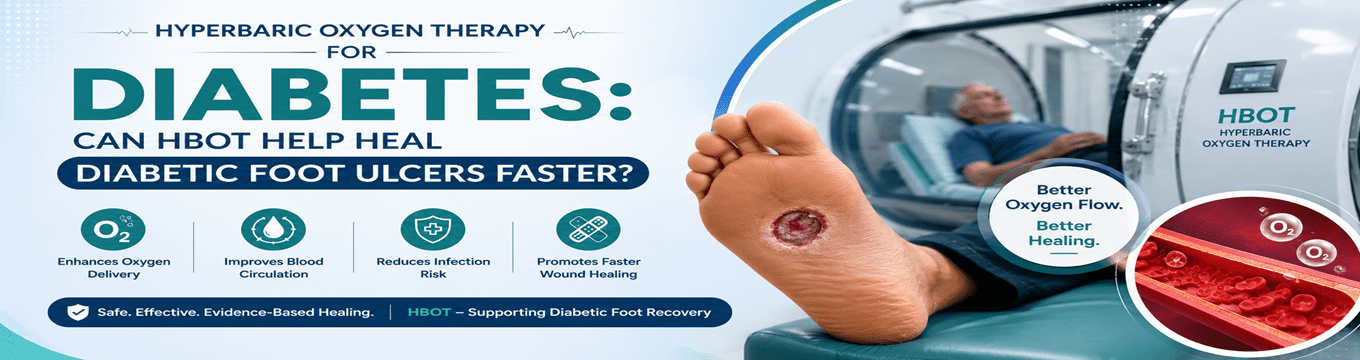
Hyperbaric Oxygen Therapy for Diabetes: Can HBOT Help Heal Diabetic Foot Ulcers Faster?
The wound has been there for months. And nothing is working.
You have changed the dressings. Taken the antibiotics. Visited the clinic more times than you can count. But that diabetic foot ulcer refuses to close. Every week it looks the same — or worse. The fear is always there, quietly growing: what if this ends in amputation? Hyperbaric Oxygen Therapy for Diabetes
You are not alone in that fear. Diabetic foot ulcers affect an estimated 15 to 25 percent of people with diabetes at some point in their lives. In India alone, the burden is staggering — the country has over 100 million people living with diabetes, and foot complications remain one of the leading causes of hospitalisation and lower-limb amputation.
Here is what most wound care protocols miss. The ulcer is not healing because the tissue underneath it is starving — starving for oxygen. Diabetes damages blood vessels and reduces circulation, especially in the extremities. Without adequate oxygen, your body simply cannot rebuild tissue, fight infection, or close the wound. Hyperbaric oxygen therapy for diabetic foot ulcers addresses this root cause directly — by flooding oxygen-deprived tissue with the one thing it needs most.
A diabetic foot ulcer is an open wound or sore that develops on the foot of a person with diabetes, most commonly on the bottom of the foot. It results from a combination of nerve damage (neuropathy), poor blood flow (peripheral vascular disease), and impaired immune function — all consequences of chronic hyperglycaemia.
What Makes Diabetic Foot Ulcers So Difficult to Heal?
To understand why HBOT matters, you first need to understand why diabetic wounds are different from ordinary wounds.
In a healthy body, a wound triggers an immediate cascade of repair: blood vessels dilate, white blood cells rush to the site, oxygen and nutrients pour in, and new tissue begins forming within days. Diabetes disrupts every step of this process.
Peripheral neuropathy means you may not even feel the wound forming. By the time you notice it, tissue damage can be significant. Poor circulation — a hallmark of diabetic vascular disease — means the wound bed receives far less blood flow than it needs. And a weakened immune response makes the ulcer vulnerable to infection, which further delays healing. To understand what happens during a structured course of treatment and when improvements typically begin, read our guide on the HBOT results timeline.
Standard wound care — debridement, offloading, dressings, antibiotics — addresses the surface. But when the underlying tissue is hypoxic (oxygen-starved), even the best wound care protocol reaches a ceiling. The wound stalls. Weeks become months. Months become years.
This is exactly where hyperbaric oxygen therapy enters the picture.
How Hyperbaric Oxygen Therapy for Diabetic Foot Ulcers Works
Hyperbaric oxygen therapy — HBOT — involves breathing 100 percent pure oxygen inside a pressurised chamber, typically at 2.0 to 2.4 atmospheres absolute (ATA). At this pressure, oxygen dissolves directly into blood plasma at concentrations far beyond what normal breathing can achieve.
Under normal atmospheric conditions, oxygen travels through the body almost exclusively via red blood cells. But red blood cells are large — they cannot reach tissue where blood vessels are damaged or absent. In a diabetic foot ulcer, this is precisely the problem. The wound bed has lost its blood supply.
At 2.0 ATA inside a certified hard-shell chamber, plasma oxygen concentration increases dramatically. This dissolved oxygen bypasses damaged blood vessels entirely, reaching hypoxic tissue directly. The result is a cascade of three critical healing mechanisms.
1. Angiogenesis — new blood vessel growth.
HBOT stimulates vascular endothelial growth factor (VEGF) production, which drives the formation of new capillaries into the wound bed. Over time, this permanently restores oxygen and nutrient delivery to the damaged area. Research by Thom SR, published in Plastic and Reconstructive Surgery (2011), established that HBOT activates these vascular repair pathways at a cellular level (Thom, Plast Reconstr Surg, 2011).
2. Collagen synthesis and tissue rebuilding.
Oxygen is a critical substrate for collagen production — the structural protein that forms the foundation of new tissue. Without sufficient oxygen, fibroblasts cannot produce collagen, and the wound cannot close. HBOT restores the oxygen supply that makes collagen synthesis possible (Bhutani & Vishwanath, Indian J Plast Surg, 2012).
3. Infection control.
HBOT enhances the ability of white blood cells to kill bacteria — a process called the oxidative burst, which is oxygen-dependent. It also potentiates the effectiveness of certain antibiotics. For diabetic foot ulcers complicated by infection, this dual action is clinically significant (Gill & Bell, QJM, 2004). For a detailed explanation of the science behind these mechanisms, read our guide on how hyperbaric oxygen therapy works.
When selecting a clinic for diabetic wound care, verify that the facility uses a PVHO-certified (pressure vessel for human occupancy) hard-shell chamber. PVHO certification ensures the chamber meets international safety standards for pressurised medical equipment — a non-negotiable requirement for clinical HBOT.
What Does the Research Say?
The evidence base for HBOT in diabetic foot ulcer management is among the strongest in hyperbaric medicine. Multiple clinical trials, systematic reviews, and health technology assessments have evaluated its role — consistently finding that HBOT, used as an adjunctive therapy alongside standard wound care, improves healing outcomes.
1. Health Quality Ontario (2017)
A comprehensive health technology assessment evaluated the evidence for HBOT in managing diabetic foot ulcers. The assessment reviewed multiple randomised controlled trials and concluded that HBOT, when added to standard wound care, increased the likelihood of complete wound healing and reduced the risk of major amputation (Health Quality Ontario, Ont Health Technol Assess Ser, 2017).
2. Perren et al. (2018)
A clinical trial published in the Open Cardiovascular Medicine Journal studied the effect of HBOT on ischaemic foot ulcers in patients with type 2 diabetes. The results demonstrated measurable improvements in wound healing parameters among patients who received adjunctive HBOT compared to those who received standard care alone (Perren et al., Open Cardiovasc Med J, 2018).
3. Bhutani & Vishwanath (2012)
Indian researchers published a detailed review on hyperbaric oxygen and wound healing in the Indian Journal of Plastic Surgery, outlining the physiological mechanisms — angiogenesis, fibroblast activation, and infection control — through which HBOT supports wound repair. This is particularly relevant for the Indian clinical context (Bhutani & Vishwanath, Indian J Plast Surg, 2012).
4. Eskes et al. (2011)
A systematic review in the World Journal of Surgery examined the evidence for HBOT in difficult-to-heal acute wounds. The review confirmed that HBOT showed benefit in cases where standard wound care had failed — precisely the clinical profile of most diabetic foot ulcer patients who are referred for hyperbaric therapy (Eskes et al., World J Surg, 2011).
The consistent finding across these studies is clear: HBOT is not a replacement for standard diabetic wound care. It is a powerful adjunctive therapy that addresses the oxygen deficit at the root of non-healing wounds — the problem that dressings, debridement, and antibiotics alone cannot solve. For a broader view of HBOT’s evidence base across conditions, explore our guide to HBOT benefits for athletes and recovery.
What to Expect During HBOT Sessions for Diabetic Wound Care
If your doctor recommends HBOT for your diabetic foot ulcer, here is what a typical treatment course looks like.
Each session lasts 60 to 90 minutes. You lie or sit comfortably inside a pressurized hard-shell chamber and breathe normally. The chamber pressurizes gradually — you may feel a mild sensation in your ears, similar to descending in an aero plane. This is temporary and easily managed.
A typical diabetic wound protocol involves 20 to 40 sessions, delivered five days a week for four to eight weeks. The number of sessions depends on wound severity, wound grade (Wagner classification), and your response to treatment. Your wound care team will monitor healing progress at regular intervals.
HBOT does not replace your existing wound care. It works alongside it. You will continue with dressings, offloading, infection management, and blood sugar control throughout the protocol. HBOT enhances the cellular environment — it gives your body the oxygen it needs to do what it is already trying to do.
Results are cumulative. Each session builds on the last — supporting ongoing angiogenesis, collagen production, and immune function. Most patients begin noticing visible changes in wound appearance after 10 to 15 sessions. For information on what HBOT sessions cost across India, read our complete HBOT cost guide.
Who Is a Good Candidate — and Who Should Be Cautious?
HBOT for diabetic foot ulcers is most commonly recommended when standard wound care has not achieved adequate healing progress — typically after 30 or more days of appropriate treatment.
The strongest candidates include patients with Wagner grade 3 or higher ulcers, ulcers with confirmed tissue hypoxia (measurable through transcutaneous oxygen monitoring), chronic non-healing wounds that have failed conventional debridement and offloading, and ulcers complicated by osteomyelitis or deep tissue infection.
HBOT is not suitable for everyone. Contraindications include untreated pneumothorax and certain pulmonary conditions. Patients with uncontrolled seizure disorders, certain ear or sinus conditions, or claustrophobia should be evaluated individually. A thorough medical assessment is essential before beginning any HBOT protocol.
The decision to add HBOT to your wound care plan should always be made in consultation with your treating physician — ideally a wound care specialist or a doctor experienced in hyperbaric medicine. HBOT is a clinical intervention, not a consumer product. The appropriate role of the therapy depends on your individual condition, wound characteristics, and overall health status (Fife et al., Plast Reconstr Surg, 2016). For those managing chronic conditions alongside diabetes, our guide on HBOT for chronic conditions like fibromyalgia explains how HBOT supports long-term recovery.
Choosing the Right HBOT Clinic for Diabetic Foot Care
Not every HBOT facility is equipped to handle diabetic wound care. Here is what to look for before booking.
Chamber type matters. Clinical HBOT for diabetic foot ulcers requires a certified hard-shell chamber operating at 2.0 ATA or above. Soft portable chambers at 1.3 ATA are not clinically equivalent and do not deliver the pressures or oxygen concentrations supported by the research cited above.
Verify PVHO or ASME certification for the chamber. Ask whether a trained hyperbaric technician is present during every session. Confirm that the facility has medical oversight — ideally a physician experienced in wound care or hyperbaric medicine.
Ask for a written protocol before committing to a package. The protocol should specify the number of sessions, frequency, and clinical goals — tailored to your wound, not a generic template. A diabetic wound protocol at a certified facility in India typically costs between ₹2,500 and ₹8,000 per session, with total treatment costs for a 30-to-40-session course ranging from ₹75,000 to over ₹3,00,000 depending on the city and facility. For a city-wise breakdown, see our HBOT cost in India guide.
Frequently Asked Questions
Q.1 Is hyperbaric oxygen therapy effective for diabetic foot ulcers?
Evidence from multiple clinical trials and health technology assessments supports HBOT as an effective adjunctive therapy for diabetic foot ulcers, particularly when standard wound care alone has not achieved healing. The Health Quality Ontario assessment (2017) concluded that HBOT, added to standard care, increased complete wound healing rates and reduced the risk of major amputation.
Q.2 How many HBOT sessions are needed for diabetic wound healing?
A typical protocol involves 20 to 40 sessions, delivered five days a week. The exact number depends on wound severity, wound grade, and individual response. Your wound care team will adjust the protocol based on healing progress.
Q.3 Is HBOT safe for diabetic patients?
HBOT is generally considered safe when administered in a certified facility under appropriate medical supervision. The most common side effects — mild ear pressure and temporary changes in vision — are reversible. Serious adverse effects are rare. A thorough medical assessment before starting the protocol is essential. For more detail, read our guide on HBOT safety and what to expect.
Q.4 Does HBOT replace standard diabetic wound care?
No. HBOT is an adjunctive therapy — it works alongside standard wound care, not instead of it. You should continue with debridement, offloading, dressings, infection management, and blood sugar control throughout your HBOT protocol. The therapy enhances healing by addressing the oxygen deficit that standard care cannot solve on its own.