
HBOT Cost Per Session: Is Hyperbaric Oxygen Therapy Worth the Money?
The HBOT cost per session in India ranges from ₹2,500 to ₹8,000. That is a wide range — and the question most people quietly ask before they book is whether it is actually worth it.
The honest answer is: it depends on what you are treating, how many sessions you need, and whether you are walking into a certified clinic or a wellness spa with a portable chamber. This guide gives you a clear framework to decide.
We will cover what drives the per-session price, which conditions have strong enough evidence to justify the cost, and what red flags to watch for when something looks too cheap.
What Does One HBOT Session Actually Include?
Before asking if the price is worth it, it helps to understand what you are actually paying for when you book a session at a certified clinic.
A single session includes:
- Pre-session safety screening — a brief check of your health status, medications, and any contraindications before you enter the chamber.
- 60 to 90 minutes in a pressurised chamber — breathing pure oxygen at 2.0 to 2.4 atmospheres absolute (ATA). This is the core therapeutic element.
- Trained technician supervision — a certified operator present for the entire session to monitor pressure, oxygen levels, and your wellbeing.
- Post-session observation — a brief check before you leave to confirm you are stable and comfortable.
This is not comparable to an oxygen facial at a spa. It is a clinical intervention that requires a pressure vessel rated for human occupancy, trained staff, and regulatory compliance. That is what the cost reflects.
For a full explanation of what HBOT does inside your body, read our guide on what HBOT actually does.
HBOT Cost Per Session in India — What the Range Looks Like
Here is the current per-session cost at certified medical-grade clinics across India:
| City | Cost Per Session | 20-Session Package | What Drives the Range |
| Chennai | ₹2,500–₹5,000 | ₹45,000–₹90,000 | Lowest real estate cost in group |
| Noida | ₹3,000–₹5,000 | ₹54,000–₹90,000 | Most affordable NCR option |
| Delhi / Gurugram | ₹3,000–₹6,000 | ₹54,000–₹1,10,000 | Established market, premium areas |
| Bangalore | ₹3,500–₹7,000 | ₹63,000–₹1,30,000 | Tech city premium, fast growth |
| Mumbai | ₹4,000–₹8,000 | ₹72,000–₹1,50,000 | Highest real estate and operational costs |
For city-specific deep dives, see our guides for HBOT in Delhi, HBOT in Mumbai, HBOT in Bangalore and HBOT in Chennai.
When Is HBOT Worth the Cost Per Session?
The value of HBOT is not the same for every condition. Here is an honest breakdown based on the available clinical evidence:
High evidence — cost is clearly justified
These are conditions where peer-reviewed research consistently supports HBOT outcomes:
- Diabetic foot wounds — A 2017 Health Technology Assessment (Health Quality Ontario) found strong evidence that HBOT reduces major amputation risk. For a patient facing amputation, the cost of 30 to 40 sessions is directly offset by avoided surgical costs and rehabilitation. Read more on HBOT for diabetic foot wounds.
- Radiation injury in cancer survivors — HBOT has substantial evidence for treating osteoradionecrosis, haemorrhagic cystitis, and soft tissue radionecrosis. These conditions are painful and difficult to treat otherwise — HBOT is one of the few effective options (Fife CE et al, Plast Reconstr Surg, 2016).
- Decompression sickness — The primary and most well-established indication. The cost-value calculation does not even apply here — it is an emergency.
- Chronic refractory osteomyelitis — HBOT used alongside antibiotics significantly improves outcomes in bone infections that do not respond to standard treatment.
Moderate evidence — cost is often justified
These conditions have promising research but less standardised protocols:
- Post-stroke neurological recovery — A randomised trial by Efrati et al (PLoS ONE, 2013) showed significant improvement in neurological function in chronic stroke patients. The evidence is growing but protocols are still being refined.
- Traumatic brain injury — Multiple studies show improvements in post-concussion symptoms, cognitive function, and nerve repair. Boussi-Gross et al (PLoS ONE, 2013) is one of the most cited.
- Fibromyalgia — A prospective clinical trial by Efrati et al (PLoS ONE, 2015) showed significant pain reduction. However patient response varies.
Emerging evidence — discuss with your doctor first
These areas have active research but protocols are not yet standardised:
- Sports recovery and performance — Athletes use HBOT for faster muscle recovery and reduced inflammation. Evidence is real but session counts are not protocol-driven.
- Longevity and anti-ageing — Telomere research and epigenetic studies show interesting early results, but this is an emerging field. Value depends heavily on your personal goals.
- Autism spectrum disorder — Parental reports are often positive. Clinical evidence is mixed. Discuss carefully with a specialist before committing to a protocol.
The Real Cost Comparison: Certified vs Cheap HBOT
This is the comparison that most people do not make — but should.
| Factor | Certified Hard Chamber | Cheap Soft Chamber | Why It Matters |
| Pressure | 2.0–2.4 ATA | 1.3 ATA | Only 2.0+ ATA has clinical evidence |
| Cost per session | ₹2,500–₹8,000 | ₹800–₹1,500 | Cheap = wrong pressure = no clinical outcome |
| Sessions to see results | 10–40 (evidence-based) | Often open-ended | You may never achieve the result at 1.3 ATA |
| Chamber certification | ASME / PVHO | None / unverified | Certified = safety, quality, accountability |
| Real total cost | Defined by protocol | Unknown — repeat spend | Certified is often cheaper over a full course |
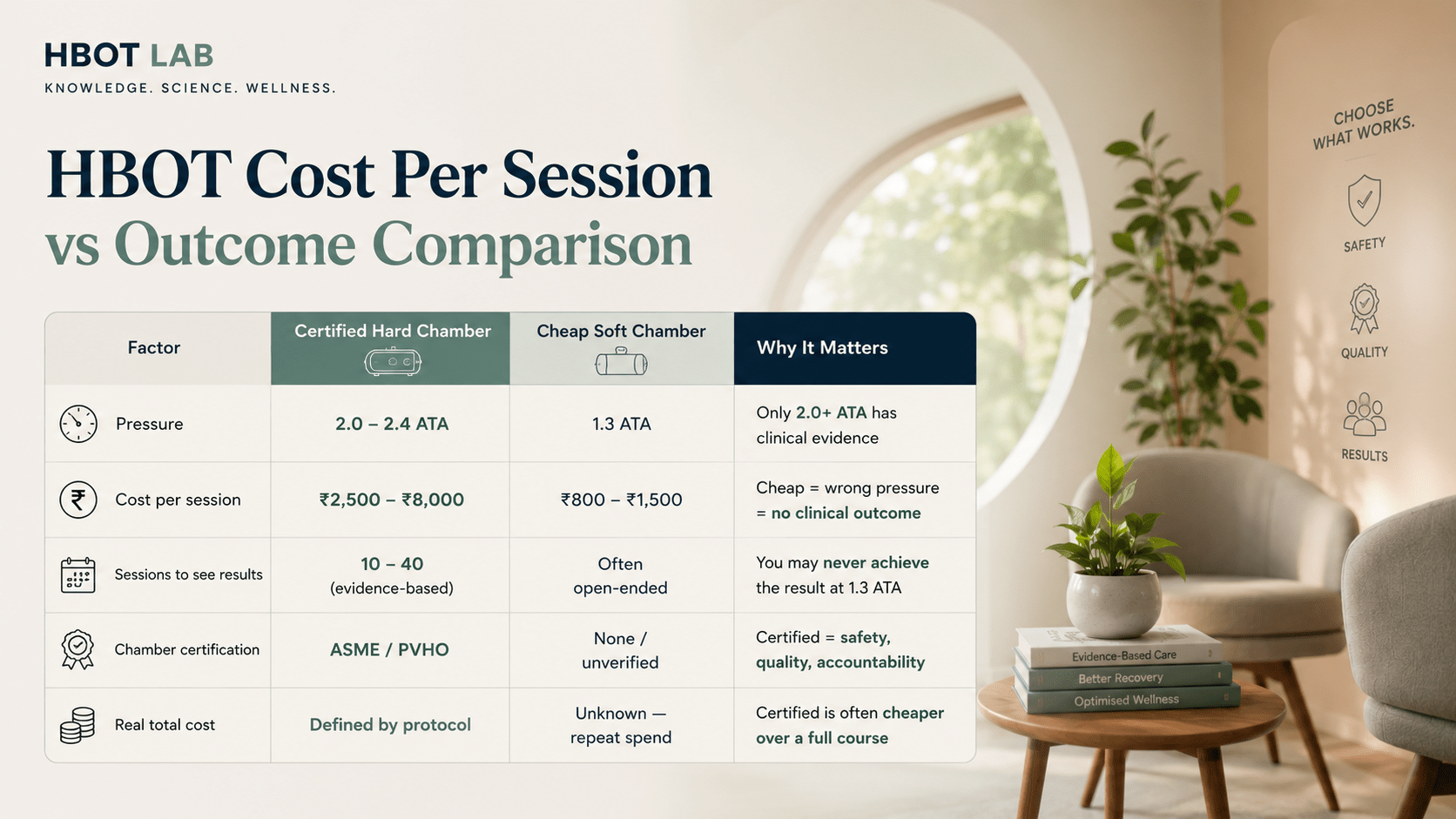
The trap with cheap HBOT is not just poor outcomes. It is that patients often spend months paying for sessions that cannot work at the pressure delivered — and then conclude that HBOT itself does not work. Read our article on why cheap HBOT chambers cost more for the full breakdown. And for what medical-grade actually means, see what makes a chamber medical-grade.
How to Calculate Whether HBOT Is Worth It for Your Condition
Here is a simple framework to work through before you book:
- Identify your condition and the evidence level — Is it in the high-evidence category above? If yes, the case for value is strong. If it is emerging evidence, be more cautious about protocol length.
- Get a written session count from a doctor — Do not let a clinic sell you a package without a protocol. A diabetic wound needs 30 to 40 sessions. A sports recovery course needs 10 to 20. Knowing this prevents open-ended spending.
- Calculate total cost at certified clinics in your city — Use the city guides for HBOT in Delhi, HBOT in Mumbai, HBOT in Bangalore, or HBOT in Chennai to benchmark correctly.
- Check insurance coverage — For high-evidence conditions, some Indian insurers and government schemes reimburse HBOT. This can significantly change the value calculation. See our guide on HBOT insurance coverage in India.
- Compare full-course cost against alternatives — For diabetic wounds, HBOT over 40 sessions at ₹4,000 per session totals ₹1,60,000. The avoided surgical cost of a below-knee amputation and subsequent care runs to many multiples of that figure.
When HBOT Is Probably Not Worth the Cost
Being honest about this is more useful than selling sessions.
- When no doctor has reviewed your case — If a clinic is willing to sell you a 40-session package without a medical consultation, that is a sign the sessions will not be protocol-driven. Walk away.
- When the chamber is not certified — A soft chamber at 1.3 ATA is not clinically equivalent to 2.0 ATA HBOT. Any money spent there is not real HBOT spend.
- When the condition has no current evidence base — General wellness, immune boosting, or vague energy improvement — without a doctor’s assessment, these are not strong justifications for a full course at any price.
- When you are buying it as prevention without any health context — Prevention protocols exist and some are well-designed, but they require a clinical baseline assessment to have any measurable value.
For more on safety and who should not do HBOT, read our guide on is HBOT safe.
Frequently Asked Questions
How much does one HBOT session cost in India?
A certified medical-grade HBOT session costs between ₹2,500 and ₹8,000 depending on the city. Chennai and Noida are most affordable. Mumbai is the most expensive. For a full city-wise breakdown, see our guide on HBOT cost in India.
Is HBOT worth the cost per session?
For conditions with strong clinical evidence — diabetic wounds, radiation injury, decompression sickness, and osteomyelitis — yes, the cost is clearly justified. For conditions with emerging evidence, the answer depends on your specific situation and doctor’s recommendation.
Why is HBOT so expensive per session?
The cost reflects three real inputs: a certified pressure chamber (₹40 lakh to ₹1.5 crore to install), trained medical staff, and clinical facility costs. A session that appears significantly cheaper is almost always delivering sub-clinical pressure.
Can I get HBOT cheaper somewhere in India?
Yes — Chennai and Noida offer certified HBOT from ₹2,500 per session. However, very cheap options (under ₹1,500) are almost always soft-chamber setups that do not deliver clinical-grade pressure. See our full HBOT treatment cost breakdown for a verified city comparison.
Does health insurance cover the HBOT cost per session in India?
Some insurers and government schemes (CGHS, ECHS) cover HBOT for specific clinical indications. Most wellness protocols are not covered. For a policy-level guide, read our article on HBOT insurance coverage in India.