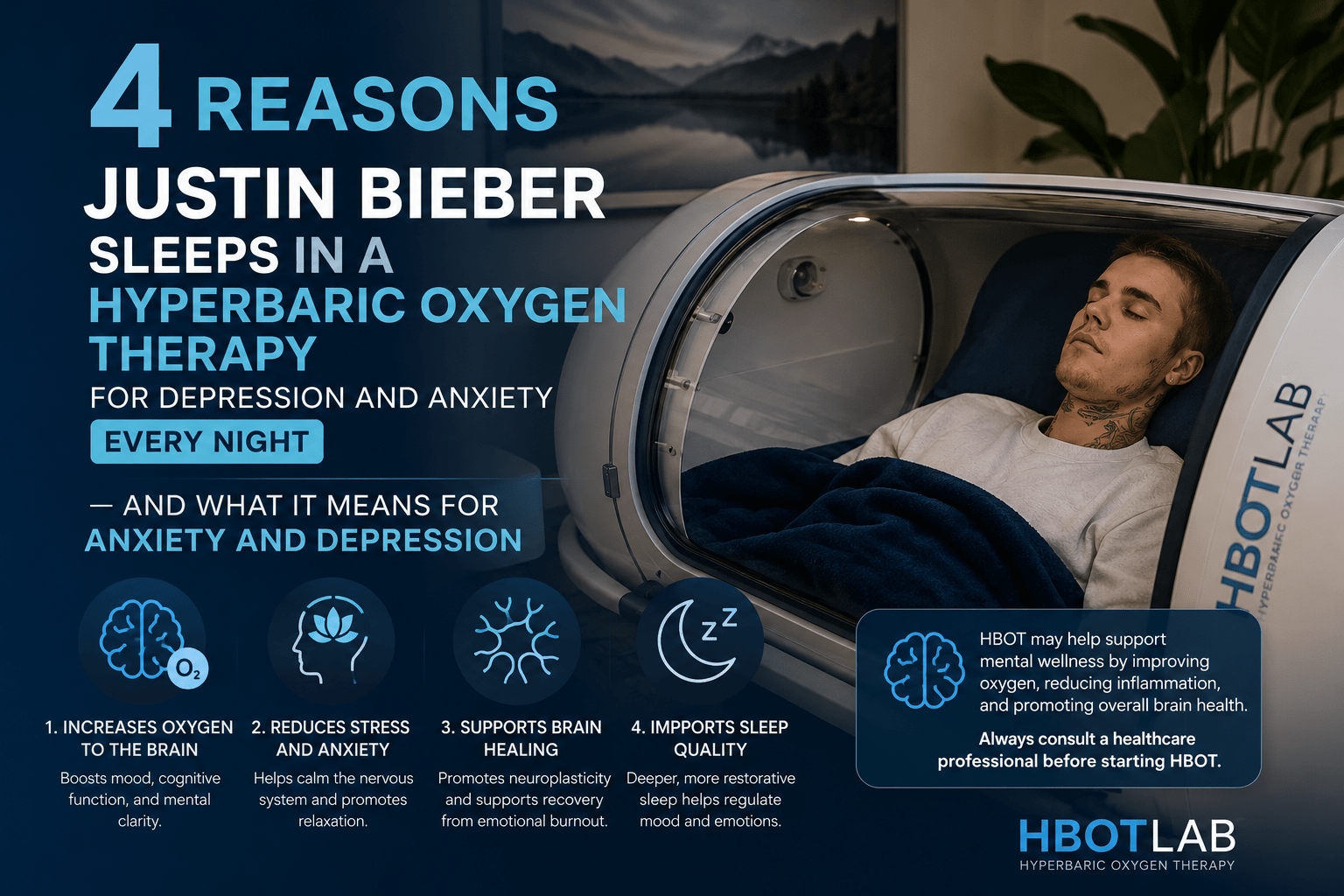
4 Reasons Justin Bieber Sleeps in a hyperbaric oxygen therapy for depression and anxiety Every Night — And What It Means for Anxiety and Depression
Anxiety does not announce itself politely. For Bieber, it arrived at the peak of fame. The tool he reached for was not a pill. It was a chamber.
You know the feeling. The kind of tired that sleep does not fix. The kind of worry that sits behind everything you do, making nothing feel quite right.
Anxiety and depression do not discriminate. They arrive in ordinary lives and extraordinary ones. Justin Bieber has sold over 150 million records. He has also spoken publicly and with rare honesty about the depression, anxiety, and physical illness that have shaped much of his adult life. In 2020, he disclosed a Lyme disease diagnosis. In 2022, he announced Ramsay Hunt syndrome — a viral condition that caused partial facial paralysis and forced him off the road. Throughout both, he has spoken about the mental health toll of chronic illness.
The tool he reaches for — alongside professional medical care — is hyperbaric oxygen therapy for depression and anxiety. In his 2020 YouTube docuseries Justin Bieber: Seasons, he revealed he owns two hyperbaric chambers — one at home, one at his studio — and uses them regularly to manage his anxiety and support his recovery. Here are the 4 biological reasons that makes sense.
Justin Bieber’s Health Battle — Context Before the Chamber
Bieber’s public health journey is relevant because it is unusually transparent. He has not just used HBOT quietly — he has explained why, in his own words, on camera.
In Seasons, his wife Hailey Bieber is filmed zipping him into the chamber. He describes it directly: “It fills up with oxygen… I really have been struggling with a lot of anxiety. You get more oxygen to your brain so it decreases your stress levels.” He has two chambers because the protocol requires consistency — and consistency requires access wherever he is working.
His conditions are medically significant. Lyme disease is a multisystem inflammatory illness that frequently produces neurological symptoms including brain fog, fatigue, mood disturbances, and anxiety. Ramsay Hunt syndrome is caused by varicella-zoster virus reactivation affecting the facial nerve — with neurological sequelae that include pain, weakness, and in some cases ongoing neurological stress. Both conditions create a substantial burden on the nervous system.
HBOT is not a replacement for the psychiatric and medical care Bieber receives. He is clear about that. It is one layer of a broader support system. For the foundational science behind how the therapy works at the cellular level, see our guide on how hyperbaric oxygen therapy works.
What Is Hyperbaric Oxygen Therapy for Depression and Anxiety — A Plain-Language Definition
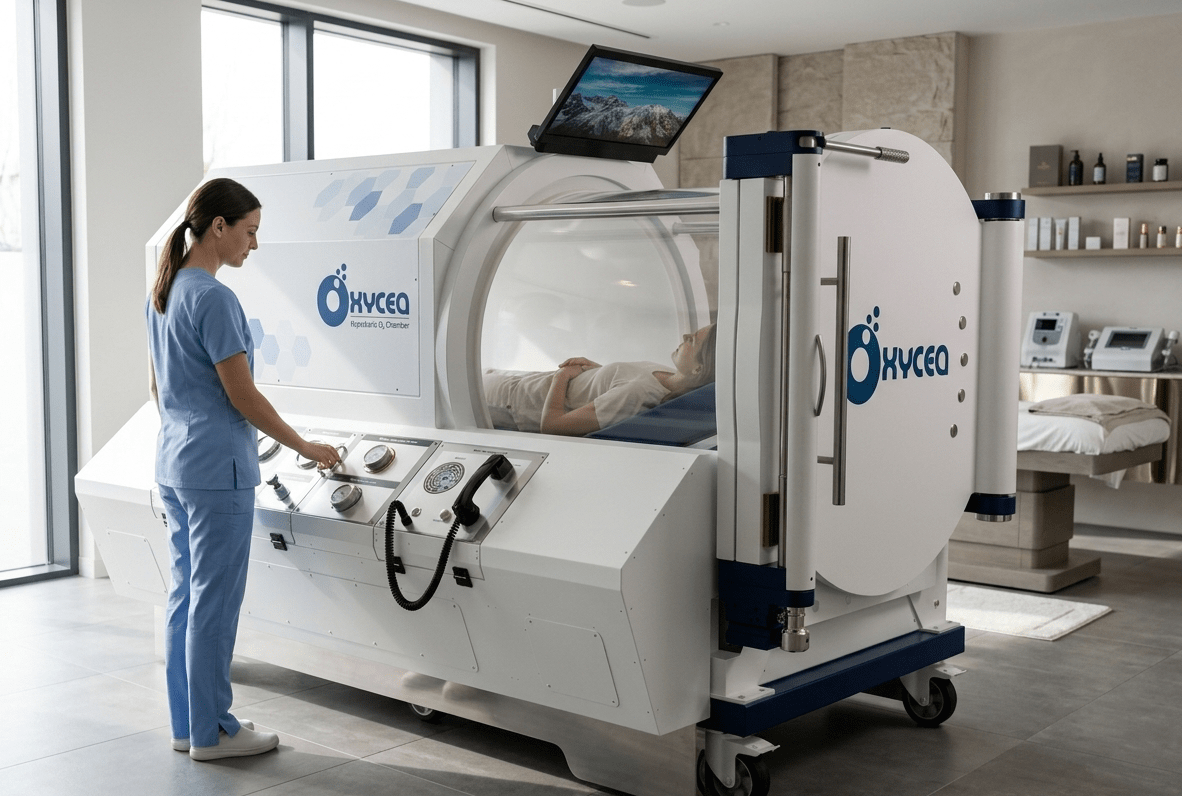
Hyperbaric oxygen therapy (HBOT) is a treatment in which a person breathes pure oxygen inside a pressurised chamber at 1.5 to 3.0 atmospheres absolute. Under this pressure, oxygen dissolves directly into blood plasma at concentrations far beyond what normal breathing achieves — including into cerebrospinal fluid, which bathes the brain and spinal cord.
For physical recovery applications — injury healing, surgical recovery, athletic performance — the mechanism is primarily about oxygenating damaged tissue. For mental health applications, the mechanism is different. It is about what happens when the brain itself receives a sustained increase in available oxygen: changes in cerebral blood flow, reductions in neuroinflammation, improvements in neurotransmitter metabolism, and support for neuroplasticity.
These are not the same mechanisms as physical tissue repair — which is why the mental health applications of HBOT are sometimes overlooked in mainstream coverage. For a breakdown of the full range of applications and how benefits build across sessions, read our guide on when HBOT benefits begin.
Reason 1 — HBOT Delivers More Oxygen to an Anxious Brain
Anxiety is not purely psychological. It has a neurobiological substrate. Chronic anxiety is associated with altered cerebral blood flow — reduced perfusion in certain brain regions including the prefrontal cortex, which regulates emotional responses and rational decision-making. When blood flow to these regions is compromised, the brain’s ability to modulate fear responses and anxiety is diminished.
HBOT directly addresses cerebral oxygenation. By increasing dissolved oxygen in plasma, it reaches brain tissue regardless of vascular restrictions that might limit red blood cell delivery. The effect is a global increase in available oxygen across brain tissue — including regions associated with emotional regulation and anxiety management.
Research by Vadas et al., published in Frontiers in Integrative Neuroscience in 2017, demonstrated that a hyperbaric oxygen environment measurably enhances brain activity and multitasking performance in healthy adults — confirming that HBOT’s cognitive effects are real and not limited to people with diagnosed neurological conditions. The mechanism is oxygen availability, not condition specificity.
Vadas D, Kalichman L, Hadanny A, et al. Hyperbaric oxygen environment can enhance brain activity and multitasking performance. Front Integr Neurosci. 2017;11:25. [View Study]
Bieber’s own description — “you get more oxygen to your brain so it decreases your stress levels” — is a lay-person’s accurate summary of this mechanism. More oxygen to the brain supports better neurological function. Better neurological function supports better anxiety regulation.
Reason 2 — HBOT Reduces the Neuroinflammation Behind Depression
One of the most significant developments in psychiatry over the last two decades is the recognition that depression is not purely a serotonin deficiency. It is, in many cases, an inflammatory condition. Chronic neuroinflammation — inflammation within the brain — disrupts neurotransmitter production, damages neural circuits, and drives the low mood, fatigue, and anhedonia that characterise depressive episodes.
For someone with Lyme disease — which is fundamentally an inflammatory condition with neurological involvement — the neuroinflammatory burden is particularly significant. The bacteria responsible for Lyme disease trigger systemic inflammatory responses that cross the blood-brain barrier and produce neuropsychiatric symptoms including depression and anxiety.
HBOT’s anti-inflammatory mechanism is well established. By modulating the NF-κB signalling pathway and reducing the production of pro-inflammatory cytokines including TNF-α and IL-6, it creates a measurable reduction in systemic and neurological inflammation. Research by Meng XE et al., published in Medical Science Monitor in 2016, confirmed that hyperbaric oxygen therapy inhibits the TLR4/NF-κB inflammatory cascade — the same pathway implicated in neuroinflammation-driven depression.
Meng XE, Zhang Y, Li N, et al. Hyperbaric oxygen alleviates secondary brain injury after trauma through inhibition of TLR4/NF-κB signaling pathway. Med Sci Monit. 2016;22:284–288. [View Study]
For Bieber, whose depression is likely compounded by the neuroinflammatory burden of Lyme disease, HBOT’s anti-inflammatory effect is not incidental — it is potentially one of the most directly relevant mechanisms available to him outside of pharmacological treatment.
Reason 3 — HBOT Supports Cognitive Recovery During Illness
Lyme disease and Ramsay Hunt syndrome both produce neurological sequelae. Lyme neuroborreliosis — neurological Lyme disease — can cause cognitive impairment, memory difficulties, processing speed reduction, and mood dysregulation that persist well beyond the acute infection phase. Ramsay Hunt syndrome can produce pain and neurological stress that compounds existing anxiety and depression.
HBOT has a documented evidence base for supporting neurocognitive recovery in patients with neurological challenges. Research by Hadanny et al., published in BMJ Open in 2018, reviewed the effect of HBOT on chronic neurocognitive deficits in patients with traumatic brain injury — and found significant improvements in cognitive function, including memory, attention, and information processing speed, following structured HBOT protocols.
Hadanny A, Abbott S, Suzin G, et al. Effect of hyperbaric oxygen therapy on chronic neurocognitive deficits of post-traumatic brain injury patients: retrospective analysis. BMJ Open. 2018;8(9):e023387. [View Study]
The cognitive burden of chronic illness — the brain fog, the difficulty concentrating, the emotional dysregulation — is one of the most debilitating aspects for people like Bieber. Not because the performance demands are too high. Because the gap between how your mind used to work and how it works now is deeply distressing.
HBOT may support the gradual restoration of cognitive function by improving cerebral oxygenation and reducing the neuroinflammatory environment that impairs it. For context on how these benefits accumulate across sessions, read our guide on the HBOT results timeline.
Reason 4 — HBOT Creates the Physiological Conditions for Better Sleep
Sleep and anxiety are locked in a bidirectional relationship. Poor sleep worsens anxiety. Anxiety worsens sleep. For people managing chronic illness, this cycle is often the hardest part — not the disease itself, but the cascading impact on sleep that erodes every other coping resource.
HBOT consistently produces sleep improvement as one of its earliest reported benefits. The mechanism is the therapy’s effect on the parasympathetic nervous system — the rest-and-digest branch of the autonomic nervous system that governs relaxation, digestion, and restorative sleep. By reducing systemic inflammation and increasing oxygen availability to brain tissue, HBOT creates the physiological conditions associated with parasympathetic dominance and deeper sleep cycles.
Thom SR’s foundational research on HBOT’s systemic mechanisms, published in Plastic and Reconstructive Surgery in 2011, identified the reduction of oxidative stress and inflammatory cytokines as core outputs of every HBOT session — both of which are directly associated with improved sleep architecture and reduced nocturnal arousal.
Thom SR. Hyperbaric oxygen: its mechanisms and efficacy. Plast Reconstr Surg. 2011;127 Suppl 1:131S–141S. [View Study]
The fact that Bieber sleeps in his chamber — not just sits in it during waking hours — suggests he is using it specifically for this sleep-support mechanism. The pressurised oxygen environment during sleep extends the duration of parasympathetic exposure, potentially amplifying the restorative effect.
Bryan Johnson’s 60-session longevity protocol, which we documented in detail in our article on the Bryan Johnson HBOT longevity protocol, also produced significant sleep quality improvements as a secondary outcome — confirming that the sleep benefit is real, measurable, and not exclusive to people with clinical sleep disorders.
What the Science Actually Says — Honest Expectations
This matters and it must be said clearly: the evidence base for HBOT in depression and anxiety is promising but not yet definitive. The peer-reviewed research cited in this article documents the biological mechanisms that make HBOT plausible as a supportive intervention for mental health. It does not establish HBOT as a proven treatment for depression or anxiety disorders.
What the evidence does support is this. HBOT reduces neuroinflammation. Neuroinflammation is a documented contributor to depression. HBOT improves cerebral oxygenation. Cerebral oxygenation supports better cognitive and emotional regulation. HBOT improves sleep quality. Sleep quality is one of the most important modifiable factors in anxiety management. Each of these mechanisms is individually documented. The direct clinical trial evidence specifically for depression and anxiety as primary outcomes remains limited.
Bieber uses HBOT alongside professional psychiatric care, not instead of it. That is the right framing. HBOT is a supportive tool — one layer of a broader system that includes therapy, medication where appropriate, lifestyle management, and professional oversight. Anyone considering HBOT for mental health support should do so with the same understanding.
For a broader view of how HBOT is used across different conditions and what realistic outcomes look like, read our article on the 6 athletes who use hyperbaric oxygen therapy — a context that shows how the same therapy supports very different biological needs.
What This Means for People in India Dealing With Anxiety or Depression
India carries one of the world’s largest mental health burdens. Anxiety disorders affect an estimated 45 million people in India. Depression affects tens of millions more. And the treatment gap — the proportion of people who need care but do not receive it — remains among the highest in the world.
HBOT is not a solution to this gap. It is not a replacement for the psychiatric care, therapy, and social support that people need and deserve. What it may offer — for those who have access to it and who are already receiving appropriate professional care — is an additional layer of physiological support. A tool that addresses the neurobiological substrate of anxiety and depression through oxygen, not pharmacology.
That is a meaningful option for some people. Not all. Not instead of other care. But alongside it — for people who want to explore every evidence-informed avenue available to them.
If you are considering HBOT as part of your wellness or mental health support, the most important first step is speaking with your doctor or mental health professional. The second step is finding a provider with genuine clinical infrastructure — not a soft-shell home chamber, but a properly equipped facility with trained supervision. Visit HBOTLAB — India’s first organised wellness HBOT franchise network — to learn more about what a structured protocol looks like.
Frequently Asked Questions
1. Does Justin Bieber really sleep in a hyperbaric oxygen chamber?
Yes. Bieber’s use of hyperbaric oxygen therapy is documented in his own words in his 2020 YouTube docuseries Justin Bieber: Seasons, in which he is filmed inside his chamber with Hailey Bieber. He has stated publicly that he owns two chambers — one at home and one at his studio — and uses them to manage anxiety and support recovery from Lyme disease and Ramsay Hunt syndrome. His description of the therapy’s effect on his stress levels is consistent with the documented neurological mechanisms of HBOT.
2. Can hyperbaric oxygen therapy help with depression and anxiety?
HBOT may support mental health through several documented biological mechanisms — reducing neuroinflammation, improving cerebral oxygenation, supporting cognitive function, and improving sleep quality. Each of these mechanisms has relevance to depression and anxiety. However, the direct clinical trial evidence for HBOT as a primary treatment for depression or anxiety disorders remains limited. HBOT is most appropriately used as a supportive adjunct to professional mental health care — not as a replacement for it. For the foundational science, read our guide on what is hyperbaric oxygen therapy.
3. Is HBOT safe for people with anxiety or mental health conditions?
For most people, HBOT is well tolerated and considered safe when administered under appropriate supervision at clinical pressures. The most commonly reported side effects are mild and temporary — ear pressure during pressurisation (similar to what you feel on an aeroplane), and occasionally mild fatigue after early sessions. People with certain conditions — including severe claustrophobia, certain pulmonary conditions, or specific medications — should consult their doctor before starting HBOT. For anyone considering HBOT for mental health support, professional medical guidance before beginning a protocol is essential. For a general overview of what to expect from a structured course, see our guide on the HBOT results timeline.


Subscribe
One Comment
Comments are closed.
[…] For the four biological reasons this mechanism is scientifically plausible, read our article on why Justin Bieber sleeps in a hyperbaric oxygen chamber. […]